




Media reforms from ground up
Scouting for compelling stories in Penang in 1976, I came across a disused mining pool in Teluk Bahang. My intuition told me the place had been excavated for sand used for construction. The pool had no protective fencing.
I contacted the developer that owned the site - which I said posed a drowning hazard to children - took a few photos, talked to nearby villagers. My story, framed to show the company’s disregard for safety laws, was not used because the developer was a major advertiser, and a ‘friend’ of one of the editors.
Scouting for compelling stories in Penang in 1976, I came across a disused mining pool in Teluk Bahang. My intuition told me the place had been excavated for sand used for construction. The pool had no protective fencing.
I contacted the developer that owned the site - which I said posed a drowning hazard to children - took a few photos, talked to nearby villagers. My story, framed to show the company’s disregard for safety laws, was not used because the developer was a major advertiser, and a ‘friend’ of one of the editors.
As a financial journalist two years later in Kuala Lumpur, I researched into the Merdeka University proposed in 1968 by the Chinese business sector, but which fell through. The Chinese papers had a good run of the story. I followed up on the Merdeka University’s implications for qualified students who were denied places in local universities because of the racial quota system. The story was not published because it might stoke racial tensions.
There were many stories that reporters of the day felt should be written but did not go beyond the editors’ desk.
Censorial state has not left us
The censorial state of reporting and dictates of editors in the late 70s has not left us. Reporters I meet at media training workshops tell similar anecdotes of frustration and disempowerment from working for autocratic editors who manage their staff on the premise that a journalist’s loyalty belongs to the editors, the owners and advertisers. Readers come a distant last.
Reporters who publicly question what they feel are unethical editorial practices run the risk of being sidestepped in the annual promotion review or marginalised in the newsroom. In some cases, reporters are summoned to show cause why they should not be dismissed for publicly criticising their employer.
 For instance
Utusan Malaysia
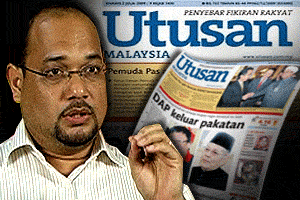
’s action against its senior journalist and NUJ president, Hata Wahari, shows how one’s news career is shaped by one’s assimilation to the bodek culture and sycophancy in the newsroom. Toe the editorial line, pander to the editors and consistently slant your stories towards the ruling parties, you might even be conferred a datukship.
For instance
Utusan Malaysia
’s action against its senior journalist and NUJ president, Hata Wahari, shows how one’s news career is shaped by one’s assimilation to the bodek culture and sycophancy in the newsroom. Toe the editorial line, pander to the editors and consistently slant your stories towards the ruling parties, you might even be conferred a datukship.
The quality of our media and political discourse will only get worse with the blogging community reacting to Utusan ’s stupid racial slanders with equally vitriolic anti-Malay rhetoric. Certainly, Utusan’s gutter sloganeering journalism serves to reinforce the bigotry of the looney right and deranged wingnuts, which then creates equally bigoted reactions from the other side.
And, this does no one any good. We must turn the media discourse towards a more proactive path. This is where media reform and civil society groups become significant rational agents of change.
It is easy to talk platitudes about how the mainstream media have betrayed its role as a watchdog of accountable governance, how it has shirked its moral obligations to its readers, how repressive media laws should be abolished to create an open media system, and so forth.
But it should not be lost on us that the majority of Malaysians may know little about or are not deeply interested in their constitutional rights to information and a free press, or how journalists’ personal values and beliefs can influence their stories, or how the online as well as mainstream media do manufacture the news.
No pressure to change
As is common in many developing countries, the general population is plausibly more concerned with building a career, accumulating wealth or just getting by raising a family than to engage in academic talk of media and political reforms. Until the majority cares enough to actively engage with media activism and civil society activities, our mainstream media is under no pressure to change its practice of lame and tame journalism.
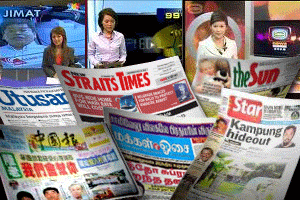 This despite a survey by Merdeka Centre last July that showed one in six Malaysian distrust the mainstream media. Audit Bureau of Circulations Malaysia figures likewise show that from 2006 to 2010 circulation of the Malay papers (
Utusan Malaysia, Berita Harian, Beritan Minggu, Mingguan Malaysia
) had consistently fallen by about 5 percent each year, and the English papers (
Star
and
NST
) by about 2 percent.
This despite a survey by Merdeka Centre last July that showed one in six Malaysian distrust the mainstream media. Audit Bureau of Circulations Malaysia figures likewise show that from 2006 to 2010 circulation of the Malay papers (
Utusan Malaysia, Berita Harian, Beritan Minggu, Mingguan Malaysia
) had consistently fallen by about 5 percent each year, and the English papers (
Star
and
NST
) by about 2 percent.
Only The Sun (14.5%) and Chinese papers (2%) enjoyed higher circulation with each passing year.
Media reform groups can certainly stir the waters of discontent. But it’s the mass consumers who can affect the mainstream media’s revenue. Radical reforms, as the history of ‘people power’ shows, can only happen from the ground up, when diverse groups come together to work for a common goal.
Surely, the grassroots need a compelling reason to get involved in shaping the future of their sources of news? Remember 1998. The people believed they had the capacity to influence the national political discourse, that they had a right to demand better quality reporting from the mainstream media.
Reformists should reclaim that moment and start to work on a long-term media literacy campaign tailored for the grassroots, especially the younger generation. Civil society groups are clever enough to figure out how to translate the online discontent with the mainstream media into a workable activist agenda that can move the grassroots and the younger generation.
Currently, the call for media reforms is limited to a minority of like-mindeds agreeing with each other. Media reform campaigns can be less elitist, less academic. Take the message to the streets, the kopi-tiams, mamak stalls, shopping malls, schools, the colleges and universities - particularly in journalism schools.
[For useful tips on ‘how to demonstrate creatively’ through ‘innovative civil disobedience’ see the essay by Wong Chin Huat in ‘ New Malaysian Essays ’ - Yin Shao Loong, 2010]
Pooling their resources
But we need money to sustain long-term programmes to educate and change attitudes. Media activists and civil society groups should thus look at collaborating and pool their resources to achieve the overarching goal of forcing the mainstream media to better serve the interests of the people rather than the state.
It’s a no brainer that a coalition of reformist groups, working with the NUJ and, ironically, mainstream journalists discontented with mainstream editorial practices, will present a stronger voice than one that’s dissipated with each group working in isolation with what seems to be a similar mission.
I am convinced that when the general population - and mainstream journalists - realise what media reforms mean to them, when they start talking about the importance of a free and credible media to a functioning democracy, and understand how this can be achieved, we will see how public pressure, if strategically mobilised, can become a powerful commercial argument for the media institutions to improve its act.
In the long run when such a public ethic exerts its influence, adherence to ethical standards can become a strong selling point for our mainstream papers, which have for too long taken the people for granted.
DR ERIC LOO left Malaysia for Australia in 1986 to work with the print media. He currently lectures at University of Wollongong, Australia, and also mentors international journalism students via UPIU , run by United Press International. He is founding editor of Asia Pacific Media Educator. His recent books are ' Best Practices of Journalism in Asia ' (2009); and 'J ournalism in Good Faith: Issues and Practices in Religion Reporting ' (co-authored with Mustafa K Anuar, 2009). Email: eloo@uow.edu.au


Report this comment
Are you sure you want to delete this comment?
This action cannot be undone.