




Ball in politicians' court
Money defines elections in Malaysia as in most democracies.
As state elections in Sarawak and the general election are looming, political parties and potential candidates need money to finance their campaigns. Their ability to raise money to fund their campaign apparatus is tested in a competitive democracy.
Money defines elections in Malaysia as in most democracies.
As state elections in Sarawak and the general election are looming, political parties and potential candidates need money to finance their campaigns. Their ability to raise money to fund their campaign apparatus is tested in a competitive democracy.
At the core of the electoral system is campaign financing which has been tainted by corruption. The ability to raise money to achieve political aims is increasingly being seen as a criterion for determining candidates. For some parties and candidates in Sarawak or for that matter Malaysia, money will pour in, thanks to businesses.
The funds raised are used for a range of activities like door-to-door visits, speeches ( ceramah ), dinners, entertainment, media advertising, project announcements and unfortunately vote buying.
The more the candidates spend , the more voters they believe they will reach. These are time-tested activities during elections in Malaysia.
To win, parties and candidates need money. This means that many capable candidates with important messages which are timely and relevant get left in the dust of the money wars.
Public financing of federal polls
A hundred years ago, a US president was concerned with the growing influence of money in elections. In 1907 Teddy Roosevelt recommended public financing of federal elections and a ban on private contributions. This still remains a great idea. It would really help elect the most qualified person and not the person who is best at “MoneyBall”.
How politics is financed is a growing global concern particularly the role of business in political financing.
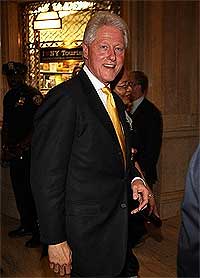 Take the case of former US president Bill Clinton (
left
) and the Lippo Group in Indonesia. Mochtar Riady’s relationship with Clinton stems from the early 1980s, when the patriarch of Lippo Group bought a minority interest in the Arkansas-based Worthen Bank. Riady sent his son James to learn the banking business in Little Rock. Soon after arriving, young Riady was introduced to the then-Governor Clinton at a Worthen luncheon.
Take the case of former US president Bill Clinton (
left
) and the Lippo Group in Indonesia. Mochtar Riady’s relationship with Clinton stems from the early 1980s, when the patriarch of Lippo Group bought a minority interest in the Arkansas-based Worthen Bank. Riady sent his son James to learn the banking business in Little Rock. Soon after arriving, young Riady was introduced to the then-Governor Clinton at a Worthen luncheon.
In a 1984 interview with an Arkansas magazine, Mochtar Riady outlined his business philosophy: “Every network has to have its foundation laid on special, personal, human connections. What I am looking at is what my partners can offer in personal contacts and business connections.”
That sums up why businesses continue to flood the river of money that flows into political parties. That river meanders so much that tracing who is filling it up is always a challenge for investigators of political financing. It is this flow of money that can foster corruption.
The connection formed with Clinton continued after he began his run for the US presidency in 1991 and was visible during the 1996 campaign. Since 1991, the Riadys and others connected to Lippo have contributed hundreds of thousands of dollars to the Democratic National Committee. The party has returned nearly half a million dollars contributed by an Indonesian couple with ties to Lippo. (Source: Bob Woodward, Washington Post , February 1995.)
President Nicolas Sarkozy of France allegedly received and accepted €150,000 (US$188,000) from L’Oreal heir Liliane Bettencourt, through Labour Minister Eric Woerth, during his 2007 presidential campaign.
A challenge for investigators
I am able to cite these two examples as the sources of political financing in the US and France are investigated and actions have been taken. In Malaysia, it is a challenge for investigators working on the issue of political financing to have access to information on the source of funds for campaign financing.
Said former Malaysian premier Dr Mahathir Mohamad in an interview in 2010: “There can be no escaping from the fact that politics is money. Without money, you just cannot move. So we have to raise funds.” But Tun, shouldn’t political parties and candidates disclose the sources of the funds?
There is an urgent and critical need for a transparent and accountable mechanism to track the money that flows in and out of the political funds of parties. In Malaysia, as the academic Terrence Gomez has said, “Money politics has a deeply rooted relationship with political patronage and abuse of power involving favouritism, nepotism and conflict of interest in the award of government concessions.”
In Sabah and Sarawak, talk of the influence of money politics to garner votes has been aired ever since elections were introduced in these states.
On 26 Feb, 1994, New Straits Times editor Ahmad A Talib wrote in his column, “Political parties too must show more finesse and sophistication in seeking support. Otherwise, Sabah politics will forever be under the dubious distinction of being run by money-seeking and money-giving politicians, their ministers included.”
Has anything changed? If anything the amounts have increased and politicians have become wealthier. No mainstream editor will write a column like Ahmad Talib did many years ago as the MSM are owned by political parties.
Political parties own the media
Malaysia is one of the few countries where political parties own the media. With the Barisan National parties controlling the MSM, any meaningful reforms to campaign financing will continue to remain a challenge.
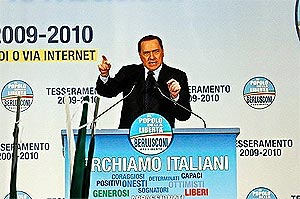 Beleaguered Italian Prime Minister Silvio Berlusconi (
right
) has a monopoly of national commercial TV. This has been a factor is his successful re-elections as political advertising influences voters. In the US, presidential candidates spend millions on TV advertising. In Malaysia, only the BN candidates have access to TV advertising.
Beleaguered Italian Prime Minister Silvio Berlusconi (
right
) has a monopoly of national commercial TV. This has been a factor is his successful re-elections as political advertising influences voters. In the US, presidential candidates spend millions on TV advertising. In Malaysia, only the BN candidates have access to TV advertising.
We need to turn to individual politicians to advocate for reforms in campaign financing such as mechanisms including regulatory reforms for greater disclosure and accountability in campaign financing.
Political financing investigation is still in its infancy in Malaysia. Civil society organisations are now advocating for reforms in political financing and proposing remedies. However, to strengthen their advocacy a strong people based coalition must be built nationally. Insights and facts on political financing in Malaysia must reach the wider society to convince them that money politics is a pervasive phenomenon in the country.
Scholars, journalists and politicians themselves must be involved in the investigation of political financing as well as the reforms to how elections are funded.
South Korea is a good example of the crucial role citizens played in reforms in political financing. In 2003, several leaders of political parties were imprisoned for illegal political financing. This led to reforms in campaign financing including the birth of pro-reform liberal Uri Party.
Are there politicians who will disclose their campaign finances in the elections in Sarawak and general election later? Will they stand up and be counted for reforms in political financing?
JOSIE M FERNANDEZ is currently an Asian Public Intellectual Fellow, director of Philanthropy Asia, consultant and researcher. Working on sustainability, consumer protection, philanthropy and anti-corruption actions are some of her current passions besides writing. She is also the editor of ‘Reforming Political Financing in Malaysia’, published by Transparency International, Malaysia.


