




Lip service to the environment
World Environment Day falls on June 5 each year. Are Malaysians truly committed to the environment or are we too dependent on the tourist dollar, bio-fuel technology and multinational investment to bother?
As individuals, are we prepared to sacrifice personal conveniences for the sake of the environment? Is our government willing to protect the environment in the face of development and progress? Are corporate bodies prepared to reduce waste and save the environment?
World Environment Day falls on June 5 each year. Are Malaysians truly committed to the environment or are we too dependent on the tourist dollar, bio-fuel technology and multinational investment to bother?
As individuals, are we prepared to sacrifice personal conveniences for the sake of the environment? Is our government willing to protect the environment in the face of development and progress? Are corporate bodies prepared to reduce waste and save the environment?
The Pakatan Rakyat state governments have shown that they are prepared to take the threat to the environment seriously.
It is their involvement with Malaysian youth, who nowadays are very concerned about environmental issues compared with previous generations, which brought about the ‘no plastic bag’ campaign.
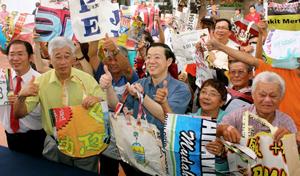 In July 2009, Penang became the first state to launch the ‘No Plastic Bag Day’ in shopping outlets to reduce our usage and dependence on these bags.
Soon after, hypermarkets and supermarkets in Selangor and other parts of the Klang Valley restricted the use of plastic bags on Saturdays.
Elizabeth Wong, the Bukit Lanjan state executive councillor, is known for her environmental work in Malaysia.
“Waste is an environmental threat. It’s a massive environmental issue. When plastic bags break down, they break down to dangerous particles,” she has said, adding that plastic bottles and styrofoam also contribute to waste.
Not everyone is happy. Selangor’s ‘No Plastic Bag Day’ policy on Saturdays, has angered the business community, while some consumers say they are inconvenienced and others say plastic bags have little impact on the environment.
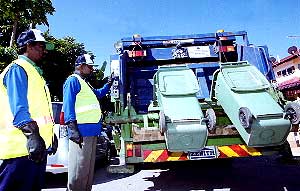 There are many ways in the home that we can alter our habits and ultimately help the environment.
How many of us separate waste into paper, plastics, cardboard, glass and so on? How many of us compost our kitchen waste?
How many have well-ventilated homes which allow the free circulation of air to cool the house? Nowadays, we resort to the overuse of air-conditioners, which is not good for the environment.
The traditional kampong house is a good example of how man can live at one with his environment - the double roof system, the slats, shutters and use of natural wood. And yet many Malaysians seem to have forgotten that our parents and grandparents lived quite happily without artificial cooling aids.
Portcullis House, in London has ventilation chimneys which cool the building - using the principles of the kampong house.
The food we eat can also affect the environment. Some of us quite happily pay for air-flown vegetables or meat from far-flung places.
L
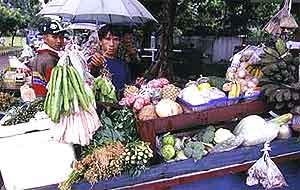 ocally produced food is just as good and nutritious, besides being cheaper. What’s wrong with eating seasonal food?
Some of us like to boast that “we eat strawberries from England, asparagus from Spain, or potatoes from America”. Why contribute to the air-miles of the food we eat? Even food that we buy and consume has its carbon footprint.
Point of no return
The liberal issuing of logging licences by governments cannot be helping the environment. Nor is the growth of one crop, like the oil palm, in Malaysia. The lack of bio-diversity cannot be good and there is the risk of a mass blight by a plant virus or insect pest.
Land that could have been used for food production is turned into land for production of feedstock for bio-fuel. Perhaps that is why we have to depend on imports for some of our food that could have been grown locally.
How about urb
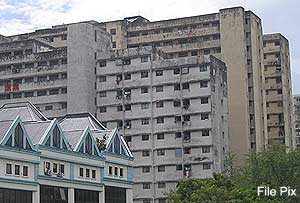 an living? We build concrete structures, pave our gardens and forget about the water run-off in a tropical climate, and are puzzled when we have flash floods.
When we concentrate on urban areas, we forget about our country cousins. They migrate to the cities and the lack of housing means we build rabbit hutches for them as dwellings or build heavily on the hillsides; we don’t have to wait long to see the disastrous impact.
While we have a proliferation of cities, we ignore the necessity of a good public transport system. We have to depend on cars to get us to work or school and all this adds to carbon emission and air-borne pollutants.
Tourists love our idyllic beaches and unspoilt islands, but for how long will these environments last before we destroy them with over-development? Where does the sewage from all multi-storey hotels go, if not to the beach? But is the sewage outlet suitably long enough and far away from the beach?
The explosion of sites and the uncontrolled numbers of visitors have all contributed to a decline in our coral reefs, so we now impose restrictions on the numbers of visitors to our islands, as has happened in Pulau Redang. Why wait till the point of no return?
What greed will do
Our mountains too are affected. Mount Kinabalu has stood tall and proud for millions of years but there is talk of development to encourage more visitors by making it ‘easier’ for climbers to reach the summit. Apart from the loss of the personal challenge, has the government considered the cost to the environment?
Hill stations have been practically destroyed by over-development. The local climate has been affected, air-borne pollutants and indiscriminate littering have reduced the value of what was once a popular attraction.
Do we learn our lessons?
No. Already there has been talk of building a cable car to Maxwell Hill (Bukit Larut) for thousands to trample on a very sensitive eco-system. No one has been shown the Environmental Impact Assessment of the development. Soon all the flora and fauna which Isabella Bird, the British explorer described over 100 years ago, will disappear.
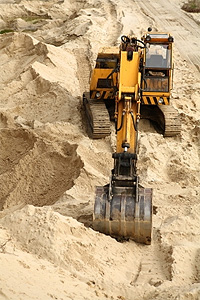 Our greed will destroy our environment. Sand is sold or smuggled to Singapore, at our expense. It is not just a matter of Singapore increasing its land mass. It is our environment that is being destroyed.
Mangrove swamps, wetlands and similar areas have been earmarked for development. Mega- dams have been built in our jungles. Limestone hills have been blasted for the cement trade and for construction.
The latest scare is the Lynas Corporation rare earth project in Gebeng, Kuantan, with the threat of radioactive waste destroying not just our children’s future, but also our livelihood and our environment.
After the meltdown at the reactor in Fukushima, Japan, governments around the world were quick to review their nuclear programmes. Germany has said it will decommission all 27 of its nuclear power stations by 2022.
Our government seems to do the opposite and is steaming ahead with an ambitious nuclear programme.
So are we really concerned about our environment or am I being overly pessimistic? Caring for the environment is a collective responsibility.
MARIAM MOKHTAR is a non-conformist traditionalist from Perak, a bucket chemist and an armchair eco-warrior. In ‘real-speak’, this translates into that she comes from Ipoh, values change but respects culture, is a petroleum chemist and also an environmental pollution-control scientist.


Are you sure you want to delete this comment?
This action cannot be undone.