




Southern Thailand - long wait for reconciliation
Su-So is a quiet and remote village in Saba Yoi district, southern Thailand. About 70 percent of the villagers are Muslims.
 Up to April 28, few outside Thailand had heard of the village in Songkhla Province. But all that changed when 19 youths were killed at dawn when they allegedly attempted to storm a police sub-station about 26km away.
They were aged between 18 and 26 years, and made up the local football team. Just three days before, it had won third place in the district football league.
The same day, 108 people were killed in the Muslim-majority southern provinces of Pattani, Narathiwat and Yala.
According to the Thai authorities, all were involved in militant activities, a claim that is resisted by the families of those involved.
About 250 people have been killed this year in southern Thailand, where several groups have led a long-running but fairly muted separatist movement.
However, the April incident - one of the most violent in recent history - has turned attention to the restive southern provinces.
Su-So is a quiet and remote village in Saba Yoi district, southern Thailand. About 70 percent of the villagers are Muslims.
 Up to April 28, few outside Thailand had heard of the village in Songkhla Province. But all that changed when 19 youths were killed at dawn when they allegedly attempted to storm a police sub-station about 26km away.
They were aged between 18 and 26 years, and made up the local football team. Just three days before, it had won third place in the district football league.
The same day, 108 people were killed in the Muslim-majority southern provinces of Pattani, Narathiwat and Yala.
According to the Thai authorities, all were involved in militant activities, a claim that is resisted by the families of those involved.
About 250 people have been killed this year in southern Thailand, where several groups have led a long-running but fairly muted separatist movement.
However, the April incident - one of the most violent in recent history - has turned attention to the restive southern provinces.
The Thai Senate foreign affairs committee, chaired by Kraisak Choonhavan, recently invited two Malaysian journalists and two politicians to visit the region. Kraisak is known to be critical of the Thai government's handling of the situation.
Meeting with community
It was a blistering hot afternoon when we arrived in Su-So for a meeting with the villagers. Most of them stood and sat around the place looking baffled, waiting for the proceedings to begin.
According to a district official, most of the villagers are uneducated or have received very little education. Most cross the boundary to earn a living in Malaysia's northern states, especially Kelantan.
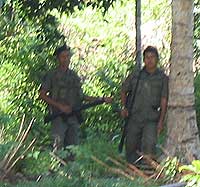 The village is surrounded with coconut, langsat and tropical fruits trees. A mosque was under construction. Beyond the orchards but within sight were a few heavily-armed troops.
Everyone seemed to know one another, speaking in Malay but a heavy Kelantanese accent. Under a canopy set up for the function, the men sat in front and the veiled women at the back.
The children remained with the women, who sat quietly and occasionally whispered to one another, as Thai senators, local community leaders and the Malaysian politicians delivered their speeches.
This was the first of the dialogues organised with community leaders and the families of the victims in Su-So village and in Pattani.
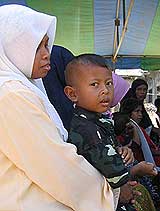
I joined the women under the canopy and struck up conversation in Malay with a woman who was hugging a child about five years old.
A young girl seated behind us chipped in to say that the woman's eldest son was one of the members in the football team who had been killed. The woman initially did not respond, but patted her son's back with increasing speed.
Then she quietly said: "This is my youngest son...the one killed was my eldest son, he was 25."
Her eyes fixed on the speakers, she responded to my question as to how she felt: "Feeling? What feeling? I don't have any feeling at all."
Basic needs
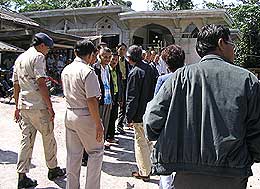 Later, parents of the dead youths were invited to a dialogue with the Thai senators at the nearly-completed mosque. It had been built almost overnight, after Thai premier Thaskin Shinawatra had visited the village as part of a remedial programme.
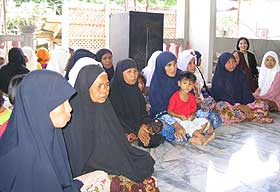
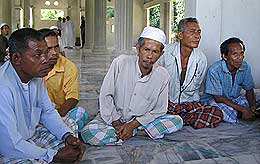
At the dialogue, the men and women again sat separately. Most remained quiet, partly because they could not speak Thai - the language used by the senators.
However, a father broke the silence and began talking with Kraisak and fellow senators Chodchoi Soponanich and Boonya Lee Led about the incident. As they spoke, tears welled up in his eyes and soon coursed down his cheeks.
As they were speaking in Thai, I used the opportunity to speak to one of the men in Malay. A rubber tapper aged 50, he had lost his only son aged 18 in the incident. He has six daughters.
He appeared calm and even smiled, but said he was still unclear as to why his son had gone with the group to the police station on April 28. The man's brother, who joined us, also said his 18-year-old son had been killed as well.
I moved to where the women were sitting. They seemed delighted when I took photos of them, and some began offering snippets of information.
 "Her son and mine died together," said a middle-aged woman pointing to an older women sitting beside her.
In a short while, more of the women said almost the same thing - of sons or husbands perishing together.
An elderly woman in a black veil, sitting behind the group, pushed forward and said "kakak menangis hari-hari (I cry every day)", before bursting into tears. Several others started crying as well.
It appeared that recrimination was not on their minds, when Kraisak asked if they had any special requests.
They seemed more interested in basic needs being met - they asked for help in caring for the widows, some of whom are pregnant, or about the possibility of performing the haj (pilgrimage to Mecca) on behalf of those who had died.
"Saya marah, tapi sabar lah (I'm angry, but have to be patient)," a father told me, a sentiment echoed by several others in the group.
Kraisak explained: "They just want their life to go back to normal as soon as possible. Any external interference could thwart the process."
Suspicious circumstances
On July 31, when we arrived in Thailand, the head of an independent inquiry into the killing of 32 of the alleged militants inside the historic Krue Se mosque in Pattani, had accused security forces of using excessive force.
Thaksin had set up the inquiry committee under intense international pressure, and the government later offered compensation to the families of those killed.
However, no independent inquiry has been called into the other deaths recorded on April 28.
Kraisak said that, to the best of his knowledge, only two knives had been found at the scene in relation to the incident involving the 19 youths in Saba Yoi.
 "Almost all the bodies showed bruises and bullet wounds at the back of their heads. Some witnesses said they were executed," he said.
We proceeded to the Krue Se mosque in Pattani and a dialogue with local community leaders. Martial law has been imposed in the areas in between.
We have passed through many heavy-armed check points between Songkhla to Pattani. Armed troops were even standing around a school field where a sports event was in progress.
I recalled the words of a woman in Su-So village who said: "Saya rasa selamat sebab kak datang sini (I feel safe because you are here)."
Although I did not understand why she said this then, the severe trauma of her experiences hit me as I travelled through the countryside with darkness falling.
Even as we wound up the trip, several explosions occurred around the region. The truth is yet to unfold, but the damage has been done. Reconciliation in Saba Yoi - and elsewhere - will be a momentous task and a long time coming.
PAULINE PUAH is a malaysiakini journalist. Her two-day visit to southern Thailand was at the invitation of the Thai senate foreign affairs committee.


