




The cultural evolution of the Straits Times
Most of Singapore's short history has been spent on developing economic clout to stand out from the region and put herself on the map.
To this end, many institutions were drawn into the project of making Singapore. Of these, the Straits Times is a key player, as the voice of Singapore's political leaders, with the task of rallying the people of Singapore together.
 Unlike the press of western democracies, the
Straits Times'
journalistic forays have been generally conservative. The paper is known more for toeing the line than being the forth estate. This has drawn immense criticism from its western counterparts.
Unlike the press of western democracies, the
Straits Times'
journalistic forays have been generally conservative. The paper is known more for toeing the line than being the forth estate. This has drawn immense criticism from its western counterparts.
In its defence, Singapore has judiciously explained the Straits Times' adopted principles of development media. The press may have adopted a policy of self-censorship but it is one that has prolonged its livelihood especially in light of its estranged relationship with the Lee Kuan Yew administration.
Lee's own opinion of the Straits Times was that it was not attuned enough to his nationalistic project, calling them 'birds of passage' rather than a supportive institution of the government.
Most of Singapore's short history has been spent on developing economic clout to stand out from the region and put herself on the map.
To this end, many institutions were drawn into the project of making Singapore. Of these, the Straits Times is a key player, as the voice of Singapore's political leaders, with the task of rallying the people of Singapore together.
 Unlike the press of western democracies, the
Straits Times'
journalistic forays have been generally conservative. The paper is known more for toeing the line than being the forth estate. This has drawn immense criticism from its western counterparts.
Unlike the press of western democracies, the
Straits Times'
journalistic forays have been generally conservative. The paper is known more for toeing the line than being the forth estate. This has drawn immense criticism from its western counterparts.
In its defence, Singapore has judiciously explained the Straits Times' adopted principles of development media. The press may have adopted a policy of self-censorship but it is one that has prolonged its livelihood especially in light of its estranged relationship with the Lee Kuan Yew administration.
Lee's own opinion of the Straits Times was that it was not attuned enough to his nationalistic project, calling them 'birds of passage' rather than a supportive institution of the government.
Be that as it may, the Straits Times' role in Singapore's development is no mere trifle. It's time to acknowledge the paper as a model to other Third World and post-colonial states around Southeast Asia in the midst of their modernisation projects.
Through the Straits Times, Singapore has incorporated both the modernisation project and development media, to build itself up from a Third World nation to a First World developed nation in 39 years. The Straits Times has challenged the view that these two development philosophies are antagonistic and cannot operate together.
In the past, the Straits Times has played the role of educator and informant. It has told the reading public the government's objectives. It activated grassroots involvement for civic society and induced communal participation toward the national development project.
It even advocated the subordination of personal freedom of choices for the project of nation-building. It attempted to gather the social forces of the people and encourage the creation of a national identity that includes all the different cultures represented in Singapore.
Juxtapose that with the engine of Singapore's modernisation and development. Through the voice of policy, the Singapore government conveyed the idea of good will, accounted for its achievements and its political will to raise Singapore's status.
The Lee Kuan Yew administration did away with the subsisting economy and put in place the structures of a developed economy, including trade, banking and finance.
A new era
Having attained first world status, the new administration of Singapore face a new and different set of modern challenges, unique to its character.
 In last year's National Day message, then Prime Minister Goh Chok Tong's address showed a lack of direction.
In a time when the world's economy has been turned on its head, the Straits Times looked inward and backward in time, acting as the government's alibi, and salvaging the remains of Singapore's pride.
But without any specific directives, the Straits Times resorted to metaphors for solutions. In the article, 'A time to be foxy', Janadas Devan used the metaphor of hedgehogs and foxes to present a dialogue between the single-minded drive of the Old Guard and the uncertain future and direction of the new.
Like the headline, the article says nothing and commits to nothing. On the other hand, the Straits Times has nothing to add and may feel that it is not in a position to do so either. The press, you see, still remains largely consensual.
Perhaps in part due to its acknowledged impact and influence on the people and in part, its own personal dynamic struggle and relationship with the government.
Development media practices are no guarantee of a consolidated national identity, especially in such a diverse community.
Although the unanimous practices of the Straits Times were in accord to the government agenda, it has neither been the sole practitioner of cultural enterprise nor can it be blamed for failing to attempt such an endeavour.
Clearly, it has tried to look to the past for cultural heritage in being sympathetic to the government, but failed to identify a truly independent and democratic identity of Singapore. Yet, the Straits Times has assisted the tangible national building exercise.
Moving with the times
The outcome of a developed, first world Singapore in less that 38 years, is sufficient proof that development media is a co-requisite to modernisation, development and integration into the global economy.
However, it will not be adequate enough to be solely relied upon to build up national identity if it is not granted sufficient liberties.
In the project to remake Singapore and make it applicable to this century as part of the developed global community, the cause of 'noble ends' and the privilege of benevolence has begun to lose its authority and drawing power.
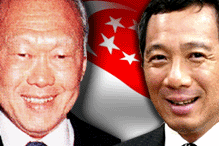 Like the administration of the Old Guard, the term of development media practices in the
Straits Times
ought also to come to an end and make way for a different model of communicative strategies.
Like the administration of the Old Guard, the term of development media practices in the
Straits Times
ought also to come to an end and make way for a different model of communicative strategies.
Local media has taken a while to respond to the changes of a more wired and connected world. The younger, savvier and more intellectually demanding population demand wider boundaries to voice their opinion.
While the Straits Times forum pages have opened up discussion areas, the papers should press for more individual and collective participation. Such efforts to equip the individual and group will activate and endow this generation of Singaporean's to take claim of the country.
Tomorrow: The touristification of Lion City
More articles in the 'A new Singapore?' series
LY-ANN TAN is teaching English as a foreign/second language in Japan, a research toward language and cultural acquisition. Born in Singapore, she received her BA (Hons) in English from The University of Sydney for her thesis on development and post-colonial media relating to Singapore.
Malaysiakini is publishing a 12-part series by different writers on the challenges facing Singapore as new leader Lee Hsien Loong takes the helm. These articles are edited by James Gomez, coordinator of the Monash Asia Institute's Singapore Studies project on civil society. For more information about the project, visit www.jamesgomeznews.com .


Are you sure you want to delete this comment?
This action cannot be undone.