




Rebranding the Lion City
 In March 2004, Singapore was re-branded 'Uniquely Singapore'. The Singapore Tourism Board (STB) replaced the former tag of 'New Asia' after eight years. Between RM67 and RM133 million dollars will be spent on telling the world that Singapore is unique.
Programmes will also be launched to generate a sense of brand ownership in the local tourism industry and among local residents. 'Uniquely Singapore' products will be created and Singaporeans will be encouraged to search for things that make their country special.
 'Uniquely' Singaporean cultures will be discovered and invented, as the STB and other state agencies jointly socially engineer and 'touristify' the Lion City.
In many other countries, residents would be concerned and react against the 'touristification' of their societies. In Singapore, however, it seems that the measure is accepted as progress in the development and emergence of Singaporean society.
What has the STB done for Singaporean society? Here are a few examples:
 In March 2004, Singapore was re-branded 'Uniquely Singapore'. The Singapore Tourism Board (STB) replaced the former tag of 'New Asia' after eight years. Between RM67 and RM133 million dollars will be spent on telling the world that Singapore is unique.
Programmes will also be launched to generate a sense of brand ownership in the local tourism industry and among local residents. 'Uniquely Singapore' products will be created and Singaporeans will be encouraged to search for things that make their country special.
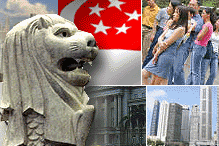 'Uniquely' Singaporean cultures will be discovered and invented, as the STB and other state agencies jointly socially engineer and 'touristify' the Lion City.
In many other countries, residents would be concerned and react against the 'touristification' of their societies. In Singapore, however, it seems that the measure is accepted as progress in the development and emergence of Singaporean society.
What has the STB done for Singaporean society? Here are a few examples:
In 1995, the STB imagined Singapore as a global city for the arts. Together with the Ministry of Information and the Arts, the STB produced the master plan to make the island-state into a 'Global City for the Arts'.
The STB predicted the advent of a cultural renaissance in Southeast Asia because of the regional economic boom. The plan would make Singapore into the cultural centre of the region.
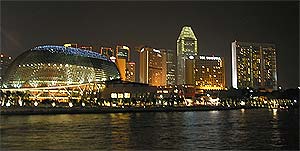 The 1997 financial crisis threw a spanner in the works, but thanks to the master plan, Singapore now has the Esplanade (
photo
) - Theatres by the Bay, the Singapore Art Museum, the Asian Civilisations Museum, as well as a lively art scene.
The 1997 financial crisis threw a spanner in the works, but thanks to the master plan, Singapore now has the Esplanade (
photo
) - Theatres by the Bay, the Singapore Art Museum, the Asian Civilisations Museum, as well as a lively art scene.
Since the 1980s, the STB has helped Singaporeans celebrate their ethnic identities. The STB supports the festive illuminations of Orchard Road (Christmas), Chinatown (Chinese New Year), Little India (Deepavali) and Geylang Serai (Hari Raya Puasa and Hari Raya Haji).
By lighting up the selected places and organising activities, Singaporeans congregate towards these focal points for festive shopping and celebration. Tourists can also experience the carnival atmosphere.
Three new museums
The STB proposed the creation of three national museums for Singapore, and these museums are sites for Singaporeans to discover their national identity. The Singapore History Museum (SHM) tells Singaporeans and the world that Singapore is a sovereign country.
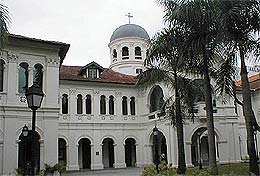 The SHM points out the country's colonial past, the achievements of the People's Action Party government and how easily Singapore was and still is bullied by its bigger neighbours. The Singapore Art Museum (SAM) showcases contemporary Southeast Asian art and alludes to Singapore's Southeast Asian identity. Close ties between Singapore and its Southeast Asian neighbours are assumed.
 The Asian Civilisations Museum (ACM), on the other hand, highlights ancient Asian material cultures, which roughly matches the Singapore's model of Chinese, Malay, Indian and other ethnicities.
By taking leaps into the distant past, the ACM celebrates Singapore's ancestral links. These layers of identity accentuate how the government and mass media present Singapore, and how Singaporeans should see themselves.
Thus, the national museums conclude that Singapore is small but successful (SHM), is part of Southeast Asia (SAM) and that Singaporeans are essentially Asian (ACM).
The STB also helps Singaporeans enjoy themselves. While Singapore was recovering from the SARS outbreak in 2003, the STB encouraged Singaporeans to 'Step Out'.
The STB initiated and/or supported locally popular activities, such as the Great Singapore Sale, the Singapore River Buskers' Festival, the Singapore Arts Festival, the Chinese New Year Chingay procession and the Singapore Food Festival.
The STB engages and mobilises local residents to make Singapore funky and exciting. These activities have become part of Singapore's culture-scape.
These examples allude to the massive influence the tourism authorities have in Singapore. However, such achievements are only possible with the support of other state agencies and the mass media.
It is also a rich organisation - it collects about RM2.2 billion annually through food and beverages outlets in Singapore.
Tourist magnet
One may also argue that Singapore is a world city. Not only are citizens taken care of in the country, tourists have their concerns taken care of too. Singapore has managed to attract about seven million tourists every year, and it has a population of only four million.
As a result, tourists are part of Singapore - while individual tourists come and go, tourists make up a shifting and yet permanent group of people in the city-state. This mobile but permanent constituency has its needs and concerns taken care of by the authorities and politicians - they are also helping Singapore imagine and transform itself.
It is accepted that Singapore has a pragmatist approach to development. Some Singaporeans are complaining that the economic basis of running the country has led to Singaporeans losing its moral, social, civic and national soul.
The 'touristification' of Singapore for economic reasons would be one of the ultimate assaults against the organic evolution of the society. But ironically, this process has also helped open up some, albeit limited, civil spaces, as we see in the art scene. These processes are uniquely Singapore.
Tomorrow: Political expression in the virtual world
More articles in the 'A new Singapore?' series
Dr OOI CAN SENG is a lecturer at the Copenhagen School of Business. He is author of Cultural Tourism and Tourism Cultures: The Business of Mediating Experiences .
Malaysiakini is publishing a 12-part series by different writers on the challenges facing Singapore as new leader Lee Hsien Loong takes the helm. These articles are edited by James Gomez, coordinator of the Monash Asia Institute's Singapore Studies project on civil society. For more information about the project, visit www.jamesgomeznews.com .


