




Nationalism overdose
Before China met Japan at the final of the Asia Cup football tournament some two weeks ago, the authorities in Beijing had gone out of its way to assure the Japanese that politics would be kept strictly off the pitch, and that the Chinese government would see to it that the friendship between the two east Asian giants would triumph through the game, regardless of who the ultimate winner was.
So, the Communist Party was greatly concerned when hundreds of Chinese football fans put up banners in the Workers' Stadium, Beijing, condemning Japan in crude and racist language, such as 'death to the Japs' and 'kill the little Japanese devils', for not facing up to its crimes against humanity during the Second World War. Supporters of the Chinese team also remained tightly seated when Kiminoseki, the Japanese anthem used both during WWII and now, was being played.
The riot of the Chinese fans immediately after Japan won the Cup did not help assure the international community of a peaceful Summer Olympics come 2008, and the public security department in Beijing promptly apologised to Tokyo for an attack against a Japanese diplomatic car.
 The rudeness of the Chinese fans, or, more to the point, the failure of the Chinese government to remind its people of the importance of international niceties, calls into question the ability of Beijing to hold any future international tournament that would involve both China and Japan without fracas.
Before China met Japan at the final of the Asia Cup football tournament some two weeks ago, the authorities in Beijing had gone out of its way to assure the Japanese that politics would be kept strictly off the pitch, and that the Chinese government would see to it that the friendship between the two east Asian giants would triumph through the game, regardless of who the ultimate winner was.
So, the Communist Party was greatly concerned when hundreds of Chinese football fans put up banners in the Workers' Stadium, Beijing, condemning Japan in crude and racist language, such as 'death to the Japs' and 'kill the little Japanese devils', for not facing up to its crimes against humanity during the Second World War. Supporters of the Chinese team also remained tightly seated when Kiminoseki, the Japanese anthem used both during WWII and now, was being played.
The riot of the Chinese fans immediately after Japan won the Cup did not help assure the international community of a peaceful Summer Olympics come 2008, and the public security department in Beijing promptly apologised to Tokyo for an attack against a Japanese diplomatic car.
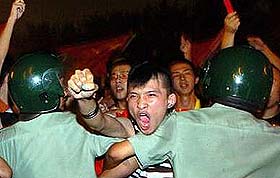 The rudeness of the Chinese fans, or, more to the point, the failure of the Chinese government to remind its people of the importance of international niceties, calls into question the ability of Beijing to hold any future international tournament that would involve both China and Japan without fracas.
Ever since the Open Door policy sanctioned by Deng Xiaoping, the late paramount leader, in 1978 and now sacredly pursued by his successors, communism as an ideology and the highest guiding principle is all but dead in China. One after another, the human disasters wrought by the Chinese Communist Party (CCP), most shocking of all the Cultural Revolution, has left the entire nation in the lurch, with tens of millions now questioning the viability of one-party rule. Finding itself losing the legitimacy to lord over the people that it claims to have 'liberated', the CCP is increasingly appealing to nationalism for its survival.
But nationalism is like a double-edged sword that cuts both ways, to be used and handled only with great care. Therefore, when the Chinese in Beijing gathered outside the American embassy in May 1999 in strong and angry protest over Nato's 'accidental bombing' of the Chinese embassy in Belgrade at the height of the Kosovo conflict, killing three Chinese citizens, the CCP officials initially permitted the crowds to stay for the first three days, before stern warnings were issued against those who refused to disperse thereafter.
Alarm bells sounded
If history is any guide, things would get out of hand had the protest been allowed to go on. With anger mounting by the days, there was no guarantee that the crowds would not turn their target on the Chinese government itself, as was the case with the initial peaceful and orderly silent protest at Tiananmen Square in April 1989 that ended up in bloodbath two months later.
Similarly, alarm bells were sounded the moment the Japanese team and their supporters were surrounded by the Chinese mobs, and I have reason to believe the Chinese government was in fact much more worried than its Japanese counterpart, as it was mindful of some crucial Japanese investments as well as a possible backlash against the CCP in the end.
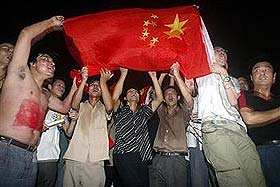 There are a series of potential flashpoints between China and Japan, the latter's refusal to apologise officially for the invasion of mainland China being the most acrimonious. Japan's effective control over the Senkaku Islands, known as the Diaoyu and claimed by China, is another. Since the early 1980s, several attempts by Tokyo to whitewash the Nanjing Massacre and 'beautify' the Pacific War as a Liberation War, with the glorious goal of casting the Asian peoples free from the imperial yoke of the white men, continue to enrage China, the Koreas and the Philippines.
As if to rub salt into the wound, Yuriko Kawaguchi, Japan's foreign minister, reportedly remarked in a recent TV programme that it was high time China 'revise' its history teaching on WWII in order to tone down the anti-Japanese feelings among the Chinese. Such imprudent statement, if true, would be a shocking insult to the victims of war.
Every August, as Japan commemorates the atomic bombings of Hiroshima and Nagasaki, the Chinese Malaysian press is awash with articles criticising Japan for not facing up to its history squarely while demanding the entire world to join in its profound sorrow over the cruelty by the United States. This year, Japan-bashing became even more intense in nearly all Chinese dailies, as many were incensed at the 'gaffe' by Kawaguchi. They may not have approved of the recklessness of the mainland Chinese football fans, but to expect publicly others to perceive history in a way similar to that of the Japanese is no doubt a demand too far.
There is, in fact, an ideological basis for Japan's perception of WWII. For many a leftwing Japanese scholar sceptical of war effort, there is a clear distinction between the invasion of China by the Japanese Imperial Army in the 1930s and the Pacific War that was set off following Japan's surprise attack on Pearl Harbour in December 1941. Yoshimi Takeuchi, a renowned sinologist, was strenuously opposed to the war waged by the militarist Japan against a weak China, but threw his weight behind the Pacific War, for he saw the latter as a brave act of standing up to the big bullies from the West. Takeuchi was again at the forefront of the movement against the US-Japan Security Pact in the 1960s.
Peculiar habit
The rightwing forces within Japan, represented by the likes of Shintaro Ishihara, the maverick mayor of Tokyo, therefore make use of the differing views over WWII to seek to justify Japan's past militarism, to the chagrin of many Asian neighbours.
To some extent, China is also to blame for Japan's lack of soul-searching over the WWII issue. The horrible crimes against humanity committed by the CCP, from the ill-conceived Great Leap Forward in the 1950s to the bloody crackdown at Tiananmen in 1989, hardly convince the world that the Chinese government is on a moral high ground to remind others to 'learn from history'. Some Chinese scholars and dissidents put the number of unnatural deaths, ie. demise due to political persecution or erroneous government policies, during the Communist rule at around 50 million.
Furthermore, for all the criticisms of Japan's attitude toward WWII, Tokyo is yet to bar any foreign critic from entering the country, and one is free to write things critical of the Japanese authorities both within and without Japan. However, Beijing is universally known for its peculiar habit of banning dissidents from Chinese soil, and its high-handedness against political opponents does not win much international sympathy when it comes to WWII.
Still, it would be unbecoming of any Japanese leader to seek to explain away Japan's WWII responsibility by citing the notorious rule of the CCP.
While the Chinese newspapers in Malaysia are still reeling with disbelief the remarks by Kawaguchi, the Malay press has been completely indifferent to the dispute. This is no surprise to me. As far as the Malay intellectual circle is concerned, the elation of the Malays at the end of British colonialism in Malaya, made possible through the Japanese invasion, was genuine and real. Without the intervention of the imperial Japan, there could well have been no Merdeka from British rule to speak of.
For Chinese Malaysians, the collective memory of the brutality of the Japanese army during WWII will linger for some time to come. With the nationalistic sentiments between China and Japan becoming increasingly unruly, perhaps it is getting more and more difficult for the Chinese Malaysian press to maintain objectivity and rationality, as well as with a Malaysian perspective on the contentious issue too.


Are you sure you want to delete this comment?
This action cannot be undone.