




Indonesias gutsy Islamists
Compared to neighboring Malaysia and Singapore, the most outstanding feature of post-Suharto Indonesia (which is, after all, a democracy unlike the other countries in the region) is the ability of its people to think the unthinkable and to do things that may be regarded as impossible elsewhere.
After having to live under more than three decades of American-backed military rule and the absence of the most fundamental freedoms, Indonesians have learned the art of political survival and have developed a political culture of their own.
The main feature of Indonesia's political culture is its adaptability and the way in which Indonesians are constantly on the lookout for new avenues and room to manoeuvre. This was most aptly demonstrated in the wake of the recent Parliamentary elections and the first round of the presidential election there.
The results of the two elections point to an increasingly evident trend in Indonesian society: The public at large has given up with parties and politicians whose only recourse is to the same old tired and dreary rhetoric of the past. The most significant outcome was the defeat of nearly all of the major Islamist parties in the country:
Put together, the Islamist parties won a measly 17.5 percent of the vote, while the rest went to the openly secular parties like the PDI-P Democratic party of Megawati Sukarnoputri and the conservative nationalists of Golkar.
Compared to neighboring Malaysia and Singapore, the most outstanding feature of post-Suharto Indonesia (which is, after all, a democracy unlike the other countries in the region) is the ability of its people to think the unthinkable and to do things that may be regarded as impossible elsewhere.
After having to live under more than three decades of American-backed military rule and the absence of the most fundamental freedoms, Indonesians have learned the art of political survival and have developed a political culture of their own.
The main feature of Indonesia's political culture is its adaptability and the way in which Indonesians are constantly on the lookout for new avenues and room to manoeuvre. This was most aptly demonstrated in the wake of the recent Parliamentary elections and the first round of the presidential election there.
The results of the two elections point to an increasingly evident trend in Indonesian society: The public at large has given up with parties and politicians whose only recourse is to the same old tired and dreary rhetoric of the past. The most significant outcome was the defeat of nearly all of the major Islamist parties in the country:
Put together, the Islamist parties won a measly 17.5 percent of the vote, while the rest went to the openly secular parties like the PDI-P Democratic party of Megawati Sukarnoputri and the conservative nationalists of Golkar.
Guts and gumption
The Indonesian Islamists, however, have outdone their peers abroad by showing guts and gumption when dealing with the painful realities of life. The most remarkable feat thus far has come from the Islamists of the PPP (Development and Unity Party) led by the Islamist leader Hamsah Haz.
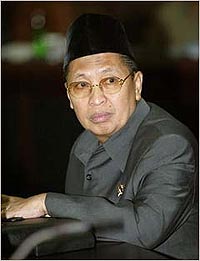 Up to the elections earlier this year, Hamsah Haz and the PPP were clearly playing to the Muslim gallery in the country, flirting with issues such as Shariah Law and the Islamic state. Hoping to tap into the aspirations of ordinary Muslims in the country, PPP ideologues and leaders were wont to use the same old rhetoric of Islamist parties the world over, with the oft-repeated claim that Islam was in danger and that conspiracies against Islam and Muslims abound.
But following the PPP's disastrous showing at the polls (it won only 9,248,764 votes, in a country of 220 million people), the leaders of the Islamist party have begun to think the unthinkable: At their recent executive committee general meeting in Bandung, Java, the PPP leadership discussed the need not only to reform and revise their methods and discourse, but even claimed that the time has come to abandon their Islamist image and symbols altogether.
The PPP's Secretary General Chozin Chumaidy noted frankly: "We have to face the results of the polls and recent elections, and accept the fact that Indonesian society is changing. This is a society that has gone through crisis and is still in crisis. In the midst of all this, the vote swing to the secular parties like PDI-P and Golkar show that the people are no longer impressed by the ostentatious show of Islamic symbols and images. They want change, and they don't want to be led by Islamist parties that simply offer rhetoric and bias."
The prognosis of Chozin Chumaidy was stark: "If we don't reform and revise our methods and tactics, we will simply lose the next generation of voters. Those who supported us before have already begun to leave us."
Another PPP leader Endin Soafihara was even more explicit: "It is mind-boggling, to say the least, that a party like PPP which has the ka'aba as its symbol and Islam as its basis, can lose so badly in a country that is majority Muslim. This shows that the Islamist parties have got it wrong and we have to learn from our errors."
Such views were echoed by Abdul Mukti, the leader of the Youth Wing of the Indonesian Muhamadijjah movement, a modernist Islamist social movement that has been on the scene since the 1920s. He welcomed the PPP's change of tactics and praised the party's leaders for their ability to re-think the premises of the Islamist political project.
According to him: "We in Indonesia still have not adapted to the culture of democracy which was denied to us during the Suharto era. Now that we have a semblance of a democracy, the values of democracy need to be inculcated in the conduct of our politics and daily life. One cardinal value to a vibrant and genuine democratic culture is the spirit of open-mindedness and fair play. In the past we used to think that if we lost politically we needed to look for new enemies or believed in our own conspiracy theories. There were rarely any objective assessments of our failures. But at least with this new example of the PPP's inward critical stance, it shows that Indonesia's Islamist parties can begin to ask serious questions about where they have gone wrong and where they are heading."
Angelic assistance
The PPP is not about to give up on political Islam completely, or turn itself into a secular party. But what it is able and prepared to do is discard the old discourse of Islamist particularism and exclusivism that effectively sidelined it from the mainstream and ended up only fueling the insecurities and paranoia of so many. In the end, the PPP leadership has come to accept that political Islam, if it is going to have any relevance today, will have to be open, plural, dynamic, cognizant of global trends, sensitive to other communities, and above all democratic.
Here is where Indonesia stands heads and shoulders above almost every other Muslim country in the world today. While political Islam remains on the ascendant and there are indeed hardline conservative and exclusive trends and groups in the troubled country, Indonesia remains a land where pluralism and tolerance prevails. Despite the negative publicity heaped on the country in the wake of the Bali resort and Marriott hotel bombings, Indonesian democracy is being kept alive by the progressive Muslim groups and parties that are still willing and able to think the unthinkable.
 The contrast is all the more evident when the PPP's open-mindedness is compared to the introverted mindset that prevails among the religious leadership of the Pan-Malaysian Islamic Party (PAS) next door, whose ulama argued that their equally disastrous defeat in the elections in March this year was due to the fact that PAS was not aided at the voting booths by 'Islamic angels'.
Apart from revealing the neo-medieval mindset at work in the inner circles of power in PAS, the PAS ulama's prognosis was also self-defeating, as it would suggest that God's angels were on the side of the government instead!


Are you sure you want to delete this comment?
This action cannot be undone.