




Anwar's release spurs calls to free Suu Kyi
The release of Malaysia's jailed ex-deputy premier Anwar Ibrahim could now spur regional efforts - ahead of the two-day Asia-Europe Meeting (Asem) Summit from tomorrow - to pressure Burma's military regime to free detained Nobel Peace Laureate Aung San Suu Kyi.
 Anwar was released on Sept 2 by the Federal Court exactly six years after former premier Dr Mahathir Mohamad - long accused of dismissing democratic procedures - fired him as his heir-apparent in a power struggle. Anwar was then convicted and jailed on sodomy and corruption charges.
"Politically, the release of Anwar has set a precedent in the region and this in turn will translate for calls within Asean for the freeing of Suu Kyi," Kobsak Chutikul, a regional foreign policy analyst, told IPS yesterday in Chiang Rai, at the Thai-Burma border.
"Suu Kyi is the only Nobel Laureate who is in custody and that creates a lot of tensions in this region and for the forward movement of Asean." said Kobsak, who was also Thailand's former ambassador to the Czech and Slovak republics and ex-economic adviser to Thai Prime Minister Thaksin Shinawatra.
Asean is a 10-member grouping of countries comprising Brunei, Burma, Cambodia, Indonesia, Laos, Malaysia, Philippines, Singapore, Thailand and Vietnam.
Burma joined the club in 1997 despite misgivings by some governments and activists inside and outside of the region, but Asean member-countries said membership would allow their 'constructive engagement' policy to slowly encourage Rangoon to open up its political system.
The release of Malaysia's jailed ex-deputy premier Anwar Ibrahim could now spur regional efforts - ahead of the two-day Asia-Europe Meeting (Asem) Summit from tomorrow - to pressure Burma's military regime to free detained Nobel Peace Laureate Aung San Suu Kyi.
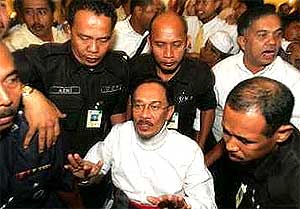 Anwar was released on Sept 2 by the Federal Court exactly six years after former premier Dr Mahathir Mohamad - long accused of dismissing democratic procedures - fired him as his heir-apparent in a power struggle. Anwar was then convicted and jailed on sodomy and corruption charges.
"Politically, the release of Anwar has set a precedent in the region and this in turn will translate for calls within Asean for the freeing of Suu Kyi," Kobsak Chutikul, a regional foreign policy analyst, told IPS yesterday in Chiang Rai, at the Thai-Burma border.
"Suu Kyi is the only Nobel Laureate who is in custody and that creates a lot of tensions in this region and for the forward movement of Asean." said Kobsak, who was also Thailand's former ambassador to the Czech and Slovak republics and ex-economic adviser to Thai Prime Minister Thaksin Shinawatra.
Asean is a 10-member grouping of countries comprising Brunei, Burma, Cambodia, Indonesia, Laos, Malaysia, Philippines, Singapore, Thailand and Vietnam.
Burma joined the club in 1997 despite misgivings by some governments and activists inside and outside of the region, but Asean member-countries said membership would allow their 'constructive engagement' policy to slowly encourage Rangoon to open up its political system.
The European Union announced over the weekend that it would attend a summit with key Asian states next month after resolving a row over military-ruled Burma,while insisting it stands firm against Rangoon.
 EU foreign ministers, who hammered out a compromise at talks in the Netherlands said they did not want to see Burma's top leaders at the Asem Summit in Hanoi, but settled for a low-level delegation. The Asian component of Asem includes Asean, Japan, South Korea and China.
Asean leadership
But the EU is threatening to further tighten sanctions against Burma unless the junta makes progress towards the path of democracy, including the release of Suu Kyi.
 "The release of Suu Kyi is a pre-condition for the international acceptance of Burma. And the international acceptance of Burma means the continuing acceptance of Asean as a key player on the international stage," said Kobsak.
At the heart of the matter is the torch of leadership of Asean, which Malaysia passes over to Burma in 2006.
In early June a Malaysian parliamentary caucus, comprising government and opposition MPs, was formed with the parliamentarians calling on Rangoon to "respect Asean and international opinion and return to the mainstream of responsible international norms and behaviour" while also calling for the release of Suu Kyi.
Among the parliamentarians in the caucus is Anwar's wife, Dr Wan Azizah Wan Ismail, who is an opposition MP.
"Malaysia is pressing for change in Burma so that when Kuala Lumpur hands over the Asean chair to Rangoon, it is done under positive circumstances," said Debbie Stothard of the regional human rights lobby Alternative Asean Network on Burma (Altsean) in an interview.
Stothard said Malaysia, previously faced a dilemma in calling for Suu Kyi's release because of Anwa''s incarceration, and stood accused by the Burmese junta of practising double standards
''Now that Anwar is free, the Malaysian parliamentary caucus will have credibility in calling for Suu Kyi's freedom and we can expect regional pressure to build up as Asem approaches," she said.
 Suu Kyi was first placed under house arrest by the military junta months before the 1990 national election, where her National League for Democracy (NLD) won the majority of seats. She was released briefly in 1995, but her movements outside Rangoon were restricted by the junta.
But Suu Kyi has spent the last year in detention after pro-government thugs attacked her convoy in May last year, and her party has since endured a renewed crackdown.
In a bid to ward of international criticism, the Burmese junta last August announced what they called a road map towards democracy. On May 17, the junta restarted a national convention to draw up a new constitution that they said would lead to free and fair elections.
But its credibility has been criticised because of the absence of Suu Kyi's NLD.
Good timing
According to Win Naing, managing editor of The New Vision - a Burmese newspaper published at the Thai-Burma border - there is optimism among activists in Burma that Suu Kyi could be free following Anwar's release.
"It's timely now, with this Anwar thing. Also, it's good timing for Asean to initiate a more effective policy with regard to Burma," he said.
"If no changes take place and Burma assumes the Asean chair in 2006, tell me which Western country would want to come to Rangoon and shake hands with the head of state who is a military general in a regime responsible for gross human rights abuses?"
But ex-Thai diplomat Kobsak was more forthright.
 "The question of Burma becoming the chair of Asean poses a lot of questions for Asean. What if Burma holds an Asean ministerial meeting in Rangoon or even a post-ministerial meeting or a summit, and nobody from outside shows up?" he asked.
"Asean's credibility has been based on the fact that everybody (both from the West and Asia) wants to come and meet with the regional grouping once a year - it's not based on wealth, it's not based on cohesion or solidarity, but it's based on the fact that Asean has an image, has a brand and has a position on the international stage.
"But if that custom or habit is broken because of Rangoon, then perhaps wherever the (Asean) meeting is held the following year, the non-Asian world would not attend." - IPS


