




The truth about detention camps
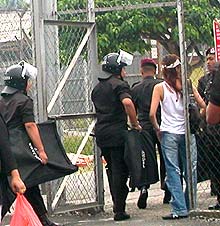
The statement made by Home Affairs Minister Azmi Khalid in relation to a recent hunger strike at the Semenyih immigration detention depot is very disturbing and unbecoming of a minister.
 According to
The Star
daily, he said: " The living conditions at the detainees quarters (at the Semenyih Detention Centre) are better than the countries they had come (from). I have looked into the menu.. it is enough to stay alive but not enough to say they are enjoying life."
According to
The Star
daily, he said: " The living conditions at the detainees quarters (at the Semenyih Detention Centre) are better than the countries they had come (from). I have looked into the menu.. it is enough to stay alive but not enough to say they are enjoying life."
His remark smacks of arrogance and is an insult to migrant workers. The conditions and the food back in the home countries of the migrants, though simple, are far better than the inhumane situation in the camps here. The homes of migrant workers may not be like Putrajaya but they live in dignity and care for each other.
The truth is that detainees here only get a handful of rice with a small piece of salted fish, which is often rotten and smelly. Water is limited and water supply does not come through daily. Recently, some volunteer doctors had to rush vitamin B injections to detainees as there were signs of beri beri and diseases arising from malnutrition.
The issue here is not about staying alive but being treated with dignity. It is about meeting basic international standards.
The statement made by Home Affairs Minister Azmi Khalid in relation to a recent hunger strike at the Semenyih immigration detention depot is very disturbing and unbecoming of a minister.
 According to
The Star
daily, he said: " The living conditions at the detainees quarters (at the Semenyih Detention Centre) are better than the countries they had come (from). I have looked into the menu.. it is enough to stay alive but not enough to say they are enjoying life."
According to
The Star
daily, he said: " The living conditions at the detainees quarters (at the Semenyih Detention Centre) are better than the countries they had come (from). I have looked into the menu.. it is enough to stay alive but not enough to say they are enjoying life."
His remark smacks of arrogance and is an insult to migrant workers. The conditions and the food back in the home countries of the migrants, though simple, are far better than the inhumane situation in the camps here. The homes of migrant workers may not be like Putrajaya but they live in dignity and care for each other.
The truth is that detainees here only get a handful of rice with a small piece of salted fish, which is often rotten and smelly. Water is limited and water supply does not come through daily. Recently, some volunteer doctors had to rush vitamin B injections to detainees as there were signs of beri beri and diseases arising from malnutrition.
The issue here is not about staying alive but being treated with dignity. It is about meeting basic international standards.
Sleeping in bathrooms
During my trial related to the Memorandum on the Abuse, Torture and Dehumanised Treatment of detainees in immigration detention camps, the contractor for food - and a prosecution witness - came up with a menu and an explanation that one kilogramme of meat was shared by four detainees. The menu even included vegetable and gravy. It sounded unbelievable.
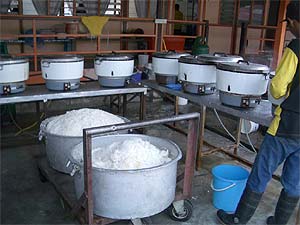 But, under cross-examination when the contractor was asked to produce purchase orders and bills, he could not do so. He could not prove his claims.
But all the detainees who testified were consistent in stating that the food they received was a handful of rice with a small piece of fried salted fish that was unpalatable.
They could not eat the food and as a result, lost a lot of weight.
We hope Azmi has not been taken for a ride and led into believing in the existence of a sumptuous menu. It may be the case on paper, but in reality, the situation is very different.
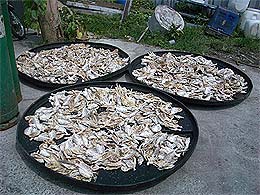 These pictures taken on Aug 9, 2004 show that the detainees are only given rice and salted fish.
Furthermore, the overflow of detainees - 1,741, which is three times the capacity - is unmanageable. Some detainees are forced to sleep in the bathrooms. Even body-to-body space is not sufficient.
The heat becomes unbearable and the overcrowding has led to the outbreak of chicken pox and skin diseases. Many suffer from fever spells and run the risk of developing pneumonia. There is limited or no access to treatment.
The women and children also face severe conditions. The children do not get adequate milk. If the mothers want to get more milk, they need to purchase it and many of them do not have the money. Breast feeding mothers are not given sufficient food. Women are also not provided with sanitary napkins. This has led to camp personnel selling these items at a high price.
Since 1995, Tenaganita has constantly raised the issues faced in immigration detention centres. However, the Home Ministry has failed to take effective measures to bring change and provide
humane treatment. The detainees who are in the camps currently are those who have served their sentence and are waiting to be deported.
Review policy
According to information received, the overcrowding in the camp is the result of the immigration department's delay in facilitating deportation. The government's policy on deportation has to be reviewed as it is not effective. The number being deported monthly is much lower than the number being admitted into the camp.
Adding to the problem is that foreign missions of the sending countries are not responding well. The consular services are either weak, indifferent or lacks the capacity to manage the large number of its nationals.
 But at the end of the day, the Malaysian government must be accountable for the inhumane conditions, the human rights violations especially the lack of access to medical treatment as well as abuses that the migrant detainees endure daily.
If the government orders a massive crackdown of undocumented workers, then it must also have the capacity to manage the detention camps within accepted international standards. The failure to provide living conditions and basic needs to detainees constitutes torture and violation of rights like right to food and water.
The arrest of refugees and asylum seekers, after allowing them entry, is ridiculous and inhumane. As a peace loving nation, we cannot send these people back to a situation where their lives will be at great risk. There must be a distinction between undocumented migrants and refugees. All refugees and asylum seekers should be released and given immediate protection. The best way is for Malaysia to ratify the UN Convention on Refugees.
We call on the prime minister to immediately institute an independent commission of inquiry to investigate the complaints in Semenyih camp and in all other camps.
This is crucial because Tenaganita has also received similar complaints from detainees in the Lenggeng camp in Negri Sembilan, Macap Umbo in Malacca and Pekan Nenas in Johor.
 Tenaganita is willing to hold a dialogue with the Home Ministry and work towards the development of a comprehensive policy on recruitment and Employment of Migrant workers.
The ad hoc system used currently continues to ignore abuses by employers, further victimises migrant workers, punishes the migrants even when she/he is innocent, creates space for corruption and abuse by officials especially relevant agencies and thus increases more problems than solutions.
Visits to the camps by ministers and officials will only remain a public relations exercise, if there is no political commitment to address the larger issues of recruitment and employment of migrant workers, corruption and lack of co-rdination between the various agencies and between the Malaysian government and sending country governments.
IRENE FERNANDEZ is director of migrant support group Tenaganita. She was convicted of spreading 'false news' after exposing the appalling conditions in the country's illegal immigration depots in 2003 and was sentenced to one-year imprisonment. Irene is currently on bail pending her appeal in the High Court.


