




Four short months for the world
I arrived in New York just over a week ago to the organised madness of the Republican National Convention (RNC), the pre-election gathering of the Republican Party. It has been a hair-raising week to my doctoral studies.
Although an overwhelmingly Democratic city, New York has been placed in a position of central symbolic importance by the Republican political effort.
The airplane hijackings and the spectacular assault on the twin towers of the World Trade Centre on Sept 11, 2001 have become lasting impressions imprinted on both the American and international consciousness.
The subsequent invasions of both Afghanistan and Iraq as the opening moves of the so-called 'war on terror' are being justified in this light.
I arrived in New York just over a week ago to the organised madness of the Republican National Convention (RNC), the pre-election gathering of the Republican Party. It has been a hair-raising week to my doctoral studies.
Although an overwhelmingly Democratic city, New York has been placed in a position of central symbolic importance by the Republican political effort.
The airplane hijackings and the spectacular assault on the twin towers of the World Trade Centre on Sept 11, 2001 have become lasting impressions imprinted on both the American and international consciousness.
The subsequent invasions of both Afghanistan and Iraq as the opening moves of the so-called 'war on terror' are being justified in this light.
The prospect of the war on terror evolving into a fully blown Cold War-like struggle spanning several decades, is fueled by persistent reminders of the trauma unleashed upon the American sense of national security.
The Republican political discourse expounded by the RNC's keynote speakers has been strikingly bellicose. Former New York mayor Rudolph Giuliani delivered a warlike speech that was greeted with rapture by the assembled masses in Madison Square Garden.
Subsequent speeches from US Vice-President Richard 'Dick' Cheney, California governor Arnold Schwartzenegger and President George W. Bush fleshed out the remainder of a two-pronged assault on terrorism and domestic 'liberal' successes (which include same-sex marriage, abortion and secular government).
In a vituperative guest speech the right-wing Democrat Senator of Georgia, Zell Miller claimed that it is the "soldier who gives freedom of the press more than the reporter. It is the soldier who gives the protestor the freedom he abuses.". It sounded like something from home.
While casting 'liberals' as set-piece villains, the speakers were, according to my American friends, unanimously liberal with the truth of the Bush administration's achievements for America and the now-global cause of 'freedom'.
They boasted of achievements in improving America's security, economy, job security, and education. While reforms have certainly been made in these areas, these appear to have increased insecurity for the ordinary man or woman. Meanwhile domestic anti-terror measures have heightened state secrecy and facilitated the invasion of privacy.
 The world is being presented to Republicans and the American public as a legitimate forum for the exercise of offensive military power. The balance of foreign policy has shifted overwhelmingly from diplomacy to war. But with regards to a war on terror, how does one wage war on a tactic?
The much abused Geneva Convention is an example of an international agreement on acceptable codes of conduct in war.
US ambassador Joseph Wilson - whose wife, a former Central Intelligence Agency employee, was outed by government conservatives in a recent political scandal - pointed out in a televised discussion that there exist a whole range of 'soft' foreign policy alternatives to war, including economic sanctions and incentives, 'subversion' and, of course, diplomacy. The war on terror threatens to slip into a war without limits.
The Bush administration's decision to wage a war on all fronts will certainly benefit defence companies and the corporate military services sector.
However, it is unclear whether such militarism will resolve America's national security worries or only serve to heighten anger and aggression towards the premier global superpower and its allies, as has been demonstrated by the bombings, threats and kidnappings targeting expatriates in the Middle East and Southeast Asia.
One thing is clear, such actions by all sides have galvanised a burgeoning progressive movement in America opposed to both terrorism and the war on terror.
Voices of dissent
Hundreds of thousands of such protestors converged on Madison Square Garden to oppose the Bush-Republican cause. Not solely left-wing activists and Democrats, their numbers also included Republicans opposed to ballooning military budgets and New Yorkers, among them relatives of 9/11 victims, outraged at the cynical use of their city to justify further suffering.
Non-violent and filled with imaginative slogans, banners and T-shirts, the protests have been billed as the largest protests ever assembled around an American political party convention.
The streets of Manhattan and Brooklyn were filled with anti-Bush posters, many pedestrians openly sported similar badges, shop windows unfurled banners proclaiming 'Elect a madman, and you get madness', whilst vendors conducted a brisk trade in all manner of T-shirts.
Digital cameras appeared to be the essential protest accessory. Street theatre, from the bad to the amusing, livened up pockets of the city. Every conceivable social demographic was out on the street expressing a viewpoint.
 An innovative series of posters labelled 'Not Just a Statistic' depicted the ID photos of military servicemen and servicewomen fallen in combat matched with a humanising blurb stating, for example, that Corporal X once stopped to deliver CPR to a roadside stranger, or Lieutenant Y loved his cats dearly.
A number of veterans from the recent Iraq invasion now opposing the war fielded daily questions from passers by in central Manhattan's Union Square.
One of the most witty critiques of the Bush administration's tax cuts favouring the rich at the expense of the poor was the be-suited protest group 'Leave No Billionaire Behind', a subversive twist on Bush's 'Leave No Child Behind's policy.
Decked out in top hats and coat tails the 'billionaires' have gaily marched and toasted cocktails in boat parties in an ironic celebration of Bush.
These were not indulgent carnival antics, protestors clearly had a media agenda for hearts and minds and would shift location in order to secure a chance of better access to the American (and perhaps global) public.
 However, independent media reporter Amy Goodman of DemocracyNow.org has charged that the political correspondents of the mainstream media have scarcely reported their points of view.
John Fund, a Wall Street Journal reporter, acknowledged a clear 'class base' in media coverage favouring white males in suits.
Conversely, the renowned bohemian confines of Greenwich Village are filled with screenings of documentaries on Bush's Brain, which focuses on chief political advisor Karl Rove.
OutFoxed, about the profound rightist influence of Rupert Murdoch's Fox News channel on the Arab language news channel Al-Jazeera, and Mike Moore's film Fahrenheit 9/11, are a common talking point.
'Four more years'
The progressive reality of America is certainly far more vibrant than those outside often perceive it to be.
Sadly, the caricature of America as the so called 'Evil Empire' is not entirely misplaced. Bigotry and xenophobia exist here in strong doses and they clearly identify with the ruling party. On the final night of the RNC, I came across a group of poster-waving protestors surrounded by a ring of police and an angry mob of anti-RNC protestors.
A quick glance at their signs identified them as Protest Warriors, Republican street activists who had been encircled by officers for their own safety. One of the posters depicted a woman in a burqa sporting a T-shirt which read, 'My son suicide bombed a bus full of Israelis and all I got was this lousy T-shirt'.
Hope for a multilateral solution was quashed by UNAmerican: 'Hey UN, we brought you into this world and we can take you out'. Although they were not a racially homogenous group, the multicultural reality of the world, let alone America, appears to be threatening to such people.
What redeemed the whole scene was the fact that the anti-RNC protestors were enraged by the visible intolerance of the Protest Warriors. Fred, an independent photographer with whom I struck up a conversation, shook his head sadly.
He described with distaste and regret that one of the banners depicted the phrase, 'Islam, religion of peace' alongside photos of Osama bin Laden and the 9/11 hijackers. I was joined on the barricades later by a grandmother who works as a building manager and two Australians who refused to shy away from the protests despite the risk of deportation if arrested.
Such displays of determination are heartening and give hope that it will be possible to make a political case for peace in America. War will only short-circuit much needed opportunities for mutual understanding to flower between America and its critics.
The ubiquitous Republican rallying cry of 'four more years' drew the retort of 'four more months' from protestors and Democrats. Much of the fate of the world in the coming decades will be decided in these few short months.
However, the race for the American presidency will be resolved not in clearly partisan states like New York or Texas, but in the so called 'swing states' of Ohio, Florida, and some 15 others. John Fund, a Wall Street Journal reporter and author of 'Stealing Elections', has voiced concerns about voter fraud and other procedural weaknesses in the American electoral system.
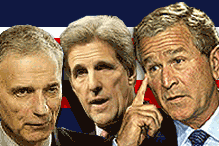 He worries of repeats of the Florida vote counting scandal, appearing in the swing states. Some 44 percent of Americans do not vote and a vocal minority has voiced disappointment in both hegemonic parties, and even the need for a genuine third alternative (independent presidential hopeful Ralph Nader is scarcely mentioned).
More importantly for those outside the US, is the fact that both candidates are firmly agreed on the need to continue the war on terror. As the New York Times (Sept 5) noted, "whether or not the war on terror is winnable, it can determine who wins an election".
Bush has been clear on his commitment to pursue this war, whilst the overwhelming impression created is that Massachusetts Senator John Kerry presents an uncertain prospect on this issue.
What is striking to an outsider is the importance that American politicians are forced to concede concerning their record in the Vietnam War. Whether one is a draft dodger or loyal serviceman stands in the shadow of the normative value that the role of president, as commander-in-chief of the United States of America's military forces, is profoundly central to how America understands the duties of its number one civil servant.
 Thus, the task of weaning Americans off military adventurism is not simply in the hands of non-Americans opposed to such policies, it is also a domestic challenge of changing fundamentals of America's political culture.
Right now Bush and Kerry are just about neck-and-neck, with commentators ceding a slight advantage to Bush in the wake of the RNC.
In a sign of the force of the Bush campaign's assault on his credibility, Kerry stretched the convention of maintaining silence for the period of the opposing party's political rally by staging a gathering in Ohio to rebut his opponents' criticism just a few hours after the RNC drew to a close.
Malaysian connection
If Malaysians pay attention to anything in November, it should be to the US presidential elections. The US is one of our largest trading partners, our currency is pegged to the US dollar, our foreign policy is increasingly in step with America's and we have already signed on to its war on terror, the new Cold War.
Although we often narrate it in more parochial national terms, Malaysia is a country profoundly shaped by Cold War dynamics, our state apparatus and socio-political make up is deeply influenced by the anti-communist counter insurgency, more so than many of us appreciate.
The undeclared war against Malayan communists has left us with a legacy of the Internal Security Act, a secret police, a near-unchallengeable ruling coalition and a less tangible inheritance of fear and insecurity routinely invoked by the government to justify repressive excesses.
We exist under four un-annulled states of emergency, stretching back four decades. In our formative years economic development was part of the policy for counter-insurgency.
Economic development and the terror of counter-terror continues to be packaged as an inseparable all-or-nothing deal by our government to the electorate (as the Kit Siang-Nazri debate on the ISA recently affirmed).
The economic growth of the last 20 years has in some measure dulled the curiosity to fully gauge the extent of the psychological, political and social impacts of our country's own little war on terror. This is not helped by the fact, as historian Professor Khoo Khay Kim recently noted, that there only exists one history department in all of Malaysia's universities.
 One question few have considered is how a state such as ours, so wholly customised to suppress insurgency in its broadest forms (both military and political), can make a transition to a more civil and equitable state, when the temptation always exists to use the tried and tested counter-insurgency machinery to suppress all dissent.
On closer inspection, Malaysia's counter-insurgency is far from being a universally realisable moral success story. We have lessons to share with America, Iraq and the world if we are willing to scrutinise ourselves more closely.
This much is clear though, if America prosecutes a war on terror over the next three decades that is anything like the last two years, there will be few apparently stable states such as Malaysia emerging from this period of strife.
As a high profile ally in this endeavour, Malaysia's own apparent stability could be stressed to breaking point from the political and economic fallout - NAM leadership and OIC chairmanship notwithstanding.
What can we citizens from a small country do?
Remind America that the worldwide outpouring of sympathy over the 9/11 tragedy was quashed by the move for war. Malaysia is known as a political leader of the Third World and the Muslim world, which perhaps gives ordinary citizens an angle of approach.
It is not just our politicians who can demonstrate good statesmanship. Our carefully nurtured reluctance to take domestic civic action should not hold internationally.
Take action now, inform yourselves as deeply as possible of American political realities browse mainstream American media as well as such websites as www.democracynow.org, www.openthegovernment.org and www.fair.org.
 Do what you can to make an impassioned, fair and rational case to those around you and to Americans, especially their media, that the world has a stake in what is decided in US politics and that outside voices can speak the language of peace, understanding and solidarity, not just anger and violence.
Write to newspapers (national, international and American), send email expressing concern to the embassy, call up satellite TV news channels that offer space for viewers comments, organise others to put their view forward.
Encourage American friends to vote. War is as bad for America as it is for the rest of the world. Americans have a right to their security but not at the expense of countless innocents.
Peaceful means are available but these involve difficult but necessary political changes. We have four short months to affect the fate of the next three decades.
YIN SHAO LOONG is a doctoral student at the Graduate Faculty of Political and Social Science at the New School University, New York.


