




Tsunami tragedy: A reflection
A crisis on the scale of the tsunami tragedy should shock us enough to wonder whether we have been grooming ourselves in front of a mirror that gives a false reflection, hiding our warts, pimples and wrinkles.
It is time to polish it and ensure that there is adequate lighting in the room. This applies to everyone, and to societies and governments affected by the disaster as well as the international community.
A crisis on the scale of the tsunami tragedy should shock us enough to wonder whether we have been grooming ourselves in front of a mirror that gives a false reflection, hiding our warts, pimples and wrinkles.
It is time to polish it and ensure that there is adequate lighting in the room. This applies to everyone, and to societies and governments affected by the disaster as well as the international community.
 Perhaps, having looked at a clear reflection of ourselves, the honesty will encourage us to recall more clearly the earlier shocks in our lives and how well or badly we dealt with them.
Remember the tidal wave of 1997? Remember how we were in a state of denial to brace ourselves for the financial disaster despite warnings given well in advance?
We had been basking for so long in the warm praises of those who spoke about the so-called Asian Economic Miracle that we got complacent. And since we were supposed to be economic tigers, we roared at our critics, as if arrogance would insulate us from severe economic crises.
Although such crisis has attacked other economies, back then, we thought we were immune from danger.
Likewise, with the current tragedy. There was a certain induced state of comfort. Since Malaysia is geographically outside the earthquake zone, we thought we were not prone to severe natural calamities. We were wrong and we have not been spared.
 As a nation that is considered rather economically and technological advanced for a developing country, Malaysia should feel some shame for being so ill-prepared for this sort of crisis. Even after the tsunami attack, some of our leaders continued to take a dismissive attitude, saying we had not been too badly affected.
As a private citizen, I have visited all the affected areas and communities in Kedah and Penang and I can say with confidence that the government did respond to assist the victim. It could have been more pro-active in terms of speed and scale of assistance, to help the affected families resume their normal lives.
The outpouring of sympathy from individuals and private groups proves that there is enough compassion within our society to make us proud. Despite our economic development, a deep sense of humanity still exists within society. But this cannot absolve the government from shouldering its responsibility and providing the leadership required to deal with the crisis.
There is a tendency among public figures to use the tragedy as an opportunity to promote themselves, giving away gigantic mock cheques. The vital question is whether the actions being taken are commensurate with the needs of the communities affected.
Slow response
We welcome the help of the international community. Organisations like Unicef, USAid and Oxfam have acted quickly to provide food and community relief in Acheh, India and Sri Lanka without regard for the victims' religious persuasions or ethnic backgrounds.
 Even our domestic NGOs have been much speedier than the government in responding to the needs of the Achenese. Insinuations have been made on the slowness of the Muslim community to respond, even in the Muslim-majority areas such as Aceh. To an extent, the criticism is valid.
But what is hidden is that the United States, as part of its 'war against terror', has zeroed in on the network of traditional Muslim charitable foundations, including waqf .
Many Muslim foundations, accused of funnelling funds to terrorist organisations, have had their bank accounts frozen in Western countries so that rich Saudi Arabian families, for instance, have no reliable means to channel their money to the affected areas.
I urge the US and other Western countries to review their action. This important matter was raised with me during my recent visit to the Middle East and in my conversations with individual Muslim philanthropists.
Two international groups deserve harsh criticism for their slow or non-existent response to the crisis, namely the Organisation of Islamic Countries (OIC) and Asean. A crisis of this magnitude definitely requires effective co-ordination and mobilisation on the part of governments.
The OIC is in a position to co-ordinate governmental efforts among member-countries in raising funds and providing relief. Unfortunately, Malaysia, which currently chairs the OIC, has not acted along those lines.
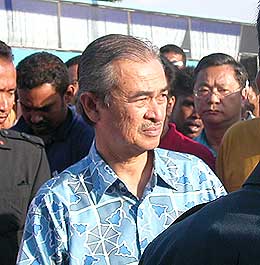 I therefore call upon the prime minister (Abdullah Ahmad Badawi.
photo
) to convene an emergency OIC meeting to deal with the crisis in Aceh and other countries. Certainly any effort to alleviate the suffering of victims must ignore the religious persuasions of those affected.
I therefore call upon the prime minister (Abdullah Ahmad Badawi.
photo
) to convene an emergency OIC meeting to deal with the crisis in Aceh and other countries. Certainly any effort to alleviate the suffering of victims must ignore the religious persuasions of those affected.
At least three Asean countries are affected, namely Indonesia, Malaysia and Thailand. Where is the much hyped Asean solidarity and what has happened to "successful regional co-operation"? Why haven't they been mobilised to deal with the crisis?
Asean has been structured in such a way that it mainly deals with organising a series of summits and dialogues with its partners on economic issues. However, the litmus test for the effectiveness or agility of a regional organisation is how speedily it responds to a regional crisis.
Seriousness and effectiveness are key elements in the resolution of a tragedy. Speed undoubtedly is the cornerstone of efficacy. Unfortunately, a much needed concerted effort by Asean remains to be seen.
ANWAR IBRAHIM is former deputy prime minister of Malaysia.


Are you sure you want to delete this comment?
This action cannot be undone.