




Bold step for MIC
Witnessing Parti Sosialis Malaysia (PSM) big gun S Arutchelvan speak at a Malaysian Indian Congress-sponsored event is an opportunity not to be missed. The Indian party's groundbreaking move to solicit views from allies and adversaries alike for input on the Ninth Malaysian Plan is certainly worth my Sunday.
The MIC has had an ambiguous relationship with the ethnic community it claims to represent. There are those who view the MIC as the pillar of the people, fighting for their rights at the highest levels of government.
Others see it as nothing more than a parasite, using its privileged position to channel government contracts and assistance to party elites, while claiming to be powerless in addressing grassroots needs such as a minimum wage for plantation workers, provision of low-cost housing and the improvement of the Tamil education system.
Given such a controversial reputation, it is a welcome surprise that MIC has been able to gather such a wide spectrum of representation for its upcoming forum on the Ninth Malaysian Plan. The list of speakers reads as a who's who within the Indian community, including prominent members of civil society, corporate sector, the civil service and unions.
Notable exceptions are distinguished members of non-BN political parties. The exception is PSM secretary general S Arutchelvan who will speak on behalf of the Plantation Workers Support Committee (PWSC). Asked how he feels about speaking at a MIC event, he said "I have no problems talking to any groups, as far important issues can be highlighted. We have been doing work in the field, and we feel we can contribute to the discussion."
Arul says that the recommendations of the PWSC can be easily implemented. "Take for example, the call for Tamil schools to be fully government aided. Similarly, the call for plantation workers to be given land or a low-cost house when their plantations are developed," he says.
Witnessing Parti Sosialis Malaysia (PSM) big gun S Arutchelvan speak at a Malaysian Indian Congress-sponsored event is an opportunity not to be missed. The Indian party's groundbreaking move to solicit views from allies and adversaries alike for input on the Ninth Malaysian Plan is certainly worth my Sunday.
The MIC has had an ambiguous relationship with the ethnic community it claims to represent. There are those who view the MIC as the pillar of the people, fighting for their rights at the highest levels of government.
Others see it as nothing more than a parasite, using its privileged position to channel government contracts and assistance to party elites, while claiming to be powerless in addressing grassroots needs such as a minimum wage for plantation workers, provision of low-cost housing and the improvement of the Tamil education system.
Given such a controversial reputation, it is a welcome surprise that MIC has been able to gather such a wide spectrum of representation for its upcoming forum on the Ninth Malaysian Plan. The list of speakers reads as a who's who within the Indian community, including prominent members of civil society, corporate sector, the civil service and unions.
Notable exceptions are distinguished members of non-BN political parties. The exception is PSM secretary general S Arutchelvan who will speak on behalf of the Plantation Workers Support Committee (PWSC). Asked how he feels about speaking at a MIC event, he said "I have no problems talking to any groups, as far important issues can be highlighted. We have been doing work in the field, and we feel we can contribute to the discussion."
Arul says that the recommendations of the PWSC can be easily implemented. "Take for example, the call for Tamil schools to be fully government aided. Similarly, the call for plantation workers to be given land or a low-cost house when their plantations are developed," he says.
Political will
 Nevertheless, Arul remains sceptical. "While I think that consultative process in itself is important, how much political will [to make changes] the MIC has is another question," he added.
The forum promises to have a "special interest" on developing plans to assist the "bottom 30 percent of Malaysian society especially among those residing in urban poor neighbourhoods and estates."
As mentioned in the invitation to the forum, "It is this section that experiences alienation and marginalization, in the context of modernization and globalization. Their issues and concerns must be at the heart of public policy deliberations, which will be focused on people development, namely building the capacity, capabilities and competencies of ordinary people to compete in the global economy"
Among others, the forum will examine issues such as access to education, access to employment, skill training, increased corporate equity and delivery mechanisms. For better or worse, the forum will stay clear of any investigating or figure pointing at the causes of the current situation. There will be no audit of what had happened to previous allocation of funds to the Indian community.
Traditionally, there have been various approaches to the problems of the Indian community.
Firstly, there are those who advocate the "assistance" approach. They argue that the Indian community have been left behind and now require active government assistance to improve their lot. They often call for a NEP-type positive discrimination for Indians, including quotas for education, more scholarships for Indians, positions in civil service and corporate equity targets.
Projects are misdirected
Secondly, there are those who call for a "merit" approach. They believe that the Indian community can stand on their own feet, provided that meritocracy is applied. They would call for a single university entrance exam to replace the current dual system, as well as more transparent and merit based approach to awarding of government contracts, civil service appointments etc. They oppose the first approach, arguing that subsidies do not create a resilient community able to compete in a globalising world. Furthermore, assistance projects are often diverted or misdirected away from target groups, instead benefitting those with privileged access.
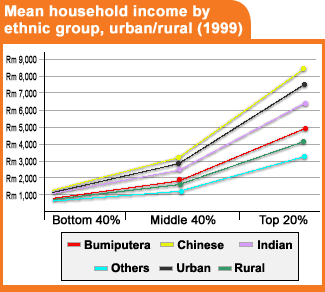 The third school looks at the issue from a class perspective. Problems effecting poorer Indians also affect the poorer sections of other Malaysian communities, including indigenous communities. They call for more emphasis on social programs, equitable growth and transparent clean governance. Among others, they advocate improving access to public health services, affordable housing, education for all, accessible public transport and higher incomes for the working class through unionisation and minimum wages policies. They oppose the laissez faire approach as not going far enough as well.
Internationally, there is a growing body of scholars, who support a Human Rights based approach to development. They passionately argue that with freedom of expression, freedom of association, free and fair elections and a competent independent judiciary, communities can organise themselves and alter their faiths and futures. It is only through oppressive regimes, that poverty is maintained.
Key policies
Personally, I am in favour of a rights and class based approach. Being Malaysians, we should go beyond our ethnicity and build a society that is equitable yet competitive. Some key policies I would like to see implemented are:
- Strengthening access to education by improving the national and Tamil educations systems.
- A merit based approach to higher education supplemented by significant improvements in the quality of education
- Sufficient assistance to the Informal Economy as a source of employment and wage earning among the urban working class
- Abolishment of anti-union legislation, and recognising International Labour Organisation (ILO) conventions of the Right to Association and Collective Bargaining
- Promotion of Social Entrepreneurship as source of social assistance
- Political and financial commitments towards housing for all
- Proper funding for public health services
- Withdrawal of the proposal to introduce the Goods and Services Tax (GST) as it is anti-poor
- Amend media laws that are opposed to a free and publicly responsible media.
Recommendations by the conference will be received by MIC president Samy Vellu and it will be interesting to see what comes of it. However, we can be assured that he will remind the conference that the MIC faces an uphill battle to convince its BN partners to accept the proposals and the need for all Indians to work with the MIC to ensure that its proposals are accepted.
For the argument to hold water, MIC needs to be prepared to be more transparent. Negotiations - and apparent defeat - behind close doors, will not suffice.
Which brings me to the conclusion. If indeed MIC cannot deliver, is MIC still relevant? Secondly, if MIC cannot deliver, perhaps it is an indication, not so much of a lack of unity among the Indian community, of the pressing need for the party to transcend ethnicity and ethnic politics.
PREMESH CHANDRAN is CEO of malaysiakini and will be attending the forum on Sunday.


