



The murky identity politics in Malaysia-China ties
“China is a big country, inhabited by many Chinese.”
- Charles de Gaulle, former French president
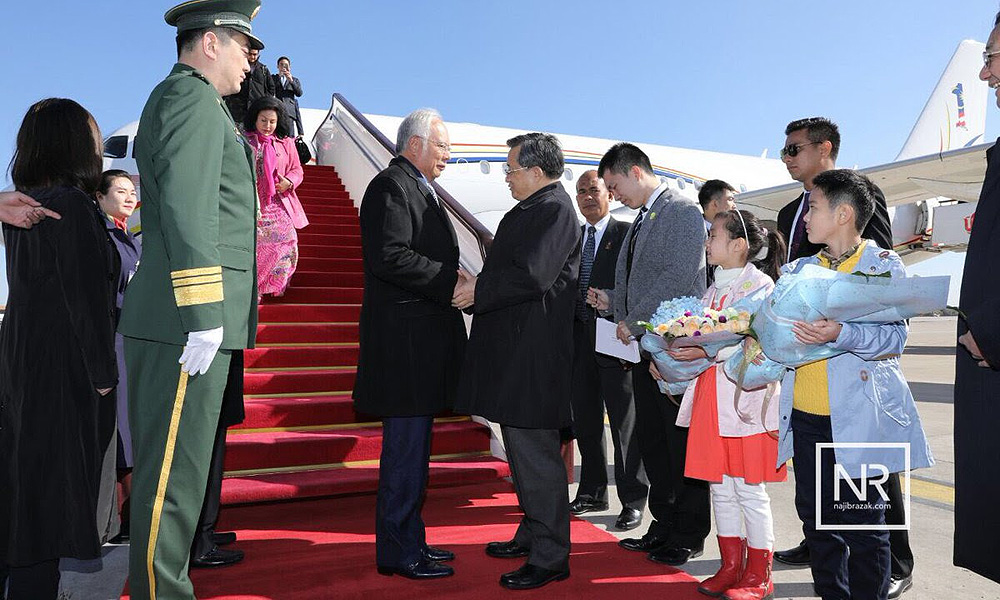
The recent Malaysia-China trade deals have resulted in an exuberant display of identity politics, which does nothing but remind everyone of the deplorable state of Malaysian politics. If someone is looking for a clear analysis of these deals beyond the superficialities of identity politics, then one has to look elsewhere.
While Umno attempts to leverage the deals as some sort of olive branch to a community it routinely demonises, the opposition meanwhile either demonises China (indirectly but sometimes directly depending on who is raising the nationalistic flag) by:
1. Claiming that Malaysian (read Malay) sovereignty is threatened, or
2. That these deals are a bailout, the implication being that China has a hand around the ‘Malay’/Umno throat thereby gaining a powerful proxy in the Malaysian political landscape.
Many articles have been written about the ‘Chinese tsunami’ that PM Najib Razak is relying on to keep him in power and that this is further evidence of China’s designs on the region. Indeed, many people seem gleeful that the corrupt regime that has for so long demonised the Chinese community has to go begging to China for a handout.
Pro-Malay media seems to be suffering from some sort of amnesia with regards to their continuous condemnation of anything Chinese and instead contextualise the China visit as something good for the average Malay-sian, with news like this from Utusan Malaysia - “Lawatan rasmi Perdana Menteri, Datuk Seri Najib Tun Razak ke China pada awal bulan ini, membuahkan hasil yang bersejarah apabila pelaburan dan kerjasama perdagangan yang dimeterai antara syarikat-syarikat Malaysia dan China mencapai angka RM144 bilion.”
In addition, Najib did not forget the little guys: “Antara perkara yang saya bangkitkan dalam lawatan ke China baru-baru ini adalah berkaitan minyak sawit dan sarang burung. Semoga usaha kerajaan ini sedikit sebanyak dapat membantu meningkatkan hasil pendapatan pekebun kecil.”
Indeed, the narrative of Malays living on handouts has been festooned on these deals as a means of demonstrating the well-documented failings of Umno and their racial policies. Establishment personalities have been scrambling to project these deals as a recalibration of their “playing safe policy” and evidence that Malaysia is looking East for mutual gain.
Pro-opposition rhetoric consist of furthering the narrative that China is taking advantage of the natives and the country is being sold piece by piece to a foreign power to settle Najib's debts. While my disdain for Najib administration is well documented (by me, mostly), making the argument that these China deals have no credibility merely because they come from the Najib regime is disingenuous.
Does China see an advantage in dealing with a potentate that has lost credibility in the West? Of course.
The meme however, that these deals were made merely to bail out Najib and serves no long-term purpose or that these deals were made mala fide ignores the reality that Malaysia has an ongoing and evolving relationship with China outside the 1MDB bubble...
“China is a big country, inhabited by many Chinese.”
- Charles de Gaulle, former French president
The recent Malaysia-China trade deals have resulted in an exuberant display of identity politics, which does nothing but remind everyone of the deplorable state of Malaysian politics. If someone is looking for a clear analysis of these deals beyond the superficialities of identity politics, then one has to look elsewhere.
While Umno attempts to leverage the deals as some sort of olive branch to a community it routinely demonises, the opposition meanwhile either demonises China (indirectly but sometimes directly depending on who is raising the nationalistic flag) by:
1. Claiming that Malaysian (read Malay) sovereignty is threatened, or
2. That these deals are a bailout, the implication being that China has a hand around the ‘Malay’/Umno throat thereby gaining a powerful proxy in the Malaysian political landscape.
Many articles have been written about the ‘Chinese tsunami’ that PM Najib Razak is relying on to keep him in power and that this is further evidence of China’s designs on the region. Indeed, many people seem gleeful that the corrupt regime that has for so long demonised the Chinese community has to go begging to China for a handout.
Pro-Malay media seems to be suffering from some sort of amnesia with regards to their continuous condemnation of anything Chinese and instead contextualise the China visit as something good for the average Malay-sian, with news like this from Utusan Malaysia - “Lawatan rasmi Perdana Menteri, Datuk Seri Najib Tun Razak ke China pada awal bulan ini, membuahkan hasil yang bersejarah apabila pelaburan dan kerjasama perdagangan yang dimeterai antara syarikat-syarikat Malaysia dan China mencapai angka RM144 bilion.”
In addition, Najib did not forget the little guys: “Antara perkara yang saya bangkitkan dalam lawatan ke China baru-baru ini adalah berkaitan minyak sawit dan sarang burung. Semoga usaha kerajaan ini sedikit sebanyak dapat membantu meningkatkan hasil pendapatan pekebun kecil.”
Indeed, the narrative of Malays living on handouts has been festooned on these deals as a means of demonstrating the well-documented failings of Umno and their racial policies. Establishment personalities have been scrambling to project these deals as a recalibration of their “playing safe policy” and evidence that Malaysia is looking East for mutual gain.
Pro-opposition rhetoric consist of furthering the narrative that China is taking advantage of the natives and the country is being sold piece by piece to a foreign power to settle Najib's debts. While my disdain for Najib administration is well documented (by me, mostly), making the argument that these China deals have no credibility merely because they come from the Najib regime is disingenuous.
Does China see an advantage in dealing with a potentate that has lost credibility in the West? Of course.
The meme however, that these deals were made merely to bail out Najib and serves no long-term purpose or that these deals were made mala fide ignores the reality that Malaysia has an ongoing and evolving relationship with China outside the 1MDB bubble.
Furthermore, the business class that supports the establishment and the opposition have always attempted to find ways to strengthen economic and bilateral ties with China.
An example of this would be the meeting Chinese Premier Li Keqiang last year had “with a group of Malaysian businesspeople to urge them to contribute to China-Malaysia cooperation. He pointed to a recent agreement to upgrade the China-Asean free trade agreement as a potential boon for Malaysia’s business community, and said China also hopes to complete the Regional Comprehensive Economic Partnership trade deal (which will include Asean, Australia, China, India, Japan, New Zealand, and South Korea) as soon as possible.”
China, on the other hand, has made its intention of using soft power as the means in which it projects itself in the Southeast Asian region. The Diplomat has been chronicling the rise of China in the region and especially China’s overtures to Malaysia.
When Chinese Premier Li Keqiang made his official visit last year, he said: “China’s development will first benefit its neighbours, including Malaysia, and I expect that everyone can seize the opportunity to contribute to the friendship and common development between China and Asean nations.”
There were enticements aplenty as reported by The Diplomat: "As proof of the benefits of working with China, Li offered up $10 billion in loans to the Asean members, to be used for infrastructure building. Li made the offer during the 18th China-Asean (10+1) leaders’ meeting, one of the many summits that took place in Malaysia this weekend. That pledge comes in addition to China’s establishment of the new Asian Infrastructure Investment Bank, which is expected to begin operations in 2016.”
Uncomfortable truth
Perhaps a good start of understanding how China operates with its trade deals is by discovering how it operates with its aid deals. Ron Matthews, Xiaojuan Ping and Li Ling’s article ‘Learning from China’s foreign aid model’ describes how China’s aid model differs from the West. They list four broad characteristics.
1. First, there is an emphasis on China’s ‘South-South’ credentials, particularly the importance of equality, common development, and a ‘partnership of equals’, reflecting what is held to be a ‘win-win’ development equation. This approach is based on aid-trade-investment deals leveraging donor-recipient synergy and mutual benefit.
2. The second major characteristic of Chinese aid is that it comes with no ‘strings attached’. The foundations for this approach lie in the country’s Five Principles for Peaceful Coexistence (including non-interference), as expounded at the 1955 Bandung Conference for non-aligned states. Beijing’s non-alignment banner is strengthened by its non-imperialistic and non-colonialist past and reflected through its current non-interventionist foreign policy.
3. The third feature of China’s aid model is that it is almost entirely bilateral, thereby retaining control over how monies are spent. State-to-state aid allows Beijing to retain ownership of the tendering process, such that prime contractorship is awarded to Chinese companies, with the preponderance of procurement sourced from Chinese supply chains.
4. The fourth attribute of China’s aid model is that while it covers grants, interest-free loans, and concessional loans, separately there is a full spectrum of wider ‘other official funding’ economic diplomacy initiatives undertaken by a plethora of government departments, including commerce, agriculture, international affairs and defence.
Now of course I am not arguing that China’s trade and aid deals are similar in nature, but what I am arguing is that China has a foreign policy outlook of mutual gain and every country in this region has discovered ways to deal with China while maintaining links with Washington and the West.
Najib's current anti-Western and look East murmurs are nothing new considering the rhetoric of former prime minister Dr Mahathir Mohamad during his tenure where he was supported by the majority of Malaysians.
As I said if it was anyone other than Najib, would these deals be as anathema to the Malaysian public as it critics would have us believe?
The great uncomfortable truth is that these China deals may not only have been a lifeline to Najib but also ultimately be a lifeline to Umno. Trade always involves some kind of societal change, hence Umno may not get to remain the Umno we despise for long.
There is a reality beyond the 1MDB bubble and the great irony is that China has worked with tinpot African dictators and is very well aware of who they are dealing with. The more constructive questions are, looking beyond Najib, do these deals do anything for the country and region, but more importantly do people really think that all China has done is merely throw money at an allegedly corrupt Muslim potentate?
S THAYAPARAN is Commander (Rtd) of the Royal Malaysian Navy.


