




Transsexuals and a life of abuse, prejudice
The transsexual community in Malaysia faces numerous forms of human rights violations, including the loss of civil and political rights, social and economic discrimination, prejudice, isolation, and exclusion, both from state and non-state actors.
For example, a study conducted by academician Teh Yik Koon in 2001 of over 500 mak nyah (a term coined and acceptable to the male-to-female transsexual community) showed that about 50 percent of the interviewees had been arrested by the police at least once, and at least five percent had been arrested 10 times or more.
Their 'crime' is often the catch-all offence of 'indecent behaviour', an arbitrary 'offence' that leaves a large amount of discretionary powers with the officers who conduct raids and arrests.
The transsexual community in Malaysia faces numerous forms of human rights violations, including the loss of civil and political rights, social and economic discrimination, prejudice, isolation, and exclusion, both from state and non-state actors.
For example, a study conducted by academician Teh Yik Koon in 2001 of over 500 mak nyah (a term coined and acceptable to the male-to-female transsexual community) showed that about 50 percent of the interviewees had been arrested by the police at least once, and at least five percent had been arrested 10 times or more.
Their 'crime' is often the catch-all offence of 'indecent behaviour', an arbitrary 'offence' that leaves a large amount of discretionary powers with the officers who conduct raids and arrests.
The right to freedom of expression is in practical terms virtually non-existent for transsexuals-in fact transsexuals are not legally recognised. According to a BBC news report in November 2004, Judge VT Singham delivered a landmark judgment when he dismissed an application by Wong Chiou Yoong, 33, who went to court seeking to be formally recognised as a man following sex-reassignment surgery.
Even with two specialists' medical reports, the National Registration Department only recognises the sex stated on the birth certificate. In spite of Wong's gender identity as a man and the surgery, the judge's opinion was that one's sex was biologically determined at birth and that there was no law that said otherwise.
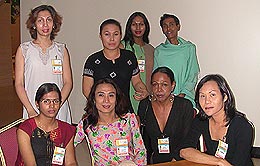 This non-recognition and rejection of transsexuals stem from a world that is only comfortable with the male and female binary, and the gender expectations that have been socially constructed around these two sexes - biological males are expected to behave and dress like 'men', biological females to behave and dress as 'women'.
When the biological sex of people do not match the gender identity they are expected to have, in particular when males behave and/or dress as 'women', they are often subjected to rejection and violence at just about every stage of life, and in most spheres of their lives.
Studies estimate male-to-female transsexuals in Malaysia to be around 10,000 to 50,000 (there is scarce data on female-to-male transsexuals). Many experience rejection and violence from their family and the community around them.
Sexually abused
About a third of those interviewed in Teh's study had been sexually abused, the majority of them between the ages of six and 15. Education and employment opportunities become scarce, and they are often forced to endure violence and persecution by religious and police authorities.
Section 21 of the Minor Offences Act 1955 states that those arrested for the 'offence' of indecent behaviour - which includes cross dressing'- can be fined anywhere between RM25 to RM50. Muslims can also be arrested by religious department enforcers and charged under the Syariah Criminal Offence Act, which provides for penalties ranging from RM800 to RM3,000 and/or imprisonment.
It is not surprising that the laws are generally used against male-to-female transsexuals since men dressed in women's clothes are viewed with greater disdain than women dressed in 'male' clothing (shirt, pants, T-shirts) which is generally deemed acceptable even if they might attract some amount of comment for sporting a 'masculine' look.
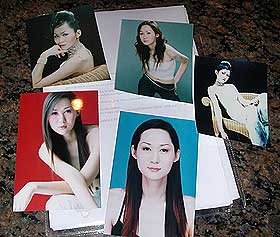 Mak nyah
are often subjected to raids by both the police and the religious departments. The majority of them are arrested under both the Penal Code and
Syariah
offences for the way they dress, but they are also often arrested on charges of soliciting, for drug-related offences, the 'offence' of loitering, and for taking part in beauty contests.
Mak nyah
are often subjected to raids by both the police and the religious departments. The majority of them are arrested under both the Penal Code and
Syariah
offences for the way they dress, but they are also often arrested on charges of soliciting, for drug-related offences, the 'offence' of loitering, and for taking part in beauty contests.
The treatment they receive at the police stations are often degrading and humiliating. According to Teh's study, over 70 percent of them were stripped of their women's clothing in front of other people, almost half reported to having been verbally jeered at, sexually humiliated, and abused, including being invited to have sex, being asked to show their breasts and private parts, being asked to change their religion, forcibly having their hair cut short, while close to 10 percent reported physical abuse. Complaints against religious department officers were similar to those made against the police.
 However, these violations are only the tip of the iceberg. As mentioned earlier, the laws in Malaysia do not recognise transsexuals. Misconceptions and ignorance regarding them have often led to both state and non-state actors unable to accept transsexuals. An example of this lack of understanding can be seen in the response of the previous religious adviser to the prime minister, Hamid Othman (
photo
), who in 2001 rejected the appeal by transsexuals for recognition on the grounds that it would 'only lure them into the sex trade'.
However, these violations are only the tip of the iceberg. As mentioned earlier, the laws in Malaysia do not recognise transsexuals. Misconceptions and ignorance regarding them have often led to both state and non-state actors unable to accept transsexuals. An example of this lack of understanding can be seen in the response of the previous religious adviser to the prime minister, Hamid Othman (
photo
), who in 2001 rejected the appeal by transsexuals for recognition on the grounds that it would 'only lure them into the sex trade'.
The irony of this is that while it is true that many mak nyah are involved in sex work (studies estimate that about two-thirds of mak nyah are sex workers), recognising them is not what forces them into sex work. Instead, it is the non-recognition and being refused other forms of employment that leave them with a narrow range of opportunities.
Educational opportunities
Lack of opportunities for education is often a problem. The above study found that while 74 percent of those interviewed had secondary schooling, only three percent had attended an institute of higher learning. There are several anecdotal reports of university students being sent out of classes because they were 'too soft' and told to come back when they became 'real men'.
Non-recognition of transsexuals by the law renders every day dealings with bureaucracies an uphill task, ranging from difficulties with the immigration and road-transport departments, insurance companies, banking procedures, having a family of their choice, funeral procedures, to name a few.
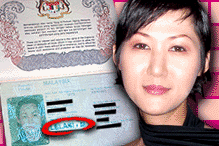 A
malaysiakini
article
in August 2004 reported on the experiences of Rina and E.E (
photo
), ethnic Indian and Chinese transsexuals respectively, who face numerous forms of discrimination and obstacles when dealing with government agencies. Rina who has had sex-reassignment surgery, for example, was refused any dealings at the Road Transport Department and at a bank because "my appearance is female but my ID says I am male.'
A
malaysiakini
article
in August 2004 reported on the experiences of Rina and E.E (
photo
), ethnic Indian and Chinese transsexuals respectively, who face numerous forms of discrimination and obstacles when dealing with government agencies. Rina who has had sex-reassignment surgery, for example, was refused any dealings at the Road Transport Department and at a bank because "my appearance is female but my ID says I am male.'
Male and female transsexuals do not all necessarily want sex-reassignment surgery. But for those who do, there is discrimination between Muslims and non-Muslims. Muslim transsexuals are in fact caught in a bind because on the one hand, they are prohibited from sex-reassignment surgery through a fatwa (decrees issued by mufti, head of the state religious office, that are automatically binding and enforceable once gazetted) by the Conference of Rulers in 1983.
At the same time, cross-dressing is also an offence. As stated at a forum on transsexuals by Khartini Slamah, a transsexual who volunteers with UNDP/UNAids, compiling data on the stigmatisation and discrimination against HIV/Aids in Asia, "We are expected to change ourselves and become 'normal' men, which is impossible if one understands what transsexualism is."
Muslim burial rites that stipulate one can only be bathed by members of the same sex often force many Muslim transsexuals to be content with their bodies, regardless of their identity. In any case, few non-Muslims opt for the surgery due to high costs and non-availability of trained surgeons locally.
Social resistance towards understanding sexual and gender identities results in the perpetuating of harm, discrimination and injustice towards transsexual communities.
ZAITUN KASIM is executive director of human rights group Suara Rakyat Malaysia. The above article is an excerpt from the Suaram Human Rights Report 2004, to be launched on Saturday at 10am, at the Selangor Chinese Assembly Hall in Kuala Lumpur.


