




Condoms and syringes: To offer or not?
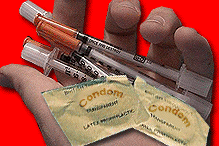
Is Malaysia sincerely serious about halting the spread of HIV/Aids in its own backyard? From the most recent development, it certainly appears to be that the government is not convinced in going ahead with its needles, condoms and methadone trial project to prevent the nation from facing more HIV/Aids developments.
 Deputy Prime Minister Najib Abdul Razak last Sunday (June 25) announced that the government would only make a final decision on this pioneer programme after consulting the National Fatwa Council (NFC). The edict received from the council will influence the government's decision on this controversial project.
Najib's reasoning on why the council was engaged was because it wanted the NFC to undertake a study on the implementation of this project according to Islamic jurisprudence.
The deputy premier also said the government's move to implement this much debated project was in line with two principles of Islamic jurisprudence namely the fact that the situation had reached an emergency level and the permission to choose between the lesser of two evils.
An obvious contradiction from the government. On one hand, it claims to want to do 'good' vis-a-vis this project while on the other hand it says there is no wrong, morally and religiously in carrying out this project. Then why engage the NFC?
Did Najib take the trouble to read what a local English daily had to say about the HIV/Aids scenario in Malaysia? The newspaper had lent voice to the concerns of the World Health Organisation (WHO) that Malaysia is at the initial stage of a HIV epidemic. The chronic situation vis-a-vis HIV/Aids has prompted WHO to watch over the development in the country.
Is Malaysia sincerely serious about halting the spread of HIV/Aids in its own backyard? From the most recent development, it certainly appears to be that the government is not convinced in going ahead with its needles, condoms and methadone trial project to prevent the nation from facing more HIV/Aids developments.
 Deputy Prime Minister Najib Abdul Razak last Sunday (June 25) announced that the government would only make a final decision on this pioneer programme after consulting the National Fatwa Council (NFC). The edict received from the council will influence the government's decision on this controversial project.
Najib's reasoning on why the council was engaged was because it wanted the NFC to undertake a study on the implementation of this project according to Islamic jurisprudence.
The deputy premier also said the government's move to implement this much debated project was in line with two principles of Islamic jurisprudence namely the fact that the situation had reached an emergency level and the permission to choose between the lesser of two evils.
An obvious contradiction from the government. On one hand, it claims to want to do 'good' vis-a-vis this project while on the other hand it says there is no wrong, morally and religiously in carrying out this project. Then why engage the NFC?
Did Najib take the trouble to read what a local English daily had to say about the HIV/Aids scenario in Malaysia? The newspaper had lent voice to the concerns of the World Health Organisation (WHO) that Malaysia is at the initial stage of a HIV epidemic. The chronic situation vis-a-vis HIV/Aids has prompted WHO to watch over the development in the country.
Those honestly concerned need not go into the abyss of confusion over the WHO pronouncement. Malaysia's ineffective measures and policies in tackling the HIV/Aids issue serves as the culprit in bringing to damaging heights the problem of HIV/Aids.
It was truly unexpected when the government recently announced that it would provide condoms and needles to1,200 drug users in a trial project beginning October, besides using the methadone drug therapy approach.
Thinking out of the box
Malaysia, a self-proclaimed moderate Islamic country is finally prepared to think 'out of the box'?
News about the needles and condoms project was made by Health Minister Dr Chua Soi Lek. And it was well received by Prime Minister Abdullah Ahmad Badawi himself who felt this was the best plan thus far to deal with the HIV/Aids situation in Malaysia.
Chua recently announced that 61,486 HIV infections including 8,955 Aids cases were reported as of September last year, with 7,083 deaths. And 75 percent of the HIV infections or 46, 292 cases involved intravenous drug users (IDUs).
 It has been reported that drug abuse is the main factor that has led to the majority of HIV/Aids cases in Malaysia. There are about 13,000 IDUs and a big number of them share needles, heightening the increase of HIV infections.
The minister was candid in admitting that existing programmes had failed to curtail the infection rate. He said studies showed there are some 20 new HIV cases every day. Bearing this data, there could be some 300,000 HIV cases within the next decade.
And for every detected case, two or three go undetected, which means by 2015 there could be 600,000 HIV cases in the country, a situation Chua declared as "alarming".
Chua said a study in 2002 showed that the rate of HIV infection dropped in 36 cities that had implemented the needle and syringe exchange programmes and increased in 67 cities without such a programme.
The minister who heads the Cabinet Sub-Committee on Drug Addicts Treatment and Rehabilitation had taken into account all available data, including a study conducted in 26 drug rehabilitation centres in 1998.
The study involving 6,326 inmates showed that 65 percent of them were IDUs. And 77 percent of them injected drugs more than thrice a day and shared needles with more than five people. The study also showed that 77.6 percent of the IDUs were sexually active, with only 18.7 percent of them using condoms during sex.
With all these facts and figures staring at our respective faces, should we still think twice in giving our health minister the benefit of the doubt to implement the needles and condoms project?
The government's decision on condoms and needles raised the expected eyebrows and was condemned not only by religious leaders but also the National Association Against Drug Abuse (Pemadam).
The latter fears that giving methadone will not help efforts at curbing drug addiction.
Religious-based objections
Leading the religious 'outburst' was none other than Perak Mufti Harussani Zakaria who was quick to shoot down Chua's idea.
Harussani's objections were followed suit by Perak Chief Minister Tajol Rosli Ghazali who would sought convenience through Islam. Tajol is of the opinion that only married drug users should receive the free condoms to prevent HIV/Aids. He said it was well and dandy if the condoms are given out to the husbands but not to bachelors because it went against the teachings of Islam which prohibits sex between unmarried couples.
Tajol further asked the Health Ministry to review the plan and consult religious leaders and non-governmental organisations before the needles and condoms project was implemented.
Then there were some other fundamentalists who are of the hardcore faith that the stand of the late pope John Paul II on condoms cannot be questioned. The late pope had declared that "The Church's moral doctrine allows no exceptions (for condoms), even for people infected with Aids or for those who want to use condoms to prevent Aids".
To some conscientious Catholics, the above decree by the late pope puts them in a moral quandary. To support or not to support is the questions that begets them. While they continue to wrestle with their own moral conscience, the nation records a rise in HIV/Aids.
Religious sentiments and the late pope John Paul II's views on morality in spite, it has to be borne in mind that diseases are not cured by guardians of public morals and religious keepers. Rather diseases, especially terminal ones like Aids can only be handled through certain effective preventive measures put in place.
Masking our fears
It would only serve and do us all good if religious sentiments are kept in their place and not 'abused' in dealing with a scenario so delicate and fragile such as HIV/Aids. To mask our fear of this disease under the cloak of religion is what has made Malaysia a hotbed, leaving the nation so 'intimate' with a HIV epidemic.
Perhaps we should reflect on the wise words of Hippocrates who so truly said "Prayer indeed is good, but while calling on the gods a man should himself lend a hand".
If we are sincere in wanting to fight the battle against HIV/Aids, then it is certainly time that we collectively diminish our 'holier- than- thou' attitude. Let us apply practicality in preventing this disease from spreading among the people. And let us humbly accept reality for what it is. We cannot anymore afford the luxury of looking and re-looking into suggestions and ideas of trying to combat the spread of HIV/Aids in our country.
As controversial as the decision might be, the health minister deserves an applause for his willingness to want to halt the spread of HIV/Aids. Indeed, the 'journey of a 1,000 miles starts with that one first step' and now, having made that decision to take that initial step, let us not doubt our ability to do that which we must and we can to stop the HIV epidemic from encroaching upon the shores of Malaysia.
The nation's humility in recognising and accepting the reality of HIV/Aids will only help save it from being ravaged by the HIV/Aids outbreak.
Amidst the condemnation by tax payers of the condoms and needles project not doing justice to them, the government must never, at any cost, have second thoughts of its decision to tackle the HIV/Aids problem head-on, like it intends to now.
Irrespective of our thoughts, this unconventional move might make the much needed difference in arresting the development of HIV/Aids in Malaysia. Unlike the pevious calls of dumping people living with HIV/Aids (PLWHAs) on an island, the harm reduction approach stems from a sensible desire to deal with this complex issue bluntly without 'beating around the bush'.
So much time and verbosity has been wasted in trying to confront the issues of HIV/Aids. The needles and condoms project is a signal that it is time the decision makers spoke less and let their actions speak for themselves. The result from this project will not produce overnight success but it will have a hand in changing the ailing scenario towards a certain improvement.
Don't be quick to dismiss
And for that matter let us not be quick to dismiss the condoms and needles effort as an impractical Western approach. This Western method, according to Malaysian Aids Council president Marina Mahathir has proven successful.
Countries like Bangladesh and Indonesia have embraced the needle exchange programme and now have a low rate of HIV. While countries like Switzerland and Australia had implemented the drug substitution therapy using methadone, a move which the Malaysian government plans to emulate.
The fear and threat coming from HIV/Aids is very real. Marina said 75 percent of drug users had HIV with 65 percent of them sharing needles. Is this situation of no concern to caring Malaysians? Does being a tax payer omit us of certain social and moral obligations? Does it allow us to choose whom as tax payers we want to save and whom we want to send to the 'gallows'?
Marina also reminded the government of the lacuna that needs to be addressed if the needles project was to be implemented. She points out that the Dangerous Drugs Act needs to be amended to facilitate this project because currently the Act 1952 makes it a crime for anyone found in possession of a syringe.
Malaysia is struggling to minimise the spread of HIV/Aids and so far the performance has been lousy. Let us not seek comfort in some miraculous cure or through religious escapism.
The decision to make a difference is ours. Let us make an informed decision, one that will go a long way in saving future lives.
That said, while the Malaysian government gambles time away in tackling the HIV/Aids issue back home, the issue of prevention and access to cheap medicine tops the agenda at the five-day long 7th Asia-Pacific AIDS Conference which commences today (July 1) in Kobe, Japan.
JJ RAY started her career with a mainstream publication. A non-conformist, she soon saw the barriers that went up whenever, through her writing, she tried to make the world a home for one and all.


