




In the claws of colonialism and jaws of nationalism
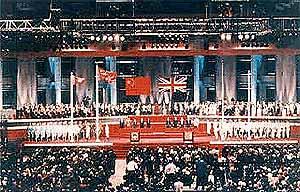
Today marks the 8th Anniversary of the resumption of Chinese sovereignty over Hong Kong, and there is bound to be much fanfare and pomp at the official level over one of the most significant dates on modern Chinese calendar.
Xu Jiatun, a former chief of the Xinhua News Agency in Hong Kong, the de facto representative office of the People's Republic of China in the then British colony, was once told that the people in Hong Kong fully embraced the resumption of sovereignty by Beijing. An incisive and observant politician, Xu, having taken office, made great effort to sound out the public's feelings and opinions, and learned in no time that the central leadership could not have been more wrong. In his memoirs, Xu writes: 'It is easy to reclaim the land of Hong Kong, but it is difficult for the heart of the Hong Kong people to come home.' (1)
For those who rejoiced at the Hong Kong handover in 1997, the transfer of sovereignty from London to Beijing did symbolise an eulogy of colonialism visited on Chinese soil and a new birth for the 'fragrant harbour'. Or did it?
Today marks the 8th Anniversary of the resumption of Chinese sovereignty over Hong Kong, and there is bound to be much fanfare and pomp at the official level over one of the most significant dates on modern Chinese calendar.
Xu Jiatun, a former chief of the Xinhua News Agency in Hong Kong, the de facto representative office of the People's Republic of China in the then British colony, was once told that the people in Hong Kong fully embraced the resumption of sovereignty by Beijing. An incisive and observant politician, Xu, having taken office, made great effort to sound out the public's feelings and opinions, and learned in no time that the central leadership could not have been more wrong. In his memoirs, Xu writes: 'It is easy to reclaim the land of Hong Kong, but it is difficult for the heart of the Hong Kong people to come home.' (1)
For those who rejoiced at the Hong Kong handover in 1997, the transfer of sovereignty from London to Beijing did symbolise an eulogy of colonialism visited on Chinese soil and a new birth for the 'fragrant harbour'. Or did it?
Independence or transfer of sovereignty is invariably perceived as an essential means of decolonisation by political elites and common folks in countries or territories that have survived colonial rule. There exists a pervasive but misguided belief that, once the goal is achieved, the alien race will cease to lord over the indigenous group of people, and political rebirth ensues. However, the post World War II history has clearly shattered a dream as such and proved that emancipation through decolonisation is all but a beautiful myth.
Nationalism, the guiding light
 Rather, the waves of independence that swept through the globe since 1945 failed to bring about brand new political imaginations, as the ruling elite sought to entrench the political structure of the freed land into the process of nation-building, la the Europeans, with nationalism as the ideological pillar and the guiding light.
As Robert J C Young, an Oxford-based guru of post-colonial studies, contends in his outstanding book Postcolonialism : 'The emancipatory narrative of a nationalism unmediated by socialism brought not the end of oppression, but oppression in new forms.' (2)
It is in fact not at all difficult to make sense of the astute view articulated by Young, provided one is prepared to discard the dichotomy of 'colonisation = oppression' and 'independence = emancipation'. National independence does not necessary entail political rebirth. On the contrary, it may very well turn out to be an ideology adroitly exploited by the ruling class to dominate the masses.
Law Wing-sang, a cultural critic based at Lingnan University of Hong Kong, whose writings I always read with great respect, argues that national independence is an unfinished project precisely because much of the anti-colonial resistance of the old days was merely premised on the agenda of the native elite to take over the position once occupied by the colonisers. (3) Therefore, Law's focus has never been on the self-aggrandising celebration of the resumption of Chinese sovereignty, but on any possible oppression in the offing.
Any attempt to analyse Hong Kong using post-colonial methodology would inevitably be met with negative response from mainland Chinese scholars. Although it is true that China as a whole has never been subjected to thorough colonisation as is the case with India, and Young, too, agrees that '. In countries where the colonial period is comparatively brief, it would clearly be ridiculous to suggest that the colonial era somehow constitutes the defining feature of their histories',(4) the issues raised in the post-colonial discourse nevertheless contain elements of universal significance, something that simply cannot and must not be overlooked.
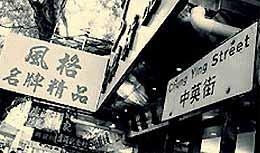 In the case of Hong Kong, the territory in fact figured very little in the grand narrative of Chinese history, perhaps until the signing of the humiliating Treaty of Nanjing in 1942, under which the island of Hong Kong was 'perpetually' ceded to the British. What is more, Wang Tao, a pioneer translator of Chinese classics into English who went from mainland China to teach at the Anglo-Chinese school in Hong Kong in the 1860s, described the territory in horribly derogatory terms, calling it a tiny island 'infested with beasts and squatted by rogues'. (5)
What a wonder, that the British, with their gunboat diplomacy, became the master of the unwanted territory, a land abandoned by the Celestial Kingdom, and with it came an historical experience that is still largely dissimilar from that of China proper. As the mainland was traumatised by incessant wars and political upheavals, Hong Kong remained a blessed and peaceful enclave, an eyewitness of the doleful Chinese history of the 19th and 20th centuries. It has a highly modernised economy and an extremely efficient administrative structure, all of which came to pass within a short span of three decades, towards the end of British rule. Thus, one can hardly regard the colonial experience of Hong Kong as a casual phenomenon bereft of defining features.
Seen in this light, Hong Kong as a former British colony is still widely viewed as an international test case in that Beijing's levels of affinity in regard to 'western values' such as human rights and political freedom are constantly scrutinised. Unlike the decolonisation exercise that had come before it in other former British possessions, Hong Kong was made to leave the comfort afforded by a liberal democracy and passed into the hands of an authoritarian regime.
One country two systems
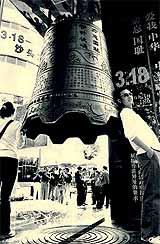 To assuage the fears and uncertainties felt by the large part of Hong Kong society, Beijing promised that there would be no change in Hong Kong for 50 years under the One Country Two Systems policy. Deng Xiaoping, the paramount leader of the Chinese Communist Party (CCP), pinned his hope on the five decades during which the seemingly insurmountable gaps between the mainland and Hong Kong would be considerably narrowed.
As Hung Ho Fung, a Hong Kong sociologist, once whimsically said: As China is gradually becoming a consumerist paradise like Hong Kong, it would be the turn of the people in the territory to exclaim: 'What is so ominous about 1997 when the mainland has everything that we have here in Hong Kong?'
Meanwhile, the CCP's commitment to keeping the status quo in Hong Kong has not obscured its need for nationalism as a basis of its anti-colonial struggle. It is at this juncture that One Country Two Systems shows its colonialist streak. Just when one was under the delusion that the resumption of Chinese sovereignty would usher in the era of universal suffrage and political independence for the people of Hong Kong, the reality cannot have been more disheartening. Instead of honouring its promise to consign colonialism to history, the CCP has managed to preserve the colonial structure in Hong Kong in toto.
In this respect, two former British high officials stand out. Geoffrey Howe, a former foreign secretary, and Percy Cradock, a China expert, were both deeply involved in the rounds of negotiations over Hong Kong with Beijing in the1980s. Today, they are still among the diplomatic darlings favoured by the Chinese officialdom on account of their willingness to accommodate Beijing's demands, including denying the Hong Kong people their right to elect post-handover leadership direct.
To guard against the democratic forces, the CCP has to raise the banner of nationalism so very often. The patriotism drive has been so effective that the nationalistic faction in Hong Kong has cultivated a blind faith in the CCP. After the resumption of Chinese sovereignty was inked in the Sino-British Joint Declaration in 1984, the people of Hong Kong have been constantly reminded of their original sin, that they had lost their 'Chinese roots' under foreign rule and needed to be redeemed by the CCP.
As Lu Sicheng, a social activist, succinctly sums up, 'Following this religious worship of nationalism, the imagined nation and state are now thoroughly enmeshed.' (6)
Taking a cue from Lu, I would argue ardent democrats such as Martin Lee and Emily Lau are mere national outcasts disqualified from speaking up for Hong Kong in the eyes of the CCP leadership. Ironically, even the radical Marxist Leung Kwok Hung , nicknamed Long Hair and an elected legislative councillor persistently challenging Beijing's authority, will not make it to the list of patriots.
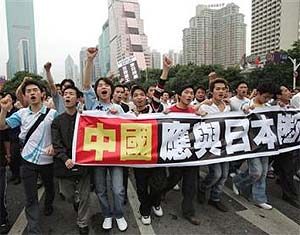 To be a patriot, one must support One Country Two Systems as well as the CCP. As far as Beijing sees it, patriots are made of those political elites and businesspeople who, through their social status and influence, sing praises unto the CCP for its colonial management of the former British colony. It would be unbecoming for a patriot to take to the streets in protest of Japan's revising history textbooks and whitewashing war atrocities, and then join a demonstration calling for a direct election of the chief executive on July 1, the anniversary of the handover. The first deed is certainly politically correct, while the second is rather repugnant. One's loyalty to the state is put to test if the two go together.
An unspoken goal
It goes without saying that the leadership in Beijing is fairly appreciative of the benevolent dictatorship instituted by the British colonialists. Freedom without democracy is what really keeps the CCP intrigued. But the Chinese leaders have an unspoken goal that is greater than just buttressing the colonial structure in Hong Kong. It hopes to improve on the modern management model bequeathed by the British, thereby proving to the world that the Chinese nation, too, is capable of running a modern city. Once materialised, it would bring immeasurable prestige and glory to a people that is still haunted by its century of humiliation.
Contrary to what is popularly perceived, the CCP has successfully reformulated its colonial relationship with Hong Kong through the image of the party and the state, and wrapped it in nationalistic appeals for public consumption. Like it or not, anti-colonial resistance has hardly been a feature in the history of Hong Kong over the last century and a half, which does not augur well for any future bargaining with the CCP, a political entity that is far more domineering than the successive British administrations in the territory.
The process of resumption of Chinese sovereignty and its subsequent developments only reveal a deeply felt dilemma, in that nationalism is not necessarily anti-colonial in nature, while the relationship between nationalism and colonialism may not have to be antagonistic, but much more complex and labyrinthine than it appears in realpolitik. Many Chinese Malaysians continue to take delight in seeing Hong Kong being an inalienable part of China. How pathetic, that we being the very victims of post-colonial politics exemplified by a semi-authoritarian government have failed to discern the colonial elements of Chinese rule, all for the sake of national pride.
Precisely because Beijing has no confidence in any other model apart from the synergy of nationalism and colonialism with which to rule Hong Kong, Donald Tsang , the new chief executive, has been given the top job in the fashion of papal election. Unlike the Pope, who pledges his undying loyalty to God, the prerequisite for a chief executive is his or her unabridged patriotism.
Even in this climate of helplessness, the Hong Kong people, best known for their post-modernity, have not lost their sense of humour, joking, 'Rather different from papal election, the smoke appears even before the chimney comes into existence.'
They cannot have been more sarcastic.
Reference:
(1) Xu Jiatun, Xu Jiatun's Hong Kong Memoirs (Xu Jiatun Xianggang Huiyilu), Taipei: Linking Publishing 1993, pp. 93-94.
(2) Robert J.C. Young, Postcolonialism , Oxford: Blackwell Publishing 2001, p.61.
(3) Law Wing-sang, Postcolonial Critique and Cultural Politics (Houzhimin Pinglun Yu Wenhua Zhengzhi), in Cultural Imaginary and Ideology (Wenhua Xiangxiang Yu Yishi Xingtai), Oxford: Oxford University Press 1997, pp. 18-19.
(4) Robert J.C. Young, p. 60.
(5) Wong Wang-chi, Wang Tao's Discourse on Hong Kong (Wang Tao De Xianggang Lunshu), in The Burden of History (Lishi De Chenzhong), Oxford: Oxford University Press 2000, pp. 218-219.
(6) Lu Sicheng, Nationalism and Colonial Rule (Minzu Zhuyi Yu Zhimin Tongzhi), in Whose City? (Shui De Chengshi), Oxford: Oxford University Press 1997, p. 62.


