




Ousted! But still waiting to enter
One of the most acrimonious political controversies in the recent past in the Southeast Asian region was the abrupt separation of Malaysia and Singapore in 1965.
The psychological effects on both sides of the Causeway - and beyond - are still being felt 40 years later.
The shocks that resulted from the dramatic event was compounded by the fact that it was only two years earlier in 1963 that Singapore was finally merged - amidst bitter polemics across the ideological spectrum - with the Peninsula to form, together with Sabah and Sarawak, the Federation of Malaysia.
Many conflicting accounts have since been advanced to find out the real and exact reasons for the love-hate or sweet-and-sour relations between the Peninsula and Singapore which almost shared the similar historical experiences of being colonised by the British Empire and rampaged by Imperial Japan, and also thousands of very emotive family and friendship ties in the civil societies.
One of the most acrimonious political controversies in the recent past in the Southeast Asian region was the abrupt separation of Malaysia and Singapore in 1965.
The psychological effects on both sides of the Causeway - and beyond - are still being felt 40 years later.
The shocks that resulted from the dramatic event was compounded by the fact that it was only two years earlier in 1963 that Singapore was finally merged - amidst bitter polemics across the ideological spectrum - with the Peninsula to form, together with Sabah and Sarawak, the Federation of Malaysia.
Many conflicting accounts have since been advanced to find out the real and exact reasons for the love-hate or sweet-and-sour relations between the Peninsula and Singapore which almost shared the similar historical experiences of being colonised by the British Empire and rampaged by Imperial Japan, and also thousands of very emotive family and friendship ties in the civil societies.
 In recent years, the best known and remembered account in the English-speaking world or Anglosphere has been Singapore Minister Mentor Lee Kuan Yew's autobiography which has also been subsequently translated into Chinese and Malay.
There are of course other English, Chinese or Malay accounts, both major and minor, that are alternative to that of Lee, such as those recalled by Malaysia's first Prime Minister Tunku Abdul Rahman and former foreign minister Ghazali Shafie on this side of the Causeway.
However, whatever their political, ideological and ethnic differences, these memoirs and recollections are essentially written from the vantage points of the victorious political decision-makers of that time.
Journalist's perspective
As such, there may be self-serving biases, narcissistic blind-spots or post facto rationalization in their narratives and discourses of historical events and incidents.
Luckily, Australia's Patrick Keith has come forward to offer to tell the story of the 1965 Malaysia-Singapore separation from a journalist's perspective in a newly published book titled Ousted! (2005, Media Masters, Singapore).
From the author's claim in the subtitle of his book, An insider's story of the ties that failed to bind , it is almost immediately clear that Keith, 74, was not an ordinary journalist. Indeed, he was not.
According to Said Zahari, the former editor-in-chief of Utusan Malayu who was detained for 17 years without trial in Singapore from 1963 to1979 but who now lives in Malaysia, he knew Keith in the 1950s as "a rather professional journalist" at one time.
Said also remembers Keith to be a good English writer.
According to Said, in the middle and late 1950s and early 1960s, he was working part-time with Radio Malaya writing commentaries for a programme called Window of the World and at that time, Keith was already a senior editor.
"Most of my critical commentaries were passed for broadcast, except one piece which was about the US's Bay of Pig fiasco in Cuba; it was referred to the Minister of Information of Malaya who finally rejected it," he recalled.
In any case, Said, a veteran journalist himself who knows the darker sides of the history of Malaysia and Singapore, would like to obtain a copy of Keith's book in Kuala Lumpur as soon as possible.
Racial politics
According to the description of the author in the book, he was born in Kuala Lumpur but migrated and settled in Australia since1968 after he had "became thoroughly disillusioned with the way racial politics were being played out in both Malaysia and Singapore".
Now, this ex-Malaysian lives in retirement in Melbourne with his wife, Constance, three grown up children and five grandchildren.
His publisher, Ian Ward said that Keith describes his racial background as a "kaleidoscopic mix of Scottish, Irish and Indian heritages that produced children ranging from fair blondes to dark-haired brownies".
 Ward, himself an Australian and veteran British journalist covering the Vietnam War now living permanently in Singapore with his wife Norma Miraflor, was a co-author and publisher of
Alias Chin Peng: My Side of History
in 2003.
Ward, himself an Australian and veteran British journalist covering the Vietnam War now living permanently in Singapore with his wife Norma Miraflor, was a co-author and publisher of
Alias Chin Peng: My Side of History
in 2003.
Keith first found a job as a reporter for the Malay Mail and then The Straits Times in the topsy-turvy days of what the British called the 'Emergency' but the Communist Party of Malaya described it as the 'Anti-Colonial War' in 1948.
True to his journalistic instinct or spirit, Keith has a more detached way of labelling that period: "desperate jungle warfare" on the part of British colonialism in Malaya.
However, he moved next to the staff of Radio Malaya and was soon appointed head of its news division. Then, he was seconded to the government's Information Department and subsequently rose to the rank of its Deputy Director of External Information. That, of course, was a job of propagandist, albeit the targets were external.
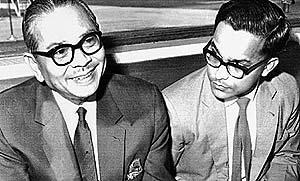 In any event, the job of a national propagandist had given Keith opportunities to know high-ranking politicians and movers and shapers of history at that time, such as Singapore's Lee Kuan Yew and Malaysia's Tunku Abdul Rahman as well as Tan Siew Sin at close range.
And that period of Keith's career in public affairs coincided with the most tumultuous times in Southeast Asia: the attempts of British, French and Dutch imperialisms to restore those 'good old days' of their oriental colonies, the upsurge of the nationalist consciousness and national liberation movements, the independence of India, victories of nationalists in Indonesia and communists in China, stalemate in the Korean War, defeat of French colonial forces at Dien Bien Phu by Vietnamese communists and, above all, the struggles, both peaceful and armed, of the Malayan (including Singaporean) people for independent nationhood.
On sale in S'pore
So, it is safe to believe, even without first reading Ousted!, that Keith's new book would offer insightful revelations of some of the well-kept secrets in the decision-making processes on both sides of the Causeway leading to the 1965 Malaysia-Singapore separation.
Well, in a now more mature Singapore, Ousted! has been released for public sale and The Straits Times has also published an extensive and prominent review of Keith's book.
Singaporeans or people in the republic have been buying and reading the book for the last few days without a riot being caused over an old man's recollection of events that occurred four decades ago.
Meanwhile, across the Causeway, although the complimentary copies of the book has been sent to the Internal Affairs Ministry for preview some 10 days ago, no news has come out to indicate whether it has been approved, banned or in the process of being censored.


