




Of privileged contracts and silencing dissent
When outspoken academic P Ramasamy was unexpectedly informed that his contract with Universiti Kebangsaan Malaysia (UKM) would be terminated barely months after it was offered, the news should not have surprised him.
Following his retirement earlier this year, Ramasamy was retained by the university, but also told that his two-year tenure of employment would be considered for approval on a month-to-month basis. The awarding of annual or two-year contracts that are subject to renewal on a monthly basis is extremely uncommon.
Indeed, the frangible nature of Ramasamy's contract was a tacit warning by UKM's management that they recognised his services were required by the university, but that there would henceforth be little tolerance of his outspokenness on issues involving Malaysian politics and society.
When outspoken academic P Ramasamy was unexpectedly informed that his contract with Universiti Kebangsaan Malaysia (UKM) would be terminated barely months after it was offered, the news should not have surprised him.
Following his retirement earlier this year, Ramasamy was retained by the university, but also told that his two-year tenure of employment would be considered for approval on a month-to-month basis. The awarding of annual or two-year contracts that are subject to renewal on a monthly basis is extremely uncommon.
Indeed, the frangible nature of Ramasamy's contract was a tacit warning by UKM's management that they recognised his services were required by the university, but that there would henceforth be little tolerance of his outspokenness on issues involving Malaysian politics and society.
Ramasamy, to his credit, had refused to be cowed by this warning, even though during more than two decades of service at UKM, he had already received a couple of letters of reprimand from the management for his public statements.
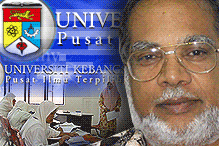 What is surprising is the decision by UKM's management to abruptly terminate Ramasamy's contract so soon after two public disputes involving two other Malaysian universities. Both these controversies had highlighted the serious problem involving the abuse of power by people in positions of authority.
The UKM decision was also astonishing given the outcome of these two issues. Both disputes were resolved in a way that had publicly embarrassed those who had acted in a manner unbecoming of their positions of leadership.
The first issue involved the attempt by the Minister of Higher Education, Shafie Salleh, to remove Mohd Zohadie as vice-chancellor of Universiti Putra Malaysia following the latter's public criticism of the minister's decision to transfer an academic programme from his university to UKM.
The minister was subsequently heavily criticised by a broad segment of society for his attempt to remove Zohadie for questioning the logic of this decision. In the event, Zohadie remains VC, but the decision to transfer the programme to UKM was not reversed.
Unilateral decision
The second issue involved the rejection, without justifiable reason, of my application for secondment to the United Nations by the management of Universiti Malaya (UM). Although I was verbally assured by vice-chancellor Hashim Yaacob that my leave would be approved, it was eventually rejected following my criticism of his management of the university.
The management subsequently stated that unpaid leave or a secondment was a privilege, not a right, and the vice-chancellor invoked his right to deny me leave ostensibly because the university could not dispense with my services. Following a public outcry, Prime Minster Abdullah Ahmad Badawi intervened, instructing UM's management to approve my application for leave.
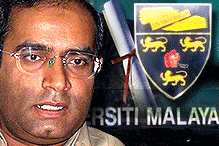 The controversy involving my leave of absence helped bring into the public domain the deeply worrying state of affairs in UM involving the blatant and unaccountable assault to the principle of academic integrity in this university.
This included the violation of academic autonomy through the tampering of examination grades awarded by lecturers and the abuse of power to endorse the promotion of unqualified staff to senior academic positions.
The matter of my leave may have been resolved, but to date no measures have been taken by the government to deal with these problems in UM.
In Ramasamy's case, what was shocking was the explanation given by Vice-Chancellor Mohamed Salleh Yasin to justify the termination of the contract. The extension of contractual appointments, he announced to the media, is a privilege, not a right. What this implies is that it is the prerogative of the management to renew such contracts. Thus, the VC had merely acted in accordance with his right to revoke the privilege that had been accorded to Ramasamy.
The fact remains, however, that Ramasamy would not have been awarded a contract in the first place had his services not been required by UKM. More appallingly, the VC had seen it fit to terminate Ramasamy's contract a month after the commencement of the new academic semester.
The dean of the faculty has himself stated that Ramasamy's services should be retained until the end of the semester for "the sake of the students". The dean's comments reveal that the decision to do away with Ramasamy's services was one made unilaterally by senior management of UKM. Ramasamy's abrupt discharge also suggests that the university's management had given no consideration to the welfare of the post-graduate students whose work he supervises.
What this reveals is not only the callousness which has come to characterise the actions and decisions of university administrators, but also their startling inability to assess the immediate as well as long-term consequences of such short-sighted and arbitrary decisions.
In this regard, then, the Ramasamy affair is a replication of the previous two higher education controversies, emphasising that the core problem that had contributed to these crises remains unaddressed and unresolved: the abuse of power by those in office.
In all three cases, those of us subjected to victimisation were critical of the university administration or of government policies. Ramasamy's dismissal only serves to confirm the widespread belief among academics that authority will simply not tolerate dissent.
Emerging issue
While the government has repeatedly and publicly stated that it will begin to institute reforms in the universities, one fundamental reason for the delay in doing so is probably that real and meaningful reforms would necessarily entail the granting of autonomy to universities, the instituting of effective checks on the power of the vice-chancellors, and the repeal of repressive legislation that curbs the rights of undergraduates to freedom of expression and of participation in issues of national concern.
The termination of Ramasamy's contract has also brought to the fore another significant area of concern that has, until now, not been broached on when discussing reforms within the universities - the issue of post-retirement contracts.
The award of a contract to a retiring or retired lecturer is a lucrative offer as he or she will receive, apart from a salary and other allowances, a monthly pension. The conferral of contracts to retiring academic staff, especially those who hold the position of professor, has long been the subject of contention in Malaysian universities.
 On one hand, the contract is seen as a justifiable recognition of the work of senior lecturers who continue to make significant contributions to the academic and intellectual life of the university while also, finally, adequately compensating them for their long and distinguished service.
On the other hand, as Ramasamy has also suggested in his comments about his dismissal, there are lecturers awarded these post-retirement contracts who hardly merit this privilege given their paltry research performance and meagre supervision record.
Similar allegations have been made in UM, with post-retirement contracts being given to academics on the basis of the senior administrative positions they have held but who had played a minor role in academic work such as leading research projects or supervising post-graduate students.
When one university chancellor recently suggested that the retirement age of lecturers should be increased, some academics argued, rightly, that this recommendation should be welcomed but with the provision that a mechanism be put in place to weed out deadwood in tertiary institutions.
The awarding of post-retirement contracts to lecturers who have not distinguished themselves as leading figures in research and the advancement of knowledge in their respective disciplines has become another avenue for the abuse of power and dispensing of patronage in Malaysian universities.
In Ramasamy's case, he is evidently a respected academic who continues to make important contributions to UKM through his teaching, supervision and research. Mohd Salleh's termination of this contract has merely served to jeopardise the welfare of Ramasamy's large community of students and bring UKM into public disrepute.
The probability of Ramasamy's reinstatement is high if there is sufficient vocal support for him. And given his immense contribution to Malaysian public life and academia, such support is not only required from within and outside tertiary institutions but also warranted.
But the matter cannot end there. The government should not delay any longer to institute the reforms that Malaysian universities urgently require, specifically those involving the independent appointment of vice-chancellors and the establishment of checks and balances to ensure fairness and transparency in the decision-making process.
The government must also show that it has the moral courage and the political will to put an immediate stop to the politicisation of universities, or the Ramasamy debacle will merely count as the latest of many more to come.
DR EDMUND TERENCE GOMEZ is associate professor of political economy at the University of Malaya. He is currently on a two- year leave of absence from UM and is based at the United Nations Research Institute of Social Development in Geneva.


Are you sure you want to delete this comment?
This action cannot be undone.