




A clearer view of jihad
Britain in the 1980s appeared negatively in our former prime minister's 'Look East' and 'Buy British last' policies.
Despite that seemingly hostile Malaysian outlook, no one can deny how closely related our country and the United Kingdom are, as events, fashions and trends that occur in the British Isles always have a great effect and gain large followings in Malaysia.
The relationship, however, is traditionally one-way: Malaysian or Malaysian events rarely influence the UK. One recent episode, however, was an exception.
For many years, the UK has been a sanctuary for refugees, asylum seekers and legal and illegal immigrants from all over the world, including the Muslim world.
Britain in the 1980s appeared negatively in our former prime minister's 'Look East' and 'Buy British last' policies.
Despite that seemingly hostile Malaysian outlook, no one can deny how closely related our country and the United Kingdom are, as events, fashions and trends that occur in the British Isles always have a great effect and gain large followings in Malaysia.
The relationship, however, is traditionally one-way: Malaysian or Malaysian events rarely influence the UK. One recent episode, however, was an exception.
For many years, the UK has been a sanctuary for refugees, asylum seekers and legal and illegal immigrants from all over the world, including the Muslim world.
However, a small minority of those who had been granted protection by the British government included people whose ideas are rejected by traditional, mainstream Islam. These people, disgruntled and forced by circumstances from their homelands, suddenly found the UK a fertile ground in which to propagate their message.
The Muslim community in the UK, as is the case in other Western countries, is relatively young, in cultural, economic and political terms. Scholars exist among them but their number is still relatively small and inadequate to cater to the needs of the community.
 The community's younger generation, in the absence of traditional Islamic institutions, such as religious schools and trained religious scholars, faced with antagonistic values of modern Britain, is without proper guidance and has been left to fend for themselves. This is the background of the community in which imported extremists of the religion found ready ears.
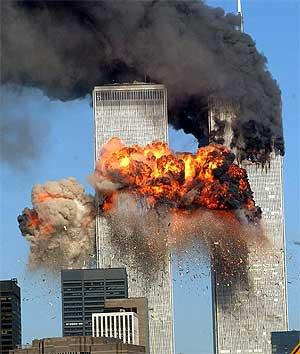
In the wake of 9/11 and 7/7, such extremist ideologues were confident enough to boldly publish an article in support of the attacks on civilians and went so far as to legitimise the attack by misquoting the verses of the Quran and the example of the Prophet s.a.w. and the early generations.
Since the first case of suicide bombings by Sunni Muslims, carried out by Hamas in 1994 in Jerusalem, the scholars of the community have relentlessly publish fatwas condemning such actions.
These fatwa , however, were written in Eastern tongues and remained throughout these years largely unknown to the British audience. Thus UK-based groups such as al-Muhajiroun did not feel themselves threatened. Their declaration in support of suicide bombings and other attacks all over the world was a show of confidence.
The fatwa
As the Malay saying goes, akhirnya bertemu buku dengan ruas , a formidable opponent finally arrived in August 2005 from a most unexpected quarter. A young, traditionally-trained Malaysian scholar, Syaikh Muhammad Afifi al-Akiti, had been until then relatively unknown. On top of his high-class Islamic education, he has received a British one, gaining a first-class honours degree, and is now at the world-renowned Oxford University.
In the previous month, he had been alerted to the group's bold statement and wrote a fatwa against it, in elegant English that bears the mark not only of an erudite, modern academic but also one who is deeply-rooted in traditional Islamic education.
 The
fatwa
, entitled
Mudafi' al-Mazlum bi Radd al-Muhamil ala Qital Man La Yuqatil
(Defending the Transgressed by Censuring the Reckless against the Killing of Civilians), does not shy away from opposing suicide bombings.
The
fatwa
, entitled
Mudafi' al-Mazlum bi Radd al-Muhamil ala Qital Man La Yuqatil
(Defending the Transgressed by Censuring the Reckless against the Killing of Civilians), does not shy away from opposing suicide bombings.
This is done methodically under three fasls (headings), defining the Islamic juridical terms ' Maqtul ' (the target), ' Amir al-Qital' (the authority), and ' Maqtul bih ' (the method), in that order. Having dealt with these terms, the author succinctly concludes: "From the consideration of the foregoing three legal particulars, it is evident that the opinion expressed regarding the 'amal in the above article in untenable by the standards of our Sacred Law."
By explicitly refuting 'the above article' the author had inadvertently, but admirably fearlessly, placed himself in direct collision with the group, al-Muhajiroun, and those who support it.
Decisive answers
The next 14 pages of the fatwa form the author's ' Masa'il Mufassala' (detailed questions and answers), in which he answers decisively 10 corollary questions pertaining to the issue, gives more clarity to his arguments and silences his opponents forever.
In one question, he deals with the issue, 'is it allowed to kill civilians if they are non-Muslims?' In another, he explains the application in modern context of the seemingly conflicting juridical rule that jihad for a Muslim is a fard kifaya (communal obligation), but becomes 'when Dar Islam is invaded or occupied a fard 'ayn (personal obligation)'. Also included is the Shafi'i School's opinion on the definition of Dar al-Islam (Negara Islam).
The author marshals all his arguments by relying on and quoting formidable authorities of the Shafi'i madhhab of Jurisprudence, from the East (such as Syaikh Nawawi al-Jawi) to the West (such as Imam an-Nawawi and Ibn Hajar), and in so doing shows his faithful allegiance to and unmistakable familiarity with one of the established schools of Sunni Islam. The benefits of this go to the readers, who can now rest and hold to the fatwa with absolute peace and utmost certainty.
To complete the fatwa , the author attaches another chapter which he calls Tatimma (the Ending). In this last part, he goes into a polemical discussion, first warning readers who will listen, to take religious knowledge and fatwa from their rightful sources, and not from cyber-muftis or other obscure self-proclaimed ulamak .
 He then reminds readers that suicide bombings were never part of the Islamic tradition, that this phenomenon is alien to the Islamic concept of Ihsan. The author also pre-emptively vanquishes any possible last, desperate attempt by the transgressors and their supporters to salvage their pride, now in tatters: while it is true that the author does not come from a region where the interests of the Muslims are at stake and there is severe conflict, this is not an obstacle to his writing of the fatwa nor does it cloud his views on the matter, where the fiqh ruling is concerned.
He makes it clear that, "we are one Umma such that when one part of the macro-body is attacked somewhere, another part inevitably feels the pain".
And elsewhere, "we will naturally feel the pain when any of our brothers and sisters die unjustly anywhere when their deaths have been caused directly by non-Muslims, but it must be the more painful for us when they die directly by the self-destroying/martyrdom/suicide missions carried out by one of our own".
Praise from scholars
Given the scholarly style and legal arguments of the fatwa , it is little surprise that its arrival was greatly welcomed by English-speaking scholars. The morning it was publicly released, a copy was presented to a gathering of Muslim scholars and students, including among them several Syrian, South African and British ulama.
One of the scholars, while acknowledging the presence of other statements by Muslim scholars condemning suicide bombings, praised the fatwa as the first that showed such eloquence and cogency of argument, and said (freely quoted): "Clearly, Syaikh Afifi is one of those rare ulama of this time who has been properly trained in the fiqh (jurisprudence) of warfare."
Indeed, the narrative style of the fatwa , in contrast to other 'press statements' by Muslim leaders and scholars, makes it special through its ability to imbue the reader, quoting one gentleman, with "a sense of being spoken to directly by its author".
Syaikh Gibril Haddad, the Damascus-based scholar who had originally sent the al-Muhajiroun article to Syaikh al-Akiti and urged him to offer a response to it, has to be commended for his effort to make the fatwa accessible to as many audiences as possible. Syaikh Haddad had voluntarily undertaken the work of editing the fatwa , adding translations and so forth.
Furthermore, he added a Taqriz (Humble Commendation) in the traditional Islamic style by composing a poem for him, as part of the introduction to the fatwa . Thanks also to his efforts and those of his friends, the fatwa is now available in booklet form, and as a PDF-file, in English and German, and translations into several other languages including Malay are forthcoming.
Intellectual anarchy
 The
fatwa
now brings us back to what has been said by our scholars past and present on the loss of
adab
and the corruption of knowledge currently rampant among the Ummah.
The
fatwa
now brings us back to what has been said by our scholars past and present on the loss of
adab
and the corruption of knowledge currently rampant among the Ummah.
Professor Syed Naquib al-Attas, the venerable Malaysian scholar, has lamented in his Prolegomena to the Metaphysics of Islam (p 19): "The disintegration of adab , which is the effect of the corruption of knowledge, creates the situation whereby false leaders in all spheres of life emerge; for it not only implies the corruption of knowledge, but it also means the loss of the capacity and ability to recognize and acknowledge true leaders."
Adab , in the tongue of a Muslim, is not simply decent manners or decorum, but denotes proper education, and thus the ability to put everything in its proper place, in the correct order. Adab does not only involve knowledge but also a sense of justice. The disintegration of adab therefore produces a state of intellectual anarchy, where common people without knowledge are raised to a level of authority in knowledge and appointed or elected decision-makers.
This, said Professor al-Attas, "provides a fertile breeding ground for the emergence of deviationists and extremists of many kinds who make ignorance their capital".
 Syaikh al-Akiti has in passing, also referred to this in his
fatwa
, when he writes in the first paragraph of the
Tatimmah
: "It is truly sad that despite our sophisticated and elaborate set of rules of engagement all having been thoroughly worked out and codified by the orthodox jurists of the
Umma
from among the generations of the
Salaf
, there are today in our midst those who are not ashamed to depart from these sacred conventions in favour of opinions espoused by persons who are not even trained in the Sacred Law"
Syaikh al-Akiti has in passing, also referred to this in his
fatwa
, when he writes in the first paragraph of the
Tatimmah
: "It is truly sad that despite our sophisticated and elaborate set of rules of engagement all having been thoroughly worked out and codified by the orthodox jurists of the
Umma
from among the generations of the
Salaf
, there are today in our midst those who are not ashamed to depart from these sacred conventions in favour of opinions espoused by persons who are not even trained in the Sacred Law"
In fact the whole concern of the fatwa has been the rectification and revival of adab - wisdom, knowledge and justice. Misleading definitions of terms have been duly corrected. The accepted explanations of Quranic verses and Prophetic Canon are supplied. What was a grey area, exists no longer.
The basis for the solution of the current ills of the Ummah therefore lies in redirecting its orientation. All responsible Muslims, instead of referring to cyber-muftis and page-turners, must now educate themselves and those around them to return everything to its right place, to regain adab, by referring matters to those most qualified to give counsel. This redirecting of themselves back to the original sources of the religion is what can be rightfully called development and progress.
Appreciate the treasure
The fatwa , ironically, although written in Oxford, was sent in the first instance to the Nusantara, the Malay archipelago, from which the author originally came. Even more interestingly, the fatwa was first read out in full at Brunei 'Darus Salam', 'the Abode of Peace', masha Allah! It is as if there is Divine Guidance working behind it.
It is therefore imperative for those who come from our region to pay particular attention to this fatwa . Despite the gentle, peaceful image the Malays and other Nusantara people present to the world, they must accept the fact that our region is dotted with areas of conflict where extremist ideas find it easy to gain followers.
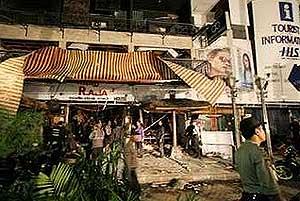 In fact, we have proved capable of the same acts of terror that we thought could only happen elsewhere. The Bali and Jakarta bombings and the high-level involvement of Malaysians are evidence enough of our inherent capacity to perpetrate such crimes.
However, true to our Malay nature, we tend to forget the treasure that is already with us. The works of our own scholars are not being given the close attention they deserve, but are left neglected and unread on the dusty shelves in our libraries. We are more adept at quoting foreign scholars and more ready to accepting their views.
Whereas in the UK, the fatwa Mudafi' al-Mazlum has created such an impact and with great alacrity in academic circles, among Muslims and non-Muslims alike, things are a bit slow on the Malaysian side. The fatwa has gained not even a mention in any of the Malaysian media since its publication.
As it is, the question to ask any Muslim, a Malaysian especially, is: have we shown the correct adab to the fatwa ?
AHMAD AFAF ABDULLAH is a London-based malaysiakini reader.


