




An Acehnese Muslim male's plea
The best way to liberate a conservative society is by liberating their women. Conservative societies always seem to oppress 'their own' women before they harm anybody else, particularly in the case of the Islamist conservatives dominating political discourses in parts of the Muslim world.
Male conservative interpretations may end in antagonism towards foreigners, but starts with internal antagonism towards 'their' women - intolerant, extreme and controlling.
The meaning of jihad among Islamic conservatives will never be a jihad for women, but for a certain type of Islam in which males are the dominant people.
The best way to liberate a conservative society is by liberating their women. Conservative societies always seem to oppress 'their own' women before they harm anybody else, particularly in the case of the Islamist conservatives dominating political discourses in parts of the Muslim world.
Male conservative interpretations may end in antagonism towards foreigners, but starts with internal antagonism towards 'their' women - intolerant, extreme and controlling.
The meaning of jihad among Islamic conservatives will never be a jihad for women, but for a certain type of Islam in which males are the dominant people.
Liberating Muslim women can stimulate change in Muslim society. This is not only because they make up the majority, but because they have the most to lose from a conservative interpretation of Islam.
Thus, they are often the first group to disagree with conservative interpretations of Islam that discriminate against Muslim sub-groups such as women or 'others'. Liberating them can create a domino effect by deconstructing the political, cultural and social system in which they are caged.
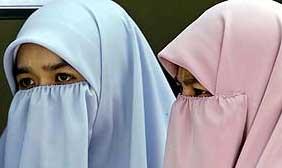 In the fight for liberation in many Muslim countries, women are in difficult position. In the province of Aceh in Indonesia, women are becoming more invisible by the day in social and political life. Not only are they forced to hide their faces behind a veil, they are also forced to hide themselves in political and social life.
Of all the marginalised groups in Aceh, the women are at the bottom. Like a Russian doll, an Acehnese woman is the minority inside a minority.
In fact, the fall of Acehnese women today is in contrast to their high position in the past. Previously, there was high recognition of the important role of women in Aceh. It was a place where there were as many heroines as heroes - several queens ruled and female military commanders led the war against colonialism.
Today, the recognition has shrunk and their involvement in social and political life is insignificant. The situation is going from bad to worse. Afghani women are better off because they are moving from worse to bad.
Dreams dashed
A woman friend, Fatimah (not her real name), is a wonderful example of the young, professional woman. She is full of dreams, works hard and speaks excellent English.
Fatimah has been working with an international agency and thought it would be the start of a useful and interesting career; she has been thinking of how she can continue her studies abroad.
Every time I met her, she talked a lot about the kinds of courses she would like to enrol for, and her dreams of visiting places in Europe. It seemed that nobody could stop her from fulfilling her dreams.
But her dreams have been dashed. Her family and my conservative society stopped her. She was told to get married recently. Soon afterwards she decided to stop working. The last time I saw her, she even stopped asking my advice about getting a grant to study abroad.
Amidst the rise of Islamic conservatism in Aceh, combined with the stubborn persistence of male cultural domination, the life of women is getting worse. It seems that now, the only way for Acehnese women to fulfil their dreams and step across the line of my society is for them to pursue their dreams on their own.
There will be no encouragement for them to pursue their studies. There will be no support and backing from their family and their society. The only way for them seems, unfortunately, to run away and stand on their own. I almost suggested to Fatimah: Run, Fatima, run!
But I realised I could not, because I don't know how many Fatimahs should run. How many of them can run or are brave enough to run? They could not run away from the tsunami wave. The might not be able to run away from the conservative wave.
 Indeed, with numbers of conservative Muslims on the rise in Aceh, the women will be the first and main target of reactionary thought. Whenever Islamic conservativism digs up medieval Islamic texts prescribing moral codes or inventing rules of conduct, its first port of call are the texts concerning the control of women.
And they will find it. If they take interpretive religious texts ( hadith ) or read the letter rather than the spirit of the Quranic teachings, gender equality cannot be achieved in Islamic society.
Given this fact, the struggle for liberation of Acehnese women cannot be postponed. It must be done now, immediately, here where we have started rebuilding Aceh from the rubble of the tsunami and after the long years of conflict.
I would like to encourage the many groups helping the Acehnese people right now, to prioritise work to help the Acehnese women first.
Giving Acehnese women priority, finding them opportunities to fulfil dreams that their society cannot give them is the best way we can help.
Positive discrimination has to become part of all our activities. If, for example, you give grants to Acehnese students, give these to Acehnese girls first.
If you assist local groups, scrutinise their work and working practices to make sure there can be a positive impact for Acehnese women.
And please, if you have to, discriminate against me, an Acehnese male.
AGUSWANDI is an Acehnese human rights advocate.


