




We had a house in Dili
A few days ago my husband, Fernando de Araujo - leader of the Democrat Party (PD) in Timor-Leste - and I, learned from a friend that our family home in Dili had been burned to the ground.
A group of men had visited our house three times previously in the days beforehand, on two occasions issuing threats, and on the third smashing everything inside the house. On their final visit they fired shots at our friends who had been guarding it for us, forcing them to flee, and then set our home alight.
A few days ago my husband, Fernando de Araujo - leader of the Democrat Party (PD) in Timor-Leste - and I, learned from a friend that our family home in Dili had been burned to the ground.
A group of men had visited our house three times previously in the days beforehand, on two occasions issuing threats, and on the third smashing everything inside the house. On their final visit they fired shots at our friends who had been guarding it for us, forcing them to flee, and then set our home alight.
Obviously in the violence that has taken place in the past few days in Dili this fate, and worse, has befallen many other East Timorese families. Some people have commented to me that it is 'just a house', which can be rebuilt and that at least we are not dead.
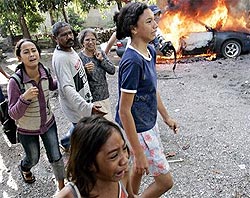 It is true that we can, and will, build another house. But I want to place the destruction of our home in some context, both political and personal.
Leaders within the East Timorese government, the F-FDTL (Falintil-Armed Forces of Timor Leste) and many media sources have characterised this violence as the random acts of the 'irrational' and 'emotional' 'masses' acting without reason, and without direction. This is simply not true.
Many of the arson attacks witnessed in Dili in the past few days have been ordered by government figures and military commanders, carried out systematically by the hiring of civilians to disguise the real criminals behind the acts.
The targeted nature of many of these arsons is reflected in the high profile names of many of the victims - the families of Minister for Internal Affairs (including police) Rogerio Lobato; Commander of the PNTL (National Police of East Timor) Paulo Martins and PNTL Deputy Commander Ismail Babo have all suffered attacks on their homes.
Disgraceful fabrication
Attributing the violence to anonymous masses is a means of avoiding accountability by those responsible. Unidentified masses cannot be taken to the International Criminal Court. Individuals, however, can, and those individuals who must face justice over these attacks are Prime Minister Mari Alkatiri himself and leaders within the F-FDTL.
Entr
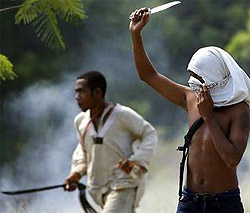 usted with the responsibility for security, the government and the F-FDTL have violated this trust by arming civilians and terrorising the communities they supposed to be protecting.
Unwilling to take responsibility for the current situation in Timor-Leste, the Prime Minister Mari Alkatiri and Foreign Minister Jose Ramos Horta, (who later made a retraction when he visited Suai), have accused my husband and I of 'instigating unrest'.
This is a disgraceful fabrication. I am a scholar. I spend every day of my life trying to get people to think and reflect, discuss and analyse, in order to understand and resolve - not create - conflict. What I have called for is a proper investigation into the killings at Taci Tolu on April 28.
The government said only five people were killed. Numerous reports from eyewitnesses have said the number was far higher. All I have demanded is transparency and accountability.
Some commentators have falsely implied that Fernando is supporting violent means. He is not.
Whilst serving seven years in Cipinang prison, Fernando de Araujo was classified by Amnesty International as a prisoner of conscience. To attain this status, one must never have advocated violence as a political weapon. Far from advocating violence, Fernando supports the petitioners as victims of state violence.
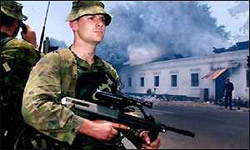 It needs to be remembered that the original 591 petitioners left their posts unarmed. They were hunted by the F-FDTL soldiers, and only later, after an unknown number of petitioners had been killed, did members of the Rapid Response Unit (UIR) police and Military Police (PM) leave their barracks with weapons to defend them.
What Fernando and the leaders of other political parties share in common with the petitioners is that they have all been marginalised and dis-empowered by the current government through the use of violence and intimidation. Our lives have been in serious danger since 1pm, April 28.
Assault on rights
This is not just a conflict between the F-FDTL (army) and PNTL (police), or between Easterners and Westerners. It is about a government that has thoroughly discredited itself through its actions lashing out and looking for scapegoats.
Our house was destroyed as part of a concerted attempt by the government to eliminate political opposition prior to the 2007 elections. The house Fernando and I built with help from so many people was a small but special place for many reasons.
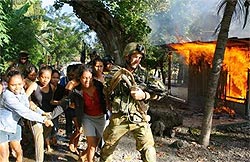 When Fernando was released from prison in 1998 he had nowhere to go and felt like he wanted to go back to Cipinang. With material and moral support from many Timorese and foreign friends, we struggled to create a warm and welcoming space that brought lots of different people together from all over Timor-Leste and also overseas.
Students, scholars, NGO workers, politicians (not only from PD) and Falintil veterans visited and stayed at our home which was also my son's playgroup. The bricks and mortar can obviously be replaced but the attack was against more than that.
It was also an assault on our rights to free and democratic political participation, and to feel secure in Timor-Leste as part of a pluralist political landscape.
The flood of kind offers to help us rebuild our home and our lives in Timor-Leste, gives us much strength and proves that this violence will fail to achieve its aims.
DR JACQUELINE SIAPNO is a lecturer in political science at the University of Melbourne.


Are you sure you want to delete this comment?
This action cannot be undone.