




Government or lifestyle?
The verdict of the Sarawak election is out. Barisan Nasional won big but not without a dent to its ego and pride. Weeks before the state elections, the incumbent chief minister of Sarawak and the deputy prime minister were confident of a clean sweep. Urbanites determined that they weren't going to hand to BN what it wanted. As a result, the BN lost big in several key cities such as Bandar Kuching, Bintulu and Miri.
Consequently, the rhetoric of the ruling coalition has changed. Supp, the chief scapegoat, was asked to fix itself. What the party did wrong was to expect the urbanites to be satisfied with its ability to deliver social services to them. In an urban constituency, the voters rejected a newly proposed wet market by voting out the incumbent BN candidate. What was wrong with them? Post-election analysis ran by some mass media suggested that the Chinese voters have revolted. Ungrateful!
The verdict of the Sarawak election is out. Barisan Nasional won big but not without a dent to its ego and pride. Weeks before the state elections, the incumbent chief minister of Sarawak and the deputy prime minister were confident of a clean sweep. Urbanites determined that they weren't going to hand to BN what it wanted. As a result, the BN lost big in several key cities such as Bandar Kuching, Bintulu and Miri.
Consequently, the rhetoric of the ruling coalition has changed. Supp, the chief scapegoat, was asked to fix itself. What the party did wrong was to expect the urbanites to be satisfied with its ability to deliver social services to them. In an urban constituency, the voters rejected a newly proposed wet market by voting out the incumbent BN candidate. What was wrong with them? Post-election analysis ran by some mass media suggested that the Chinese voters have revolted. Ungrateful!
I predict that what happened in Sarawak is symptomatic of the larger problem facing other major BN component parties especially MCA and Gerakan in the Peninsular at the next general elections. There major issues and election promises which have not been delivered by the government. The post-mortem has failed to identify or differentiate the grouses and needs of urbanites and those of the rural folks. These component parties will suffer a similar fate like the Supp and face the wrath of the urban voters.
 While hard infrastructure development, the provision of basic amenities and cash handouts are able to win rural votes, more urbanites are demanding for quality development, better governance, less corruption and a higher quality of life. The biggest ever electoral mandate given to the BN government in 2004 was not a stamp of approval of its past performances.
Elsewhere, I have argued that the mandate was given to the new administration's election pledge for major reforms. The emphasis on the promised reforms was attractive, the creation of a first world mentality. A mental level that is all encompassing. It should be able to induce a new vigour in our way of life including that of the public sector. It should put us on the right pedestal to strive for the elusive advantages of enhanced competitiveness, transparency and integrity. It was supposed to elevate meritocracy to a new level of national euphoria.
Half way through the first term of the new administration, nothing new has come out of it. The earlier passion about the creation of a first world mentality was soon discovered to be nothing more than hype. Overuse of the term 'first world mentality' has actually polluted its purity. In another rhetoric twist, the ruling elites told us that we will achieve a first world nation status on our own terms and definition. We are not good at creating new technologies or management models but we are definitely great at creating new slogans.
Crystal - clear effect
Reforms started are now left battling to stay alive and relevant. We want to achieve the status of a first world nation without all its trappings eg, proper check and balance mechanisms, institutional integrity and accountability, a constructive and lively civil society, respect for the rule of law, quality socio-economic development, equal rights and opportunities to all citizens and the primacy of the federal constitution.
Contradiction is rife in the current administration. They want us to embrace a first world mentality but not ready to let our minds think freely. Intellectualism is still being undermined and under-recognised. They told us that Malaysians are not yet ready to think critically about the issues - eg, socio-economic, ethnic relations and religious freedom - confronting them daily.
Instead, media channels are being used extensively by the ruling elites to mould a certain kind of mental model. I suspect that the first world mentality that the government asks us to aspire for is the one that they try to determine for all of us. Is it controversial? Think harder. It is hybrid mental model which combines the elements of political subordination, elitism, feudalism, racism, Islamism and crony-capitalism. I do not know how it works if it does work at all.
As a result, when it was necessary, the Umno-led government conveniently brought back the New Economic Policy (NEP) as a key pillar of the nation's socio-economic plan. The NEP was supposed to be the right antidote to correct the unequal wealth and income ownership and distribution between ethnic groups in Malaysia and to end the British colonial divide-and-rule policy which had created a clear identification of race to an economic activity.
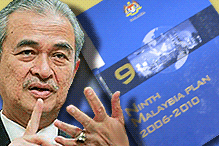 The outcome of the NEP and its side effect is crystal clear. Not only has NEP achieved its stated objectives but it has created some problems of its own. Statistics in the 9th Malaysia Plan report are self-explanatory. First, intra-ethnic income disparity within all ethnic groups has widened. Second, the poorest 40 percent in the society continues to be marginalised. Umno has failed its own people by enriching a few and allowing the lower strata of the community to continue languishing in poverty.
As a nation, we are poorer as a result of a manic surge to get rich quick through easily accessible government contracts if you are well-connected. Thanks to the Internet and the mudslinging and power struggles within the main political parties, we are privy to some of the major failures, abuses and wastages in the name of failed public projects and white elephants.
Due to the need of the new administration to strengthen its Malay power base, it is willing to play the NEP card without clearly assessing its short-comings, addressing potential abuses, reconsidering the current and future needs of the nation and striving to eradicate social injustices.
Some of the problems are institutionalised. To correct them, we have to deconstruct the current prevailing culture and to tear down the cancerous system which promotes racism, nepotism, elitism and cronyism. Otherwise, the national unity plan is nothing but a farce and a weak policy serving the political rhetoric of the ruling elites.
The obvious choice
Nevertheless, a good policy should continue to receive our support. Prime Minister Abdullah Badawi's concept of Islam Hadhari reflects his sincerity in promoting ethno-religious moderation, socio-economic progressiveness and social justice. It intends to reassure the world and to reaffirm the status of Islam as a religion which embraces good universal values.
To be more convincing, the proponents of Islam Hadhari should prove its successful implementation in the country first before undertaking a self-promotion world-wide on the virtues of the concept. Islam is non-racial and non-discriminatory but full of compassion and human love. This is my understanding of Islam Hadhari.
 Umno and the present administration must prove that it is committed to the values and virtues that it preaches. It should be mindful that the use of the racial card does come with a price. It will not only cause Umno to lose its credibility within the international community but may backfire and sabotage its other component partners as well in the next general elections.
For example, Deputy Prime Minister Najib Razak is correct about discriminatory requirements requested by employers advertising for positions. Perhaps he forgot to point out that all types of discrimination eg, bumiputera, religion and gender - if not affecting the performance of the advertised position - should be discouraged. Not only the Mandarin language.
The verdict of the Sarawak state elections should serve as a food for thought to all political parties. It is easy to find a convenient scapegoat and easier to blame the ungrateful Chinese community.
In the end, if the most adversely affected political parties are not able to convince a big, sloppy and egoistic partner to take a deep self-introspection, then, they should not fret over the wrath of urban voters who are fed-up with endless of abuses, wastages and failures.
Urbanites have been told times over to change their lifestyle to accommodate higher cost of living due to the inability of the government to provide better public transport system or to negotiate better contractual terms with suppliers of privatised projects. In time to come, between changing their already miserable lifestyle and changing an equally miserable government the choice can be very obvious.
KHOO KAY PENG is a political analyst. He advocates a non-racial Malaysian society.


