




Reappraising Mahathirs legacy
Tun Dr Mahathir Mohamad took office as the fourth prime minister of Malaysia on July 16, 1981. For 22 years until he stepped down in October 2003, Mahathir was not only the longest serving prime minister of Malaysia but has also been credited for engineering Malaysia's rapid modernisation earning him the soubriquet of 'Bapa Kemodenan Malaysia' (Father of Modernisation).
 Malaysia's physical transformation is obvious. After all, Mahathir presided over a period of phenomenal growth and at the end of his tenure, Malaysia bristled with concrete symbols from a gleaming airport to an impressive skyline.
Mahathir left office in a blaze of endearment and glowing tributes. Three years later, the period for veneration is over and the shenanigans of Mahathir's rule are slowly being untangled and the warts of his administration are beginning to show.
A reappraisal of his legacy will show that the transformation of Malaysia has come with a price.
Tun Dr Mahathir Mohamad took office as the fourth prime minister of Malaysia on July 16, 1981. For 22 years until he stepped down in October 2003, Mahathir was not only the longest serving prime minister of Malaysia but has also been credited for engineering Malaysia's rapid modernisation earning him the soubriquet of 'Bapa Kemodenan Malaysia' (Father of Modernisation).
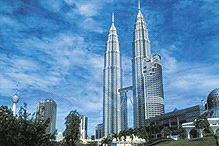 Malaysia's physical transformation is obvious. After all, Mahathir presided over a period of phenomenal growth and at the end of his tenure, Malaysia bristled with concrete symbols from a gleaming airport to an impressive skyline.
Mahathir left office in a blaze of endearment and glowing tributes. Three years later, the period for veneration is over and the shenanigans of Mahathir's rule are slowly being untangled and the warts of his administration are beginning to show.
A reappraisal of his legacy will show that the transformation of Malaysia has come with a price.
The Malaysian judiciary before Mahathir though conservative, was, however, fairly independent and the envy of the region. Today it is a mere shadow of its former glory. In fact, there has been cases of chief justices who left office in a shadow of controversy.
Judicial independence from the executive was so severely compromised that it was reduced to becoming a chimera during Mahathir's period. The judiciary not only became subservient, but also became the tool of the executive.
For the Malaysian judiciary, the watershed event was the removal of Tun Salleh Abas as the Lord President and the suspension of five Supreme Court judges and the eventual sacking of two of them. In the aftermath of the crisis in 1988, even the Supreme Court was renamed as the Federal Court while the Lord President's position was renamed to Chief Justice.
There are various interpretation of these events but the main outcome has been that the judiciary becoming politically compliant, strengthening of the hands of the executive.
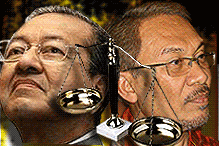 Then there was the Anwar Ibrahim saga in 1997 when Mahathir used homosexual allegations as the reason to sack Anwar, then deputy prime minister and finance minister from the cabinet and Umno.
The government then brought sodomy and abuse of power charges against Anwar. He was found guilty and sentenced to six years imprisonment for corruption and nine years imprisonment for sodomy.
Mahathir perceived Anwar's moves as an attempt by Anwar and his supporters to grab power. This earned Mahathir's wrath and he responded with vigour and without scruples.
Economic nationalism
Recognising that the Malaysia's education system was losing its competitive advantage and particularly the standard of English was deteriorating, in a complete reversal of policy, Mahathir attempted to remedy the situation by ordering the teaching of mathematics and science in English. However, having allowed and watched the rot set in, the reversal came a little too late.
Thus it did not come at a surprise when the human resource minister recently revealed that there are almost 60,000 unemployed graduates and most of them were not proficient in English.
Under Mahathir, not only was there a gradual decline in the Malaysian education system but the education system itself became polarised. Teachers, instead of teaching were often more concerned with form and dressing. Instead of building on the heritage of the mission schools, school administrators worked hard to 'Malay-nise' these schools.
 In the past, children of all races mixed freely and studied together thereby building common bonds of friendship and understanding. Today, many parents, particularly the Chinese, have begun sending their children to vernacular schools seeing national schools are on a slide.
Schools could have been the best place to initiate and cultivate national unity but that opportunity has long gone. Malaysians have regressed and have become polarised from the school-going age.
Industrialisation and privatisation have been the centerpieces of Mahathir's era. Mahathir wanted to transform Malaysia from an agricultural-based economy to become a regional industrialisation hub. To achieve this, Dr Mahathir had his initiatives and plans and launched his favoured projects with flourishes of economic nationalism.
In the end, many of the projects entailed huge losses, flaws and abuses and even needed government bailouts at the expense of public funds.
An example is Perwaja Steel which was Mahathir's showpiece steel plant to spearhead the country's industrialisation match. Today it is a spectacular failure, having lost billions by mid- 1990. Proton another of Mahathir's pet project is now floundering with plummeting car sales and is still looking for a suitor.
 Together with industrialisation, privatisation was to have been the centerpiece of Mahathir's efforts to leapfrog to a First World status from a Third World one. It was also meant to be an effective tool for redistribution of wealth. A noble vision. Unfortunately, Malaysia's privatisation, first launched in 1983, got off on the wrong footing because many projects were awarded to political favorites without competitive bidding.
The government's public assets were privatised at discounts but the government used public funds to re-nationalised assets at prices far exceeding market levels. The government-linked businessmen were doubly blessed by firstly benefiting from the privatisation and secondly, when crisis struck, to be able to walk away unscathed from the debts and liabilities.
Soon government-linked businessmen were comforted to know that it was alright to fail as the government would ultimately bail them out using public funds.
Flawed polices
It was this blurring of the relationship and boundaries between business, politics and state which inevitably gave rise to patronage, bailouts and corruption, the consequence of this being billions of public funds wasted or squandered.
The proof can be seen in the aftermath of the 1997 financial crisis. In the 1997 economic crisis, the top 10 borrowers in Malaysia had a staggering total of US$36 billion in non-performing loans. These borrowers were, of course, the fortunate few who had Mahathir's imprimatur.
Much is said about Mahathir's defiance of the International Monetary Fund following the 1997 crisis which was widely blamed on East Asian corruption, cronyism and nepotism. To be fair, Mahathir's capital controls seemed eminently sensible in September 1998 when there seemed no end to the Asian crisis.
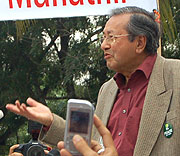 Dr Mahathir blamed the 1997 crisis on currency speculators, particularly George Soros. He conveniently forgot that his own government was also responsible for very expensive speculative failures when Bank Negara suffered multi-billion ringgit losses from its massive purchases of the sterling before the sterling's collapse in September 1992.
For Mahathir, it was the currency speculators, the West and the Jews which caused the 97 crisis but never his mismanagement.
Mahathir has been praised for saving Malaysia but lost amidst the laudatory praises is the question as to how did Malaysia end up in the 1997 mess in the first place? Was Malaysia's economy so pernicious that it took, only one man, Soros, to cripple Malaysia's economy?
Looking back, Dr Mahathir Mohamed should bear responsibility for the 1997 crisis for it was his own flawed policies, major failures in implementation and abuse in high places that created the mess. It took the 1997 crisis to lay bare his economic mismanagement.
Reevaluating Mahathir's legacy will show that although he had the hardware, in using the wrong software the drive has developed a major fault.
NORMAN FERNANDEZ is a practising lawyer and vice-chairman of DAP Johor.


