




COMMENT | Despite being 10,000km apart, Poland and M'sia have a lot in common
COMMENT | Poland and Malaysia are about 10,000km apart, nine hours direct flight time. Is this far? It really depends. Speaking of distance, it certainly is not close.
Two hundred years ago, it would take more than six months to cross by sailship. Today, we cover it in hours by plane or in a flicker with the internet. But it really depends on what we are looking for. Is it speed and efficiency or just the experience of travel, getting to know other lands, cultures and landscapes?
Back in 1986, it took me more than six months to complete a leisurely overland journey from Singapore to Malaysia, Thailand, India, Nepal and then across Tibet and the rest of China to Mongolia, across the USSR and back home to Poland.
The Malaysian leg of my journey I remember as taking place in a very well organised and well-run country, with excellent highways and comfortable buses. The image of friendly, smiling and polite people was the most memorable. In my mind, they became synonymous with Malaysia.
I came back five years later, this time on a stopover on my journey from Australia for a short visit to Tioman. I fell truly in love with its pristine beaches, lush tropical jungle and even with the monkeys one hoped to avoid when walking through the forest to the virgin Monkey Beach. That is why, when given a choice of three Asian countries to represent Poland in...
COMMENT | Poland and Malaysia are about 10,000km apart, nine hours direct flight time. Is this far? It really depends. Speaking of distance, it certainly is not close.
Two hundred years ago, it would take more than six months to cross by sailship. Today, we cover it in hours by plane or in a flicker with the internet. But it really depends on what we are looking for. Is it speed and efficiency or just the experience of travel, getting to know other lands, cultures and landscapes?
Back in 1986, it took me more than six months to complete a leisurely overland journey from Singapore to Malaysia, Thailand, India, Nepal and then across Tibet and the rest of China to Mongolia, across the USSR and back home to Poland.
The Malaysian leg of my journey I remember as taking place in a very well organised and well-run country, with excellent highways and comfortable buses. The image of friendly, smiling and polite people was the most memorable. In my mind, they became synonymous with Malaysia.
I came back five years later, this time on a stopover on my journey from Australia for a short visit to Tioman. I fell truly in love with its pristine beaches, lush tropical jungle and even with the monkeys one hoped to avoid when walking through the forest to the virgin Monkey Beach. That is why, when given a choice of three Asian countries to represent Poland in, I did not hesitate and chose Malaysia.
There was more to my choice, of course. For years, Malaysia fascinated me as an example of a “can-do country” so different from many others across the world. This, as a matter of fact, is what it shares with Poland, not just a similar surface area and more or less the same population size.
Both our countries have a similar historical experience of colonisation. In the case of Poland, it was 120 years of alien rule by the neighbouring states of Russia, Prussia and Austria that divided Poland and exploited it for their economic and political needs, just as the colonial masters exploited Malaysia.
We understand and share Malaysians’ attachment to their own language, culture, traditions and religion. We are equally attached to our sovereignty and laws. The more external pressures our two countries are subjected to, the more resilient we become.
One might ask how close are the ties between Poland and Malaysia, after 50 years of bilateral diplomatic relations, considering all the variables of traditions, religion, climate and way of life? Pretty close, in fact.
Appreciation of social similarities and of differences as well as a wonderment at the natural beauty of Malaysia was common among Polish visitors centuries ago, just as they are common today. Poles have been coming to Malaya as missionaries, travellers, soldiers and merchants.
Probably, the first Pole to come to the Malay Peninsula was the Jesuit missionary and doctor Wojciech Męciński, who in April 1635 arrived at the famous port of Malacca where he treated sick soldiers. Męciński spent two years in the peninsula before leaving for Macao.
Another well-known Polish clergyman who visited then British Malaya was Archbishop Władysław Michał Zaleski, a traveller and a botanist. One of his most important works was the book Travels in Indochina in 1897 and 1898, in which he described his impressions from meetings with local people and the development of the Christian faith in Malaya.
During his travels in Southeast Asia, he visited the island of Penang, where he admired, among others, the beauty of the newly created botanical garden. About Penang he wrote the following: "Penang belongs to the diocese of Malacca, which has 10,000 Chinese Catholics. As a tropical landscape, Penang is wonderfully beautiful. Everything is green and soaked in light." And it remains so today, I dare say.
Probably the best known Pole, a seafarer in Southeast Asia and world-famous 19th-century writer was Józef Teodor Konrad Korzeniowski (Joseph Conrad). In his writings, Korzeniowski often referred to Malay culture and the experiences from his stay in then-British Malaya.
The plot of his debut novel "Almayer's Folly" (1895) takes place on the eastern coast of Borneo and focuses on the main character Almayer - a Dutch merchant who wants to ensure his half-Malay daughter social status and wealth. Some of his other stories are also set in today’s Malaysia and Indonesia. Korzeniowski is considered as one of the first authors to introduce Southeast Asia to readers around the world.
During World War II, both our peoples fought on the side of the Allies. After the Japanese attack on Malaya in December 1941, three ships of the Polish Merchant Navy supported the British military operations. SS Kościuszko, SS Pułaski, and MS Sobieski, all luxurious liners, were used to transport British forces to Burma and India.
At the end of the war, MS Sobieski and SS Pułaski were assigned to take part in the invasion of the Malay Peninsula. This ultimately never happened as in the meantime Japan surrendered.
Unlike Malaysia, which gained independence soon after the war, Poland had to struggle for the next four decades to free itself from the neocolonial domination of the Soviet Union. It succeeded in 1989 and it was only then that political and economic relations between our two countries gathered speed.
Mahathir visited Poland in 2002
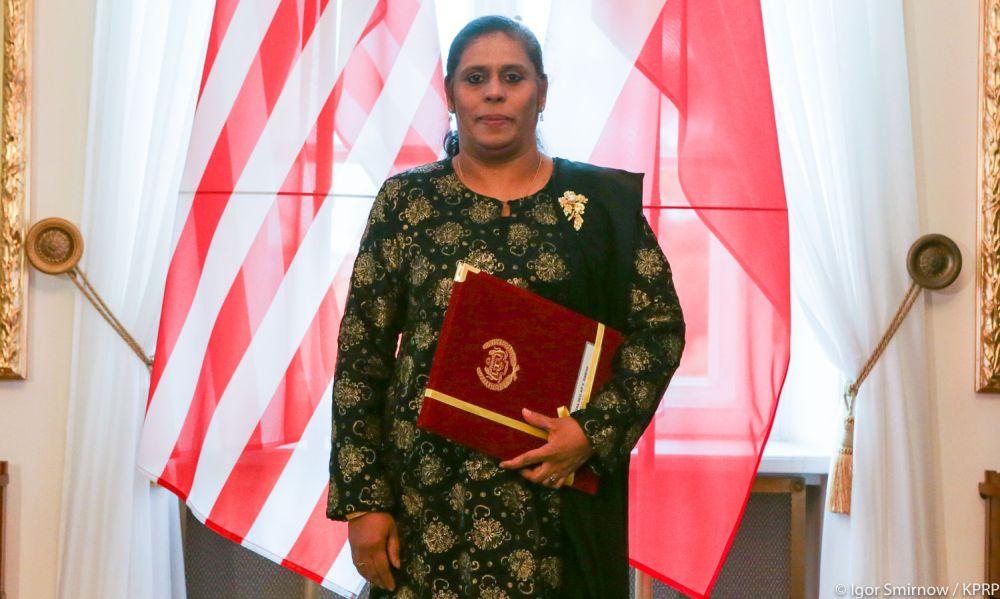
Visits at the highest level have intensified in the 1990s. His Majesty the King of Malaysia visited Poland twice, Poland’s president and two prime ministers paid visits to Malaysia. Dr Mahathir Mohamad, the longtime prime minister of Malaysia visited Poland in 2002 and was decorated with the Grand Cross of the Order of Merit.
In 2000, the first Honorary Consulate of the Republic of Poland was established in Kuching covering the states of Sabah and Sarawak, and in 2014, the Polish Honorary Consulate was opened in George Town. Today, trade and economic cooperation form the basis of our bilateral relations.
In 2011, the office of the Malaysian trade promotion agency Matrade for Central and Eastern Europe was opened in Warsaw and in 2018, the Polish PAIH Foreign Trade Office was established in Kuala Lumpur to actively promote Polish companies in the export of goods and services and in the implementation of investment projects.
In 2020, despite the pandemic, Polish-Malaysian trade grew to a record US$1.5 billion (RM6.2 billion). Malaysia remains Poland’s second-largest trading partner in Asean.

The main sectors of Polish-Malaysian economic cooperation include the electronics, chemical, machinery and agri-food industry. In recent years, cooperation in the halal sector has been gaining importance.
Since 2011, Malaysia has recognised the Muslim Religious Union in the Republic of Poland (MZR) as the body authorised to certify products in accordance with the principles of Halal Malaysia Islam. Since 2018, the Polish Halal Institute is the second Polish institution authorised to issue such certificates.
Poland is Europe’s largest importer of palm oil for use in the chemical cosmetic and food industry and much of it comes from Malaysia. The prospects for bilateral cooperation are bright. Poland’s economy, dynamic and resilient, survived very well the ravages of the Covid-19 pandemic and again entered the path of rapid growth as one of Europe’s top and fastest developing countries.
With 25 million of its 38 million inhabitants already vaccinated against the Sars-CoV-2 virus and the number of infected people steadily falling, the country is opening up. Malaysian businesspersons, tourists and students are most welcome.
In fact, Malaysian students have known Poland very well for many years now. Well over 1,000 Malaysians completed their education in Poland, most of them in medical studies. They are now among the frontliners keeping Malaysians safe during the Covid-19 pandemic. There is no better example of the close ties and growing cooperation between our two states and peoples.
PROF KRZYSZTOF DEBNICKI (photo at the top) is the Ambassador of the Republic of Poland to Malaysia and Brunei Darussalam.
The views expressed here are those of the author/contributor and do not necessarily represent the views of Malaysiakini.




Are you sure you want to delete this comment?
This action cannot be undone.