




Venice of the East to resurface?
The proposed Kra Canal fascinates the mind. The limits of human imagination are only bound by our very own mortality. Since the early civilisations and throughout the ages of human annals, we have achieved the apparently insurmountable and survived the unendurable. The earth's physical features have been re-designed and re-engineered to suit mankind.
It is not a novel idea and the Isthmus of Kra which is a narrow land bridge that connects the Malay Peninsula with the mainland of Asia has been in existence for generations. The eastern part of the land bridge belongs to Thailand; the western part belongs to the Thanintharyi division of Myanmar. To the west of the Isthmus is the Andaman Sea, to the east is the Gulf of Thailand. The Isthmus gets its name from the city of Kra Buri, in the Ranong province of Thailand. Thus, the Isthmus of Kra by divine design connects us to each other and with the rest of the world.
The proposed Kra Canal fascinates the mind. The limits of human imagination are only bound by our very own mortality. Since the early civilisations and throughout the ages of human annals, we have achieved the apparently insurmountable and survived the unendurable. The earth's physical features have been re-designed and re-engineered to suit mankind.
It is not a novel idea and the Isthmus of Kra which is a narrow land bridge that connects the Malay Peninsula with the mainland of Asia has been in existence for generations. The eastern part of the land bridge belongs to Thailand; the western part belongs to the Thanintharyi division of Myanmar. To the west of the Isthmus is the Andaman Sea, to the east is the Gulf of Thailand. The Isthmus gets its name from the city of Kra Buri, in the Ranong province of Thailand. Thus, the Isthmus of Kra by divine design connects us to each other and with the rest of the world.
King Narai the Great whom presided over the Golden Age of Siam had the foresight when he officially established diplomatic channels with foreigners. He had commissioned the French engineer de Lamar to survey the possibility of building a waterway to connect Songkhla with Mranma (Myanmar). Three centuries later the Kra canal is still intensely debated.
The 21st century may yet see Thailand opening up further to foreign participation. Ever rising oil prices, security issues, and the rise of China warrant this colossal project.
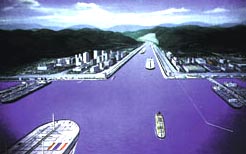 Recently, at two separate seminars involving the Armed Forces of Thailand, businessmen, academics and bureaucrats; a consensus in favor of the Thai canal Project emerged. The Royal Thai Navy leads the band of supporters as it hopes to re-establish its influence. Captain Soonpuen Soomaphi, spokesman of the Royal Naval Academy said:"The Thai Navy must take the lead, because Thailand is on both the Indian and Pacific oceans, and we have to realise our sea power and exercise it." Thus renewed political and economic interests will give life to this antiquated idea.
The total project cost is astounding. Numerous parties have offered to foot the bill but the government has the burden of responsibility to ensure that the process stands up to public scrutiny. Some have called it the mother-of-all-mega-projects with a never-ending story. Allegations of manipulation and corruption as well as economic downturns have stalled the construction of the canal.
The 1997 financial crisis plunged the Thai economy into debt with the IMF. Needless to say that the canal project was put aside only to resurface now in prosperous times for Thailand. Present day estimates put the cost of construction of the canal at approximately US$23 billion.
Deeper implications
Enter China. The construction of the canal has deeper implications for the global order as a new superpower rises. China's ascent hinges on her re-assertion of her maritime power. In the words of Zeng He "Admiral of the Western seas".
"We have beheld in the ocean huge waves like mountains rising sky-high, and we have set eyes on barbarian regions hidden away beyond a blue of light vapors, while our sails, loftily unfurled, day and night continued their course like that of a star, traversing the savage waves as if we were treading a public thoroughfare." (Louise Levathes, When China Ruled the Seas, The Treasure Fleet of the Dragon Throne , 1405-1433, Oxford University Press, 1996, pg. 75).
The 'string of pearls theory' conceives the setting up of strategic military and diplomatic bases along the major sea lanes stretching from the South China Sea to the Middle East. Power projection is what it is all about. The United States Military reports that Chinese posturing by militarily controlling oil shipping lanes via the Kra canal would lead to a 'climate of uncertainty'.
The Thai government however is more than happy to receive the Chinese as they pledge to underwrite more than US$20 billion for the Kra canal construction costs. China has even put the establishment of Chinese port facilities on the cards. Evidently the Thais are eager to play a role in the geopolitical game. The suspended free trade agreement talks with the United States and the recent coup d'etat in which the United States has cancelled millions of dollars in military aid to the Kingdom all make having an ally in China good sense. Hence the waterways of the Kra canal are the bloodstreams of an emerging beast.
The Straits of Malacca through which a third of the world's trade and half of its oil passes is the center of a heightened geopolitical struggle in the post Sept 11 era. The United States had at one point considered deploying special forces on high-speed vessels along the Straits to prevent piracy and terrorist threats. If the statistics of the Piracy Reporting Center of the International Maritime Bureau (IMB) are anything to go by then the justification for the Kra canal gets a bonus point. Proponents of the Kra canal argue that it would save up to between 3-4 days sailing time by avoiding the Straits of Malacca therefore benefiting the global economy. This would result in Malaysia and Singapore's port operations being seriously affected as observers note that the Straits would in time become a sleepy backwater.
Thailand's burning south is the other problem. The Muslim separatists once largely ignored by Bangkok and the majority of Thais have had the consequential effect precipitating the fall of Thaksin Shinawatra's government. Thus, the relentless explosions, fighting and unrest there has prompted the Thai government to look further north than Ranong. The relocation of the canal from the heart of the troubled region thus poses a catch-22 scenario for the Thai government. The new secure site would ultimately deprive the southern Thai Muslims of economic prosperity and community development that has so far eluded them, resulting in possible expanded clashes in the entire south.
Whatever the challenges, the importance of and pressing need for the canal to Thailand is evident. This time conditions may just be right for the Kra Canal.
IMRAN IMTIAZ SHAH YACOB is a broadcast journalist and a lawyer.


