




Vote of no confidence in Abdullah
That the prime minister is fast turning into a great liability for Umno and the Barisan Nasional (BN) government is a gross understatement. Abdullah Ahmad Badawi is precisely the reason why the BN will have a bad outing come the next general election.
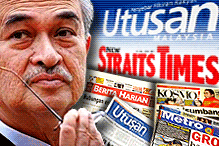
Call it what you will, but I see it as vote of no confidence in the beleaguered Umno president, perpetrated by none other than the party's supreme council members over the aborted attempt at merging Utusan Melayu and New Straits Times Press (NSTP).
Few may recall that Umno took over Utusan Melayu after an acrimonious battle with the editor and journalists in 1961 for control of the newspaper and, consequently, the mind of the Malays.
That the prime minister is fast turning into a great liability for Umno and the Barisan Nasional (BN) government is a gross understatement. Abdullah Ahmad Badawi is precisely the reason why the BN will have a bad outing come the next general election.
Call it what you will, but I see it as vote of no confidence in the beleaguered Umno president, perpetrated by none other than the party's supreme council members over the aborted attempt at merging Utusan Melayu and New Straits Times Press (NSTP).
Few may recall that Umno took over Utusan Melayu after an acrimonious battle with the editor and journalists in 1961 for control of the newspaper and, consequently, the mind of the Malays.
To recapitulate, Umno controls about 50 percent equity interest in Utusan Melayu, which publishes Malay-language dailies Utusan Malaysia and Kosmo .
Umno control over NSTP, however, has always been through a nominee group - the latest being Media Prima, which holds a 43 percent stake. NSTP publishes the English-language daily New Strait Times and Malay dailies Berita Harian and Harian Metro .
 Needless to say, the proposed merger would have been strategic for Umno as it would have paved the way for the BN to directly control all private TV stations through Media Prima, which now owns TV3, ntv7, 8TV and Channel 9.
The new entity would have come under the direct control of Umno which would have a monopoly of Malay-language newspapers - there would be a combined daily circulation of about 724,794 with a readership of about 4.6 million. A lot of money would also be consolidated within Umno's coffers through advertising revenue. This could arguably be advantageous to Utusan which is in need of cost-savings.
In an act that smacks of their flamboyant nature, both the prime minister and his deputy committed themselves and were pretty much for the merger exercise when it was mooted last month.
However, it sparked a raging debate within both Umno's grassroots support and leadership. Utusan Malaysia has for decades promoted the concerns and interests of Umno and its Malay Agenda. Some of the anxiety may be understandable in view of likely change of identity, although Abdullah had said that editorial independence would be retained.
Others felt that Utusan (read Umno) should now directly control NSTP and Media Prima through a reverse takeover, despite insufficient funds.
Internal rebellion
In what now seems to be interpreted as an Umno-style 'rebellion', the supreme council's decision - which voted overwhelmingly (43-8) against the exercise - can only be interpreted as the beginning of the end of Abdullah's presidency and premiership. 'Rebellion' by ministers like Rais Yatim and Rafidah Aziz is very telling and speaks volume of the fast-eroding confidence in Abdullah's leadership.
 His ineptness was accentuated when he admitted - rather obliviously - that the decision to abort the merger was perhaps the "best decision". How could he have taken such a diametrically opposed position? As amusing as it may be, it signifies his incompetent grasp of political events and global challenges.
Little wonder then that former premier Dr Mahathir Mohamad launched a series of vitriolic attack as soon as he noted the gross incapability of his hand-picked successor. Many have since added to the chorus of voices calling for Abdullah to resign before he is 'obliged' to do so by his party or better still, booted out democratically in a free and fair election. But will we ever have such an exercise?
The prolific writings of malaysiakini columnists on Abdullah's leadership are but a small sampling of the many rantings and critiques, since then amplified in the blogosphere, urging the premier to 'gracefully' step down in a sincere quest to mitigate damage to the nation both politically and economically.
Incidentally, bloggers must be ready for a severe backlash as they are seen as an irritation to unbridled authoritarian rule and unsurpassed excesses. The blogosphere and the alternative media have become a formidable threat to the unchallenged hegemony of the print and electronic media which have buried the truth under edifice after edifice of lies.
With the existence of the alternative media, those in power are no longer are able to simply hoodwink the once "bewildered herd" ( borrowing Walter Lippman's phrase) or the silent majority, who in a 'spectator democracy' can be used to "manufacture consent" ( Noam Chomsky Media Control).
 The defamation suit filed by NSTP and some of its executives against bloggers Jeff Ooi and Ahirudin Attan may herald the beginning of an end to Internet freedom. While we may not agree with everything they write, we must stand united to defend the little democratic space now available and to fight for our right to free speech and the people's access to alternative views.
Those in power will frighten us, terrorise us and intimidate us, so that we will be afraid and cower in fear. Let me invoke Voltaire, who wrote, "When the government is wrong, it is dangerous to be right".
In what is now seen as a face-saving effort, the NSTP-Utusan merger has been called off on grounds that they were unable to reach a scheme of merger that would be beneficial to both parties and their stakeholders.
This may be what they want the country and the world to believe, but not everyone can be fooled - it is, in fact, a pronouncement of a vote of no confidence in the premier. Period.
DR DZULKIFLI AHMAD is director of the PAS Research Centre.


