




Racial melting pot on the boil
Asia's melting pot, Malaysia, is celebrating 50 years of independence from British rule but against a backdrop of mounting racial disquiet fueled by race-based politics, redundant policies that divide and discriminate, and affirmative action that favours Malays over the Chinese and Indian Malaysians.
Even Prime Minister Abdullah Ahmad Badawi admitted recently that the major races that make up this unique country are drifting apart owing to racial and religious divisions and built-in discrimination.
''The situation is worrisome,'' he said in a televised address last December, appealing for racial understanding, tolerance and national unity.
Asia's melting pot, Malaysia, is celebrating 50 years of independence from British rule but against a backdrop of mounting racial disquiet fueled by race-based politics, redundant policies that divide and discriminate, and affirmative action that favours Malays over the Chinese and Indian Malaysians.
Even Prime Minister Abdullah Ahmad Badawi admitted recently that the major races that make up this unique country are drifting apart owing to racial and religious divisions and built-in discrimination.
''The situation is worrisome,'' he said in a televised address last December, appealing for racial understanding, tolerance and national unity.
Foreign travellers who only see peace, stability and development, are unaware that racism and discrimination pervade every aspect of Malaysian society.
The country's first-ever survey of race relations conducted last year confirmed that, below this faade, racism, discrimination and religious bigotry run deep.
For instance all political parties are race-based and champion the cause of their particular race. Playing the 'race card' is a sure and tried method to advance politically.
The education system is heavily segregated with nearly 90 percent of Chinese students studying in Mandarin-medium schools and as large a proportion of Malays preferring national schools or Islamic schools where the Malay language and Islam are emphasised.
Inter-racial mistrust, resentment and condescending attitudes are common features of daily life, as the race relations survey showed.
Despite these setbacks, nowhere in Asia can one find so many different races and cultures calling one country home. Besides the majority Malays, other racial groups include Chinese, Indians, Arabs, Europeans, Eurasians and dozens of ethnic and aboriginal communities.
A potpourri of religions co-exists from the majority Muslims to Christians, Hindus, Buddhists, Taoists, Sikhs and numerous native belief systems.
 "We co-exist, even live together but we live separately in our own worlds," said DAP lawmaker M Kulasegaran from the minority Indian community that makes up about 8 percent of the population of 26 million and is the most economically disadvantaged of the ethnic groups.
"The outward peace and stability is not built on justice or meritocracy but made possible by fear and other drastic measures. An expanding economy with tremendous wealth creation had hid the warts...as the economy slows, the warts are surfacing.
"We celebrate 50 years of independence as a nation but the people are further apart than ever. We don't know one another, we go to different schools, have people from our own races as friends and live separate lives."
Preferential treatment
Malays, making up about 60 percent of the population, were the most backward economically at independence in 1957 but, through a 'Malays-first' policies, have advanced on many fronts and today form a sizeable middle class.
Despite the advances, Malay wealth is in the hands of a politically well-connected elite while in the rural areas, the Malay poor predominate.
The Chinese who first arrived as labourers to work the tin mines, now form 25 percent of the population and are economically the most vibrant - controlling some 60 percent of the economy.
At the core of racial divide is the New Economic Policy (NEP), originally designed to eradicate poverty irrespective of race and to create wealth and ensure economic equality.
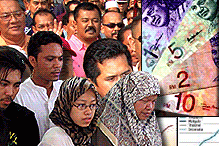 However, in its implementation, Malays have benefitted over other races - including in preferential employment, education, scholarships, business, access to cheaper housing and assisted savings.
Originally designed to last for 20 years, the basic policies have continued under different names, sparking envy and resentment between Malays and others, although the latter have come to accept the discrimination as the price of peace and stability.
But as the economy shrinks and wealth contracts and a new generation of Malaysians comes into their own, many are unwilling and unable to stomach the discrimination that is institutionalised.
"I was born here, I am a citizen, why should I be treated as second or third class?" asked law student Amarjeet Singh, who did not make it to a local university despite having good grades.
"We simple can't continue with these unfair policies," he told IPS .
Missing link
Even some sections of the Malay leadership led by former prime minister Dr Mahathir Mohamad have said that the unfair advantage have made Malays uncompetitive. He called the aid "crutches" in a major speech a year before he retired in 2003, calling for such assistance to be reviewed.
 Abdullah also believes that the "crutches'' have to go, but a class of Malays has arisen with powerful political clout who have enjoyed the privileges, see these as their birthright and demand their continuity.
Although the political will for major change is missing, the government has taken steps to close the divide. But critics say it is only curing the fever without eradicating the cause of the infection.
One experiment in racial integration is the 'Vision Schools' schools where students from all races share sports fields, assembly halls and canteens, but attend classes conducted in their own language.
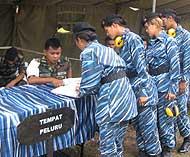 Another initiative is a compulsory National Service programme started in 2004 for those between 18 and 35 years of age.
It puts youths from different racial background under a single roof. Trainees are currently chosen at random and taken to camps for three months to learn teamwork and about one another's cultures.
But the experts say racism is too deeply entrenched in official policies and the socio-political system for such "half hearted" measures to make an impact.
On the political front, opposition icon Anwar Ibrahim, on a political comeback after six years in prison, is campaigning on a platform offering affirmative action for all needy Malaysians and an end to race politics. But it will be left to the voters to decide.
- IPS


Are you sure you want to delete this comment?
This action cannot be undone.