




Death knell for democracy and morality
Machap was still a convincing win for Barisan Nasional (BN). It was a gallant battle by DAP despite being overwhelmed by the sheer size of BN's election machinery.
But, the by-election signified the cruel death of true democracy and morality. It was an election where winning was everything. A victory that costs us our morality is not something that we should celebrate.
Machap was still a convincing win for Barisan Nasional (BN). It was a gallant battle by DAP despite being overwhelmed by the sheer size of BN's election machinery.
But, the by-election signified the cruel death of true democracy and morality. It was an election where winning was everything. A victory that costs us our morality is not something that we should celebrate.
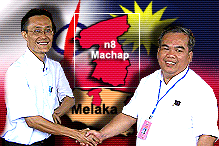 The aftermath of the Machap by-election serves us with several key observations. It is important that we take serious note of its implications before society descends deeper into moral decay.
First, it was clear that some of the politicians involved in the by-election campaign sought to equate technicalities to rights. In Machap, the announcements and pledges of new projects and development funds are considered technically acceptable because they are apparently made by politicians who act in their capacity as ministers.
Technically, they acted within the ambit of a responsible and caring government. But a technically correct decision does not make it morally right. More so when these politicians are representing a coalition party whose candidate was directly seeking to be elected by the voters.
What we have witnessed was an effect of valueless and amoral materialism rearing its ugly head through developmental politics. In this regard, winning is more important than morality and good values.
'Useless' EC
Another dilemma faced by the concerned public is the lack of a mechanism to check on abuses of our democratic processes especially the conduct of a free and fair election. The Election Commission (EC) is seen as a mere administrator and tool of the ruling elites to run elections in order to legitimise their hold on power.
It is neither a watchdog nor a guardian of democracy in the country. Its lack of moral compass is evident when the commission chairperson Abdul Rashid Abdul Rahman said that development promises by ministers to voters during an election could not be construed as vote-buying. The promises made are not wrong but the timing when they were made is wrong. It is hard to understand why Abdul Rashid failed to see that a conflict of interest existed here.
The 'uselessness' of the EC was cemented when he had also said that vote-buying was not the EC's problem, and that it was for the Anti-Corruption Agency (ACA) to investigate.
However, the blame should not be shouldered by the politicians only. Members of a society who are willing to tolerate, preserve and coexist with a bunch of morally deficit politicians and are willing to be bribed are equally guilty.
It is a hard and bumpy road ahead in our efforts to press for more transparency and accountability. The fight against corruption is a lonely battle especially when a large segment of the society is growing fonder of the act of developmental politics or to put it more crudely vote-buying.
We can expect a similar trend being repeated at the Ijok by-election. Already the state government has announced a windfall of RM36 million for various development projects in the area. History is set to be repeated and the opposition will again go howling to the EC and demand for action to be taken against BN. It will be an act in futility.
Since the opposition is not our answer to solve this lack of morality issue because they are equally entrapped in the cat-and-mouse game, surely there must be something we can do to correct the current situation.
More talk and action
The responsibility has to rest on the shoulder of our nascent civil society. The civil society has to do more talk and more action. Civil society organisations, backed by civic conscious media groups, have to organise more awareness campaigns on the ills of corruption and abuse of power. This should start at the grassroots level and start them as young as possible. Sad to say, with limited resources we may have to give up on the ones who are already entrenched in their mindset with the kickbacks of the current system.
We do need more Haris Ibrahims, Malik Imtiazs, Marina Mahathirs, Farish Noors, Azly Rahmans, James Wongs, Jeff Oois and others. We do not need to agree with all their individual views but nonetheless the effort put in by these activists have contributed to the diversity of views and the opening up of our civil space to dissent and criticism.
For the rest of us who do not have the energy and passion of these activists, we can do something for our own family. To inculcate good moral values in our children, we should not leave it to the schools alone. The lesson should start at home. Parents who are concerned about their children's education e.g. how to enroll them into the best schools should be equally concerned about the kind of society they want their children to grow up in later.
Hence, we should stop being myopic and self-centered. As good citizens of this country, it is timely that we take more serious interest in its affairs. Politicians who are keen to rule must ensure that they do not misrule. We must make sure these politicians keep their pledges.
One immediate challenge for them is to reject racial compartmentalisation in our race-centric political model. Racial politics created race affirmative policies which are prone to abuse and corruption. Hence, both the opposition and non-Umno component parties must start to rethink their political model and take the first step to end racial politics by making themselves multiracial.
It is a tall order to hope for a dominant racial party such as Umno to start the ball rolling. However, the party will be forced to change its perspective and behaviour if it finds itself no longer dealing with race-based political parties within BN or outside the coalition.
Would anyone dare pick up the gauntlet?
KHOO KAY PENG heads a political think-tank.


Are you sure you want to delete this comment?
This action cannot be undone.