




Mission 2057, a delayed Vision 2020?
Many Malaysians are happy that Prime Minister Abdullah Badawi has found his new marital bliss. He told the nation a happy prime minister makes a good prime minister. We fully agree with him. I am sure the prime minister agrees that a good prime minister is one who puts the interests of the multiracial Malaysian society close to his heart.
At the recent Umno 60th anniversary celebration, Abdullah touched briefly on his Mission 2057. He said the mission would become the development guideline for another 50 years. Although he did not specifically say how, I believe the document is now being drafted by ISIS to be released just before the 50th independence celebration. The blueprint will be a continuation of the Vision 2020. The verdict is still out there if we can achieve the objectives and targets set out in the Vision 2020.
Many Malaysians are happy that Prime Minister Abdullah Badawi has found his new marital bliss. He told the nation a happy prime minister makes a good prime minister. We fully agree with him. I am sure the prime minister agrees that a good prime minister is one who puts the interests of the multiracial Malaysian society close to his heart.
At the recent Umno 60th anniversary celebration, Abdullah touched briefly on his Mission 2057. He said the mission would become the development guideline for another 50 years. Although he did not specifically say how, I believe the document is now being drafted by ISIS to be released just before the 50th independence celebration. The blueprint will be a continuation of the Vision 2020. The verdict is still out there if we can achieve the objectives and targets set out in the Vision 2020.
However, he did mention the government would continue to ensure that culture, harmony, unity, cooperation and tolerance in religion be continued as value-added to the country's achievement. He stressed attention on human capital enhancement and cultural and artistic development too.
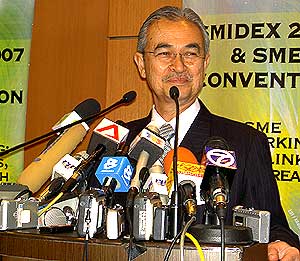 I am delighted Abdullah has invited the participation of the people in formulating the long-term mission. To be more inclusive, the government wanted the people including opposition parties, women, youths, professionals and non-governmental organisations (NGOs) to discuss and provide views for the country's future. With this invitation, I would like to start the ball rolling on what should be included in the Mission 2057 blueprint to ensure that it represents the interests, needs and aspirations of a fair, just and harmonious Malaysian society.
Just and harmonious society
The most important element in the Mission 2057 would be to ensure the continuous socio-economic and personal development of a truly fair, just and harmonious Malaysian society, assuming that the objective to create a Bangsa Malaysia (Malaysian nation) in Vision 2020 is met. It is very important for the government to address the pressing and growing intra-community income gap which leads to disgruntlement and other social issues.
I acknowledged that any programme aimed at restructuring a society is a long haul process. Hence, the government should start now by recognizing the problem and make necessary adjustment from a socio-economic policy which is race centric to one which is class centric. It takes a stubborn denial syndrome not to admit that the present policy has failed to address the intra-community income disparity.
The government should compute how much wealth is being held by the hundred richest individuals of each community in the country. This will provide a good indication on the concentration of wealth in the hands of a few and to quash the myth that all Chinese Malaysians are rich and all Bumiputera are poor.
Second, the prime minister expressed his hope that Umno will grow strength-to-strength for the next 50 years to ensure the rights and needs of the Malays are protected. Understandably, he said this at the 60th anniversary of Umno but the Mission 2057 is supposed to hinge on the extension of the Vision 2020. At the assembly, he was addressing a particular crowd from a particular community. However, the Mission 2057 is supposed to be a public blueprint containing aspirations and hope shared by all Malaysians regardless of ethnicity or creed.
On the contrary, if the objectives of Vision 2020 are met the current political model should similarly undergo a proper adjustment to ensure that political parties by then represent Malaysians and championing the rights of all Malaysians regardless of wealth ownership or social status. I hope the Prime Minister can give us his assurance that a truly united, fair, just and harmonious Bangsa Malaysia can be achieved by year 2020.
Religious tolerance
Third, Abdullah mentioned religious tolerance as a value added to our material progress. Apart from tolerance, I hope the Prime Minister will call for mutual respect and continuous dialogue between religious leaders of various faiths. To many people, religion is a channel to glorify God and to form a spiritual bonding between them and God. Nevertheless, their methods, interpretations and spiritual approaches do differ.
Here is where a mutual understanding of each other's religion is helpful. Unfortunately, many of us find interfaith dialogue a dirty word or a ploy to subservient our religion. In a human world, mutual understanding can only be forged through sincere, respectful, open and flexible dialogue. Any party to a dialogue seeking an exclusive position for the faith it represents will ensure the breakdown of a dialogue. Our problem is many of us are seeking for such exclusivity either egoistically or emotionally in the absent of reason.
On this part, Abdullah introduced his version of civilisational Islam or 'Islam Hadhari' aiming at interpreting Islam in the modern context of 21st century. He insisted that Islam Hadhari is not a new branch of Islam but merely seeks to interpret its values in the right time period. This is a very important point. It is undeniable that the interpretation of Islamic values and lessons in the 14th century has to be different from Islam in the 21st century. Such flexibility is not only good to its followers but to ensure the religion remains evergreen and relevant.
In Malaysia, apart from the communal divide, perpetuated from the colonial era, religious divide appears to be showing a more distinct crack with Muslims and non-Muslims on the opposite sides. For example, the federal court judgment against Lina Joy unavoidably dragged in both the Christian and Islamic religious bodies and their followers. Some parties alleged that the spirit of the federal constitution is being interpreted along religious belief. The issue of judicial and legal authority is set to become one of the biggest stumbling blocks in our quest to create a united, just, fair and harmonious society.
Dual legal system?
The Mission 2057 should address this socio-religious divide and the question of legal authority. Should Malaysia create a dual legal system one for the Muslims and the other for non-Muslims? Or should we continue to accept and respect the federal constitutions as the supreme law of the land and the civil courts as religious-free courts where justice is meted out regardless of race or creed? As the world is becoming more pluralistic, the urge to coexist harmoniously must become stronger. Otherwise, peace and harmony will elude us.
Fourth, the Mission 2057 should strive to strengthen the democratic institutions in the country to ensure that democracy continues to flourish. Unless Francis Fukuyama is proven wrong, I foresee us practicing a democratic system beyond year 2057. According to Fukuyama, the state that emerges at the end of history is liberal insofar as it recognizes and protects through a system of law man's universal right to freedom and democratic insofar as it exists only with the consent of the governed. We must ensure the rights promised to us at the birth of the nation and enshrined in the federal constitutions remained protected, respected and dispensed at all times.
Finally but not exhaustive, I fully agree the emphasis put on human capital enhancement. A respected statesman told me that the main failure of the affirmative action is the lack of emphasis on skills development of the Bumiputera community especially the Malays. As a result, many of them are not able to capitalize on opportunities given by the government through grants, subsidies, licenses and projects. Featured almost daily are news about abandoned projects, shoddy constructions, poor management and maintenance works and others. We do not need a rocket scientist to tell us the sign.
Malay entrepreneurs who are able to acquire the necessary skills to capitalise on the opportunities given have succeeded. With the right attitude and skills, they will succeed regardless of the affirmative policy.
Hence, the government should focus on human capital enhancement with the primary focus of uplifting the skills and knowledge level of our human resources. In the advent of globalization, the only way for a country to progress in to actively innovate and create specialized knowledge. Our ambitious projects of the various economic development corridors would be the first to welcome local skilled workers.
With slightly more than two months away before the announcement of the Mission 2057 blueprint, I hope the prime minister will launch an extensive dialogue with all stakeholders, as promised earlier. I would like to urge Malaysians to speak out and exercise your rights to dictate the kind of society you want to live in be it in the next five years or 50 years.
Politicians must be made to walk their talk.
KHOO KAY PENG is an independent policy and political analyst.


