




True 'daughter of the east'
As a child, I would feel all the feverish excitement of ushering in yet another year, countdown and all.
But with passing time, I would worry, wondering on what note the year would end and what the following year would unveil.
On Dec 27, 2007, I was left speechless when former Pakistan premier Benazir Bhutto was assassinated. She was someone I truly admired.
As a child, I would feel all the feverish excitement of ushering in yet another year, countdown and all.
But with passing time, I would worry, wondering on what note the year would end and what the following year would unveil.
On Dec 27, 2007, I was left speechless when former Pakistan premier Benazir Bhutto was assassinated. She was someone I truly admired.
Rawalpindi, where she was gunned down after a political rally, was also the city where her father Zulfikar Ali Bhutto - who founded the Pakistan People’s Party (PPP) - had been executed after being ousted as prime minister. Benazir - his beloved ‘Pinky’ - took over the party.
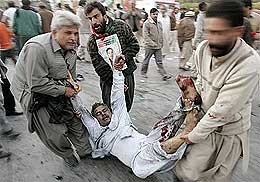 My heart sank on Oct 18 when she returned to Pakistan from London and immediately faced the first attempt on her life. But typical Bhutto that she was, Benazir came out of that incident, which left 140 people dead, more determined to champion the people's rights and to continue her father's fight to restore democracy.
After the attack, Benazir visited her father's tomb in the family mausoleum. It was perhaps her way of seeking his blessings and telling him she would do all she could to ensure that both the PPP and the Bhutto struggle would prevail.
Barely two months later, she lies buried next to her father and her two brothers, her struggles to restore democracy and fight Islamic extremism an unfinished business.
She had earlier admitted that her three children were worried for her safety, but had told them that being a Bhutto means displaying nothing less than courage.
Nevertheless, in an interview with India's Outlook magazine in Dubai in 2006, Benazir said she hoped her children would choose a different career path.
"Even though I come from a political family with a strong sense of duty to my country I would strongly advise my children to stay away from politics, to serve the country in other ways. As a doctor, a social worker, anything," she said.
That wish was not to be - her son, 19-year-old Bilawal, has just been named chairperson of the PPP.
Belief in democracy
During her two short stints as prime minister, from 1988-90 and 1993-96, Benazir made a commitment to improve the lives of people, especially women. While she had many plans in mind, only a few were translated into action because her party was too busy tackling opposition rebuttal of her government.
Benazir might have been loved by thousands but she also made enemies. She was admired by the West for her liberal outlook and frank and vociferous attacks on militants and terrorists.
She was not one who minced her words. She was intelligent, very sharp and politically shrewd to take on male detractors within the country’s violence-laden politics.
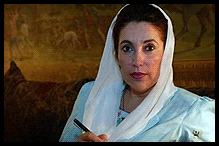 Benazir went through a steep learning curve while at Oxford and Harvard University, a period that she described as the "four of the happiest years of my life" and which had formed "the very basis of my belief in democracy".
"I was a very shy girl who led an insulated life. It was only when I came to ... university, that suddenly I saw the power of people. I didn't know such a power existed. I saw people critising their own president. You couldn't do that in Pakistan, you'd be thrown in prison. I saw the press take on the government,” she said.
"I was determined to go back home and to give my people the freedoms and the choices - the individual dignity which I saw my college mates and everyone else in the West have. That early education influence has profoundly affected my outlook on life."
Time, to her, was her most important ally and that would explain why she tirelessly conducted rally after rally to reach out to the people and win their support for a third term as premier.
Benazir never hid the fact that she had received death threats, but did not use this as an excuse to bolt out of the country and live comfortably elsewhere. In her own words, her heart had remained in Pakistan throughout her self-imposed eight-year exile in London.
She was once listed by People magazine as one of 'The Fifty Most Beautiful People'. Her charisma and persona made her existence larger than life. She was not only adored but idolised by many.
Benazir Bhutto, a woman extraordinaire who wanted to be an ordinary leader for ordinary people, will never be forgotten. She lives on in the hearts of those who love her.
May this courageous 'daughter of the east' and mother rest in peace. And may the coming year and the years after that bring peace into the hearts of everyone.
JJ RAY started her career with a mainstream publication. A non-conformist, she soon saw the barriers that went up whenever, through her writing, she tried to make the world a home for one and all.


