




Rising to challenges or denial? (Pt 1)
The past year has been a tumultuous one for Malaysians. Despite the economy doing well with booming oil and gas revenues and soaring primary commodity export values, and the achievement of a milestone as the nation reached its 50 anniversary of attaining independence, the mood of the country has turned somber, and amongst some segments of the population, sour and negative.
The past year has been a tumultuous one for Malaysians. Despite the economy doing well with booming oil and gas revenues and soaring primary commodity export values, and the achievement of a milestone as the nation reached its 50 anniversary of attaining independence, the mood of the country has turned somber, and amongst some segments of the population, sour and negative.
Increasingly, many observers are becoming pessimistic at the prospect for future peaceful development and steady progress if current trends in the country continue. This picture of a country racked in anxiety and dissatisfaction on many aspects of nationhood that neighboring countries feel at greater ease with - or take for granted - runs counter to the official depiction of a harmonious and unified multi-ethnic and multi-religious country that the government and its supporters are keen to convey to Malaysians and the rest of the world.
What has gone wrong during the past year, and where is the responsibility for the fault lines that have widened on key aspects of the country’s fragile social cohesion? On the religious front, concerns over an increasingly assertive and illiberal Islamic state system intruding into the religious rights and freedom of other faiths have been steadily increasing amongst non-Muslims.
 In late 2005, the public’s attention had been riveted on the case of mountaineering hero, Moorthy, a Hindu who was converted to Islam literally on his death bed and - against the wishes of his family - was buried as a Muslim. The Lina Joy case saw an attempt by an ordinary citizen wishing to exercise her right to conversion from Islam to Christianity reflected in the removal of her Islamic religious affiliation in her identity card finally rejected by the country’s highest court of appeal.
The handling of both cases by the authorities only served to aggravate already mistrustful relations between Muslims and non-Muslims, especially Hindus and Christians. It also seemed to mark a decisive encroachment by Muslim zealots on the secular character of the country’s constitution and signaled the increasing willingness of Umno, the ruling party, abetted by its supporters in key institutions such as the judiciary and bureaucracy, to use the religious card to ensure continuing political support from the Malay/Muslim population.
On the racial front, it is not surprising that the most significant event of the year was sparked by the rising sense of religious (and racial) marginalisation and discrimination felt by some segments of the population. What is perhaps surprising is that this particular event took so long to materialise.
Communities displaced
Amongst the various minority ethnic and religious groups in the country, no other community (apart from perhaps the Orang Asli and other smaller non-Bumiputra indigenous minorities) feels a greater sense of being neglected and left behind in the country’s progress than the Indians. Despite the one-sidedness of the official statistical system in focusing on bumiputera poverty and bumiputera lack of participation in the modern sectors of the economy, there is sufficient quantitative and qualitative evidence to show that poor Indians (and possibly those from the middle-class too) are falling back in key aspects of economic and social life.
A recent report to the Government containing proposals for the Ninth Malaysia Plan had identified the plight of low income Indians as one of the main issues that needed urgent attention by the authorities.
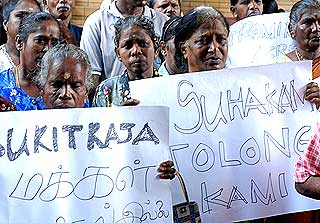 In analysing the lack of effectiveness of government measures and earlier plans to address the socio-economic problems of the Indian community, it is noted that these problems are rooted in the displacement of the community from the plantation economy. These plantation communities, scattered all over the country, earned low wages (although above the official poverty line), lived in poor conditions without adequate facilities, experienced low levels of health care and had their children educated in poorly equipped Tamil primary schools.
Government rural development programmess in the 70s and 80s never reached them or provided assistance to small token numbers. Though the government regularly promised that specific strategies would be adopted to improve the livelihood and quality of life of the plantation population, little was done to improve their lot.
Despite the country recording impressive economic growth in the last four decades, the largely Indian plantation communities were not only left behind but had become victims to the overall national development. Over 300,000 Indian poor had been displaced after the plantations that traditionally provided them modest livelihoods were acquired for property and township development or changed hands in other ways in the last two decades.
When evicted from the plantations, these workers not only lost their jobs; they also lost housing, basic amenities, socio-cultural facilities and their community support system built up over a long period of time. Another significant blow was the loss of access to plots of vegetable farming and cattle grazing land allotted by the companies to workers to cultivate and supplement their modest incomes.
Unprecedented public rally
It was not unexpected therefore that these people would face difficulties and hardship in negotiating the transition from the plantations to urban living. The displaced plantation communities, with few skills and little savings, have swelled the ranks of urban squatter settlements and the urban poor.
Most of these communities have began and ended in lower rung jobs, competing with foreign migrant workers for meager incomes. Despite the very large number of Indians involved in this involuntary stream of migration and full awareness by the authorities of the traumatic impact of their displacement – it has been known for some time that suicide rates are the highest amongst Indians and that many Indian youths have turned to gangsterism - little has been provided by government in terms of concrete assistance in the same way that the Malay poor has been targeted.
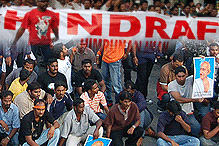 The combination of socio-economic exclusion and deprivation together with repeated disrespect of Hindu religious rights by state authorities in demolishing Hindu temples and shrines (many of these temples and shrines were set up during pre-independence days on private plantation lands which had since been transferred to state ownership) has become a powerful rallying point for Indian activists who have lost faith with the MIC.
Banding themselves in an organisation called Hindraf this - until recently virtually unknown - organisation appears to have precipitated a chain of events that has had the greatest political impact during the year.
Despite Hindraf cranking up the pressure internationally, the authorities continued to pay it little attention. This failure to appreciate the gravity of the situation and the deep sense of discrimination and marginalisation amongst poor Indians quickly changed when Hindraf called for their rally in Kuala Lumpur on Nov 25.
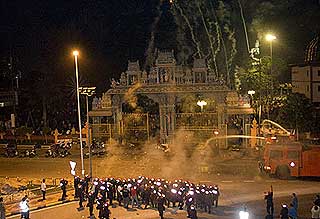
The dramatic police crackdown on the Hindraf rally - and its aftermath in the use of the draconian Internal Security Act to imprison the five leaders of the movement indefinitely without due process - is now part of the political lore of the country. I
Its ripple effects, however, are already visible and are likely to continue for some time. In particular, the ability of the movement to bring together as many as 40,000 supporters (thousands more from other states and outside Kuala Lumpur were prevented by police road blocks from reaching the rally) in defiance of a legal order is unprecedented in the recent history of the country.
Government lambasted
The official view continues to be of a small group of political malcontents and mischief-makers using race and religion to whip up popular sentiment for issues and causes that have little or no basis in reality.
This, however, is being contradicted by the extensive damage control campaign that the government and its supporters have mounted since the rally.
Although the Barisan Nasional has attempted to provide the impression of a closing of ranks on the prime minister’s decision to crack down on Hindraf and his warning on the use of state force and power against dissenters, there is a considerable body of opinion within the ruling party itself that the government has over-reacted.
 Prominent Umno backbencher and Kota Baru Member of Parliament Zaid Ibrahim – who also runs one of the biggest legal firms in the country – has argued that demonstrations should not be treated as a challenge or threat.
He further argued that although he did not agree fully with Hindraf’s demands, the government had indeed failed to address issues such as the series of religion-related controversies involving converts, demolition of temples and the perceived Islamisation policy.
A leader of another component party of the BN was even more forthright. In his scathing public statement entitled ‘Discrimination from Womb to Tomb’ S Paranjothy – the Gerakan Youth deputy chief - criticised the government for its policies towards the Indian community.
Pointing out that Indians form the most neglected group in economic terms, he lambasted the Government for treating them ‘as fourth-class citizens’ and pointedly stated that ‘where the Indians predominate over their fellow Malaysians is mostly in prison, violent crimes, gangsterism, suicide and social ills [as] government policies have failed to improve (their situation)’.
Part II: How will the government react?
DR LIM TECK GHEE is director of the Centre for Policy Initiatives. The above is the first part of a summary of a paper he presented at Singapore’s Institute of Southeast Asian Studies Regional Outlook Forum 2008 earlier this month.


