




Wake up Indian women! It's your field day!
Every Malaysian, whether he/she is registered to be a voter or otherwise is debating heatedly over what they think to be the issue with regards to the 12th General Election of Malaysia. The recent incidences are playing a greater and undeniable role in making up their minds. But the date, 8 March 2008 of the said election touches a cord in my memory.
In the election fever no one seems to be talking about this special date. It is the International Women’s day. Every concerned women activist will talk and reiterate about gender equality, gender sensitisation, gender aspirations, breaking the barrier of the glass ceiling and so on. All is well if it is just a jargon.
Every Malaysian, whether he/she is registered to be a voter or otherwise is debating heatedly over what they think to be the issue with regards to the 12th General Election of Malaysia. The recent incidences are playing a greater and undeniable role in making up their minds. But the date, 8 March 2008 of the said election touches a cord in my memory.
In the election fever no one seems to be talking about this special date. It is the International Women’s day. Every concerned women activist will talk and reiterate about gender equality, gender sensitisation, gender aspirations, breaking the barrier of the glass ceiling and so on. All is well if it is just a jargon.
But what about working towards application in the election realm? How many parties are ready to field women candidates? What percentage of increase in women candidacy that every party can assure of?
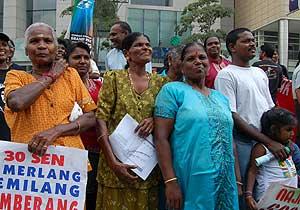
 Coming back nearer home myself being an Indian woman, I wonder how many of the parties will field Malaysian Indian women? While we agree some are strictly Malay or Chinese ethnicity based parties what about Indian based parties and multi-racial parties such as Malaysian Indian Congress (MIC), People’s Progressive party (PPP), Gerakan and Democratic Action Party (DAP) and Parti KeAdilan Rakyat (PKR)?
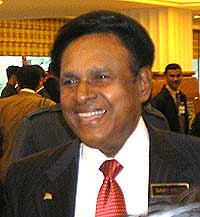
When I take a trip down the Malaysian election history, I can’t but take my hats off to Malaysian Indian Congress (MIC) and its current president Samy Vellu. Ok, ok don’t charge. Hear me out first as to why I say that.
Indian women senators
Even today we are still fighting for more women to come into leadership positions and decision making offices. And that too finding Malaysian Indian women in such status is a far cry. First of all they are victimised as women and secondly they are victimised as Indian women. Reasons that are lame or otherwise are attributed to many factors – family, culture, traditional, religious and many more.
 But some how MIC and its current president seem to have placed their trust in women. The very first Indian woman senator was Puan Sri Janaky Athi Nagappan (1980 -1986). Who appointed her to that position boldly when there was no precedence set in the Indian community? Of course it was Samy Vellu.
Since then came the never hindered stream of MIC women senators Datin Valli Muthusamy (1986 – 1990), Puan Sri Sarasa Pasmanickam (1992 – 1998), Datin Paduka Jaya Partiban (1999 – 2005) and now the current Senator Logachitra Gopalakrishnan (2007).
How many other parties with Indian membership have appointed Indian women senators? As far as I know it was Gerakan that appointed Dato Rhina Bharr (2004 -2007) to be senator for one term. Other than that none comes to my mind. Why? Don’t we have Indian women members in our Indian based or multi-racial political parties?
Indian women in state assembly
When we come to fielding a Indian women candidate either for a state seat or parliamentary seat as well, the same scenario prevails. Again it is MIC, which has started fielding Indian women candidates for the state as well as parliament positions.
The very first woman to contest for a state seat was Tan Sri Devaky Krishnan (1959), as MIC candidate under the Alliance ticket in Sentul DUN area. In 1990 election, Datin Valli Muthusamy stood in Prai. Both had lost. But then it never stopped the president or the party from fielding women candidates for the state seats.
Kamala Ganapathy was fielded for Kota Raja in 1999 and she won. Then she was fielded and won in the Sri Andalas seat in the 2004 election and again she is being fielded for the same Sri Andalas for this 2008 election as well. Now for the 12th General Election two more woman Mrs Thangeswari (Hutang Merlintang, Perak) and Mrs Murugesvary (Tenggaroh, Johore) have been fielded for state seats.
Incidentally, Kamala Ganapathy is also the first Indian woman who has become a member of a State Exco (2007). Other than MIC, it was only Party Socialist (opposition) that fielded once an Indian woman candidate in Puan Ganga Nair who won the 1966 election in Selangor. After her, no more Indian women candidate has been roped in by any other political party other than MIC.
Indian women in Parliament
When we look at the scenario of the parliamentary seats, there too we see the same trend prevailing. MIC and Samy Vellu seem to be the trail blazers. Dr Leela Rama was the first Indian woman to be fielded for a parliamentary constituency in the 1995 elections for Kapar, which she won. She was the first Indian woman MP.
 After her, Komala Krishnamoorthy stood for the same seat in the 1999 and 2004 general elections and won. Komala is the second Indian woman who has become the Member of Parliament. She is also the first Indian woman to be with the government position of being the Parliament Secretary to the Ministry of Education.
I am not saying that whatever is accorded to Indian women in MIC is just sufficient. But then what is happening to other parties, their leadership and members? Is there a denial that women are not good for elected positions? Or aren’t there any Indian women members in their respective parties? How do they explain this exclusion syndrome? If women are discriminated in society, the Indian women are doubly discriminated in these parties.
So women, think wisely and cast your votes prudently. Or if you fall for the colourful political rhetoric and hypocritical show of eloquent and vocal fight for the cause of women ... you are your own enemies!
(My grateful acknowledgement goes to Tan Sri Devaky Krishnan, Puan Sri Sarasa Pasamanickam, Datin Paduka Jaya Partiban, YB Kamala Ganapathy, Dr Leela Rama, YB Loga Chitra Kobalakrishnan & Mr Chandrakantham of Tamil Nesan for their input)
JASMINE ADAICKALAM is Yayasan Strategik Sosical (YSS) Service Consultant.


