




Rough justice again for Anwar?
When asked about Anwar Ibrahim’s sodomy allegation, I was tempted to rule out any political motive initially but the development of the case has made me change my mind. Both sides of the political divide have politicised the issue to the benefit of one and detriment of the other.
When asked about Anwar Ibrahim’s sodomy allegation, I was tempted to rule out any political motive initially but the development of the case has made me change my mind. Both sides of the political divide have politicised the issue to the benefit of one and detriment of the other.
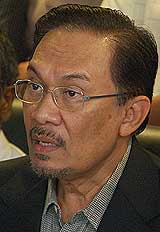 Members of Anwar’s coalition Pakatan Rakyat (PR) have charged the ruling regime for conspiring with his accuser, Saiful Bukhari Azlan, and the police for derailing Anwar’s plan to take over the federal government by Sept 16. Saiful is painted as an opportunist and the puppet of a certain leader who is also beleaguered by damning accusations.
Moreover, Saiful has appeared very gung-ho and even challenged Anwar to an Islamic swearing to prove his innocence. Saiful’s actions do not help strengthen his case as his behaviour contrasts with other traumatised sexually abused victims.
Since then, the PKR de facto leader has benefitted from a surge in popularity and public sympathy. Anwar is the clear winner in public perception. Reeling from the first sodomy charge against him 10 years ago and the lack of public confidence in key institutions in the country, this accusation is less sticky and has lost an element of surprise. The public did not react in awe but instead grew tired of such political drama.
Dramatic arrest
The manner in which Anwar was detained outside his house by a special task force in balaclava before the police deadline, delivered a crucial blow to the police’s already battered public image. Despite Federal CID director Mohd Bakri Zinin’s claim that Anwar might renege on his promise to show up, the action was still too dramatic. Anwar is a well-known politician and not an undercover terrorist.
Strategically, it is no surprise if Anwar were to announce his candidacy in a parliamentary by-election in the near future. Riding on the wave of his popularity and public sympathy, he is widely expected to win hands down.
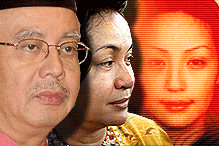 In contrast, Deputy Prime Minister Najib Razak’s wife Rosmah Mansor was accorded different treatment when the police went to take her statement. She was treated, rightly so, courteously. Meanwhile, Najib was not even required to give his statement although the manner in which two statutory declarations were filed on two consecutive days by an important witness, private investigator P Balasubramaniam, was highly suspicious.
In Anwar’s case, the police are now looking at legal options to compel him to give his DNA to them. However, with nothing much revealed in Raja Petra Kamarudin’s statutory declaration against Rosmah, the police have detained the former and charged him with a criminal defamation offence.
Since these cases involve important public figures, the police should hold a public conference to explain and divulge the details which led them to their conclusions. Both cases have a similarity – based on accusations – but were treated very differently by the relevant authorities. The police should convince Malaysians that they will act without fear or favour.
Credibility deficit
Politically, the Barisan Nasional will continue to suffer from the perception gap and credibility deficit. It cannot afford to politicise these cases. Hence, Home Minister Syed Hamid Albar’s contradictory statements did not help the image of his government.
First, he claimed that the police decided to be "flexible" by releasing Anwar on bail although the offence was a non-bailable one. Then, he acknowledged that the police had yet to formally charge him with any crime.
Syed Hamid’s statements made a mockery of our rule of law. If Anwar is formally charged with an offence, there should not be a need for the police to show any flexibility. But he is innocent until proven guilty and like all Malaysians, he should be treated with the full protection of his constitutional rights.
As such, Prime Minister Abdullah Ahmad Badawi’s leadership transition plan and reform agenda looks very shaky at the moment. Perception is very important in politics. To ensure a successful transition and the preservation of his reformist legacy, Abdullah must ensure solid public support and confidence in the top leadership.
If Anwar is required to endure the full process of law to measure his credibility, so must other leaders inflicted with similar accusations. This is a peril of public office. Thus far, the proposed reforms on both the judiciary and the police force are taking a snail’s pace.
The restoration of service gratuity to judges sacked during the 1988 judicial crisis is only a tip of the iceberg. Cabinet members, especially those from Umno, have refused to support the proposal by de-facto law minister Zaid Ibrahim to create a peer-based Judiciary Commission to appoint and promote judges.
Constitutional amendments which will help restore the judiciary’s independence are still in the pipeline. The proposal to set up an Independent Police Complaints and Misconduct Commission is not on the menu.
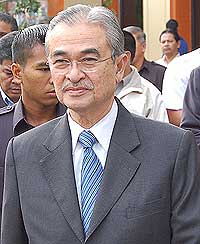 Ultimately, Abdullah’s reform pledges will be severely tested by the manner in which the VK Lingam judicial appointment fixing scandal, Anwar’s sodomy accusation, Najib and Rosmah’s alleged involvement in the Altantuya Shaariibuu case and other landmark cases handled by both the judiciary and the police.
It is pertinent for his reform-centric administration to focus on strengthening key institutions to ensure their empowerment to carry out their duties above politics and perceived favouritism.
The freeing of the Anti-Corruption Agency from the Attorney-General’s office and by according it with direct prosecution powers is a step in the right direction.
Now, all eyes are on the reforms of both the judiciary and the police. Politicians must not put Malaysia’s international image in jeopardy.
KHOO KAY PENG is a corporate consultant and an independent political analyst. He is a co-author of Non-Sectarian Politics in Malaysia: The Case of Parti Gerakan Rakyat Malaysia .


