




Change, we must: Najib and the political rhetoric of change
Our next prime minister's recent call to his party, Barisan Nasional (contrast Barack Obama's call to his nation), "Change or else..." seemed to resonate with the current mood of the country.
Our next prime minister's recent call to his party, Barisan Nasional (contrast Barack Obama's call to his nation), "Change or else..." seemed to resonate with the current mood of the country.
In fact, he acknowledged that, the Obama-effect has swept the world. It may be a little too late for Najib and BN because the fact is, Malaysians had called for change when after more than two decades of Mahathir Mohamad’s rule, they supported Abdullah Ahmad Badawi's promise of change in his first general election as prime minister in 2004 with an overwhelming mandate.
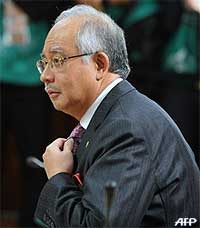 For some reason, Najib did not seemed to take that call seriously.
When the Abdulah administration failed to deliver the changes, which included a clean government, Malaysians from all walks of life in an unprecedented move since our independence, walked the streets under the auspices of Bersih in November 2007 to remind the government of its promises and its failure to deliver.
Again, for some reason, Najib did not respond to that call.
That too went unheeded and when Hindraf, which was formed a few years earlier to address the case of SM Moorthy, began to call the Indian community nationwide to stand up and demand for their rights. Najib, again, did not respond to that call.
The final and perhaps most deafening call for change in Malaysia must have been, ironically, our peaceful and for the most part, quiet acts of Malaysians marking ballot papers in the 12th General Election on March 3, 2008.
In that defining election, BN lost not only its two-third majority of the federal government, but for the first time in 50 years of independence, the people in five out of 13 states voted for the opposition coalition Pakatan Rakyat to govern their states.
Najib should not look far for the hungry desire for change. He should not look at the election results in the United States. The call is much much closer to home if only he and BN are willing to listen.
Rhetoric or resolution?
In more recent developments, the Kuala Terengganu by-election results seemed to be one of the tipping points of the ruling party's final defeats. From another perspective, Najib's call for change seemed to confirm that within the BN’s highest leadership, the fear is truer than ever.
Nonetheless, since Najib's announcement, which incidentally was at a launching of a book called ‘Politik Baru’ (New Politics), not many real changes were being whispered around, even in the media.
Najib did hint at a higher deficit federal budget to be announced soon. His rhetoric seemed to pick up pro-growth terminology of stimulus packages, etc. This, if anything, however, will remain lip service at best and wastage at worst if a stringent spending policy is not put into place.
What the BN government needs to do is to build confidence that our tax money will be well spent to boost the economy and provide jobs.
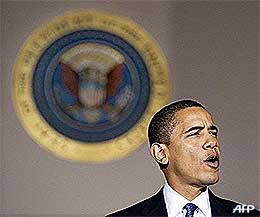 Obama's first 100 days will be hailed by many, including his critics. Part of his efforts is to close ranks, even with the Republicans. Similarly, Najib could do well to win the hearts of the opposition and the people, although given his political bad press, it would almost be an unsurmountable task.
With allegations rife of his personal involvement in the Perak political crisis, Najib is also not making much effort to garner popular support to smooth his takeover of the helm of the country next month.
What Malaysia does not need at this time is more conspiracy theory of kidnapings, the MACC and military taking politically motivated instructions from high-level government officials, and Pakatan Rakyat and BN playing poker on who has more ‘frogs’.
Instead, Najib, BN and Pakatan should concentrate on a more determined action to help normal Malaysians face an impending economic crunch.
It is during times like this that the government can consider issues like education and re-training programmes for our nation's human resources, especially among the vast number of unemployed graduates.
It is during times like this that the government can make revisions of public contracts and projects for better consumption of public funds and towards building more people-oriented developments.
It is during times like this that the government can consider a review of the public delivery system to set an economic-sustaining infrastructure in place and to provide a better quality of life for Malaysians from all walks of life.
Losing focus
These are some of the many things Najib should be concerned with or seen to be concerned with right now as the next prime minister of Malaysia, but unfortunately, for some reason, he seems obsessed with charting his own paths to power.
The response to change should be for the sake of the people, and not be used as a tool for a party's political survival. If it is indeed for the latter, then the agenda for change may be jeopardised.
Najib was right to say that Malaysians are "no longer impressed with the rhetoric of change which are nothing but plain rhetorics".
The problem has been the government treating Malaysians like children who can’t think for themselves. If only the government has been wise enough to listen to the voice of the people, after all, such is the essence of democracy.
The voice of the people must be heard everyday, not just once every five years and it should determine the direction of our own destiny as a nation. This is Najib's and probably BN’s final opportunity to reinforce democracy in our beloved Malaysia.
The fact is, the need for change, globally or locally has never been more urgent. The question remains, will our politicians really listen this time? The fact is, change is inevitable, and the question remains, which of our politicians will be left behind and left out in their stubbornness to keep the status quo?
STEVEN SIM is special assistant, Penang state exco, Youth & Sports,Women, Family & Community Development.


