




Custodial death revives calls for police reforms
The death of a youth in police custody and the torture of another in a police lock-up in recent weeks has shocked Malaysians and revived calls for an oversight body proposed in 2006 by a royal commission but unimplemented because of opposition from senior officers in the command.
Kugan Ananthan, 22, died on Jan 20, five days after he was detained at the Taipan police station in Subang Jaya, Selangor.
The death of a youth in police custody and the torture of another in a police lock-up in recent weeks has shocked Malaysians and revived calls for an oversight body proposed in 2006 by a royal commission but unimplemented because of opposition from senior officers in the command.
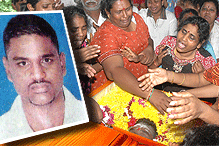 Kugan Ananthan, 22, died on Jan 20, five days after he was detained at the Taipan police station in Subang Jaya, Selangor.
Police claimed that Kugan had died of ‘breathing difficulties’ but a group of 50 people, including Kugan’s family members, stormed the mortuary where his body was taken for a post-mortem. Some took photographs of the body which displayed signs of injury and subsequently had the pictures posted on the Internet.
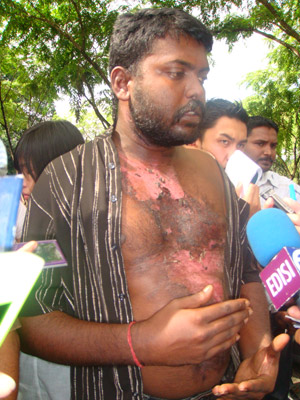
Earlier in January another youth, B Prabakar, had emerged out of a police lock-up in Brickfields revealing his neck-to-waist scalded chest, with the skin peeling off. Prabakar accused the police of beating him up and scalding him with hot water to extract a confession for crimes he said he did not commit.
Seven police officers have pleaded not guilty after being charged at the Kuala Lumpur Sessions Court on Jan 15 with committing an act of ‘criminal intimidation’ and ‘voluntarily causing hurt to extort confession’.
"We hope the death of Kugan would force the government to finally table a really tough oversight commission to curb abuses in the police force," said lawyer Karpal Singh.
 "The death of Kugan again shows why we need a strong and viable oversight commission to curb abuse and return transparency, accountability and respectability."
According to statistics revealed in Parliament last year, there were a total of 1,535 custodial deaths in the country between 2003 and 2007, figures which included death from diseases like HIV/Aids.
Between 2000 and 2004, eighty people in police custody had died, Parliament was told last year. Of these, only 39 cases were referred to a magistrate for inquiry while inquests were held only on six cases. Beyond these bare facts, no in-depth study has been carried out into deaths in police custody.
"It’s like dropping into a big black hole once arrested. Increasingly, the one way to come out is in a coffin. We need to shine a light over the entire process, to make everything transparent and above board," said opposition parliamentarian S Manikavasagam.
'There should be no more'
"We are determined that this should be the last case of death under custody. There should not be one more, ever. The people can’t tolerate this type of murder any longer," said P Ramasamy, opposition legislator and deputy chief minister of opposition-ruled Penang.
"We must have a permanent solution to this dilemma of youths getting tortured and beaten to death. The world is watching us," he told IPS.
Both Kugan and Prabakar, victims of police brutality, are Tamils, representing a marginalised minority that constitutes eight percent of the population. But the Tamil community is blamed for at least 40 percent of thefts, robberies, gang wars and violent crimes that take place in the country.
 In some localities where Tamils predominate, police statistics show their rate of involvement in crime is over 50 percent, indicating serious marginalisation from mainstream socio-economic improvements and alienation.
Opposition political parties are now putting severe pressure on the ruling Barisan Nasional government, politically weakened by heavy polls losses in 2008, to reign in the police force.
"There is nobody to guard the innocent from the excesses of the police," Charles Santiago, opposition lawmaker told IPS. "Any solution has to be multilevel from providing opportunities to minority Indians to advance socio-economically to alleviating their poverty and curbing and seriously punishing police excesses."
Lack of commitment
Responding to criticism, the attorney- general has pressed charges against lower rank personnel for causing grievous hurt by use of boiling water to extract a confession. Founded by the British colonial authorities in the 18th century, the police force was a key institution of law and order that survived the two World Wars and performed admirably defeating a communist insurgency and deftly handling race- riots.
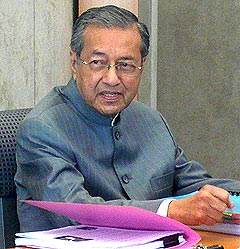 However, observers say the police force went to seed during the 22-year autocratic rule of former premier Dr Mahathir Mohammad, who gave the force a free hand as long as it served him and went after his political enemies.
By the time Mahathir’s successor Abdullah Ahmad Badawi formed the royal commission, some opposition lawmakers felt the force was beyond redemption and that a new force needed to be created from ground up.
The commission recommended numerous changes and many of them were carried out, including better pay, housing, training, new equipment and other service perks but the key change - to form an independent oversight commission - remained unborn.
Abdullah introduced a watered down version of the commission last year but was forced to withdraw it following widespread protests.
The non-implementation of the recommendations "demonstrates a lack of commitment on the part of the Malaysian government to bring about reform and to establish compliance with human rights standards as a norm in policing work in Malaysia," Amnesty International said in a statement, following the death of Kugan.
- IPS


Are you sure you want to delete this comment?
This action cannot be undone.