




Pak Lah - the captain who missed the boat
He was at his strongest a year ago this month. If there were lingering doubts over his leadership previously, there were none when the poll results came in on March 21, 2004.
He was at his strongest a year ago this month. If there were lingering doubts over his leadership previously, there were none when the poll results came in on March 21, 2004.
 Yet, Abdullah Ahmad Badawi, the nation's fifth prime minister and by far the most popular, squandered the opportunity given to him. He had promised a clean government in return for a clear mandate from Malaysian voters.
Instead, his post-election cabinet comprised familiar faces whose reputation had been sullied by graft scandals . No wonder, many were disappointed. It was business as usual, we decried. A year later, it is still business as usual .
Clearly, the thumping electoral victory was Abdullah's best tool to stamp his authority in the post-Mahathir regime. He failed to do that and it proved to be a costly mistake. By the time the Umno polls were held six months later, Abdullah's magic was already dissipating.
His men, or those seen to be linked to him, were soundly trashed in the race for the party leadership. Abdullah's son-in-law, Khairy Jamaluddin, was booed from the floor when he was anointed the party's deputy youth leader.
Had Abdullah sent a strong signal to the party chieftains that he was firmly in charge in the wake of his landslide victory last March, the situation would have been different.
What went wrong?
Policy flip-flops
The most telling is Abdullah's inability to be decisive. Take the flip-flops in his illegal migrant workers policy - one minute, the crackdown was on, another, it was off.
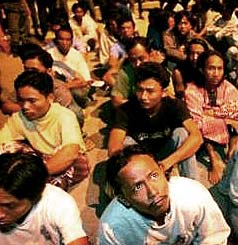 Not only that, the expulsion of illegal migrant workers was so ill-thought out that even before the crackdown began early this month, many had questioned the obvious: why deport the workers only to take them back later?
Wouldn't it be better to legalise them in Malaysia instead of forcing the workers to fork out a tidy sum for transportation and a myriad of fees for their return to the country?
Was the policy in reality meant to protect errant employers who otherwise had to vouch for their illegal workers during the legalisation process? Or was it to enrich the many labour recruitment agencies which are bound to profit from the hefty fees imposed on returning workers?
No one in government has adequately explain the asinine policy. Not surprisingly, the plan flopped spectacularly - few of the workers have returned. That blunder alone was enough to put a small dent in our economy.
Indecisiveness aside, Abdullah's advisers are of little help either. Granted, they had been remarkable - no, brilliant - spin-doctors for their boss.
 But they are increasingly hampered by their own political ambitions - their survival in the ruling party depends on not rocking the boat too hard. For example, son-in-law Khairy (
photo, left
) and key aide Ahmad Zaki Zahid are both rising stars in Umno and as such, they have not only Abdullah's interests to protect but their own as well.
Some argue that Abdullah may not have the required power to do the necessary. Unless he treads gently, he is inviting potential challenges to his leadership, so they say. But former deputy prime minister Anwar Ibrahim scoffed at that idea.
"The corrupt leaders and warlords can pressure the PM but they are also scared, very scared ... of the instruments of the government and perception of the general public," he told malaysiakini in an interview last year.
Having been cast out when he was the country's second most powerful man, Anwar should know what he is talking about.
Cabinet reshuffle?
There is now talk about another cabinet reshuffle. The hope is perhaps that this time, Abdullah would do it right. But don't hold your breath as Abdullah has less room to wriggle now that party bigwigs have had time to hem in from all sides.
And it doesn't look any better for Abdullah in the coming years either. The next party polls - due in 2007 - will most likely be held after the 2008 (or at the latest mid-2009) general election.
 Umno has consistently put off its party polls for fear that infighting would affect unity ahead of the general election. The party has the power to postpone its polls for 18 months and it is expected to exercise that option again.
This spells trouble for Abdullah. Regardless of how well the government - or the economy - does, a swing against the ruling Barisan Nasional is likely in the 2008 election. Abdullah will face the next party polls in a far weaker position when compared to last year.
Put simply, Abdullah has missed the boat on reforms.
Abdullah might have decided to go slow on the promised wide-ranging reforms for fear of a party revolt. But by not moving decisively, he has unwittingly opened himself to a possible challenge come the next party polls.
That, to say the least, is ironic.


Lapor komen ini
Anda pasti mahu padam komen ini?
Komen anda tidak akan boleh dikembalikan semula.