




Interviewing Dr M
Dr Mahathir Mohamad still holds the highest office in the country. Literally that is. As advisor to national oil company Petronas, he occupies the topmost floor of the world's second tallest building - Kuala Lumpur's Twin Towers.
It was there, on the 86th floor, where malaysiakini met Mahathir .
Dr Mahathir Mohamad still holds the highest office in the country. Literally that is. As advisor to national oil company Petronas, he occupies the topmost floor of the world's second tallest building - Kuala Lumpur's Twin Towers.
It was there, on the 86th floor, where malaysiakini met Mahathir .
It's not clear why Mahathir, out of the blue, agreed to talk to malaysiakini. Over the past six years, we had tried, time and again, to get him to talk to us. We had been unsuccessful. Until now.
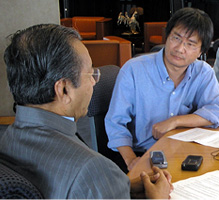 One thing is certain. He did not do it because of the half-bridge issue. Mahathir agreed to the interview sometime in March and before the government - much to his chagrin - made a U-turn on the bridge project. The interview was later put off to April. Then came another postponement. This time it was marked down for May 11.
That was before Mahathir realised May 11 was Umno's 60th anniversary. It was one event which he couldn't afford to miss. Tongues would wag, especially after his open spat with the government over the half-bridge.
So when we were told that the interview - already cancelled three times - would be on May 16, we had no idea it would happen until the day itself.
What is clear, however, is that this was a reluctant interview. Mahathir was apparently persuaded to do so by one of his advisors.
As expected, he has not changed his view of malaysiakini , and strongly hinted that he made a mistake in granting us the interview.
He took pains to stress that he had been severely criticised by malaysiakini when he was prime minister. Of course, we told him that we had also placed the present government over hot coals and will do so if the opposition wins power. But he would have nothing of that.
We had a lot of questions to ask the man who had declared malaysiakini his enemy. Too many in fact. We were given half an hour but managed to stretch it to 45 minutes. Still, that wasn't enough for us. It would take more than one interview to get Mahathir to account for many of his decisions when he was the country's most powerful man.
What mistakes?
Opening the session, he said flatly he would not answer some of the 19 questions which we had earlier faxed him.
He began by refusing to answer our first - his assessment of Abdullah Ahmad Badawi's performance. By keeping mum, he indeed said a lot about the rot in ties with his handpicked successor.
Nevertheless, the interview confirmed something we had known - Mahathir is not someone who would accept his shortcomings easily.
When asked about the mistakes he had made in his 22 years in power, he shot back, "What?"
Like Perwaja, we said.
"Perwaja was not a mistake. Perwaja was a good project," he said about the state-owned steel company which cost taxpayers some RM10 billion in losses. "But I couldn't help it if the management did not know how to run it."
So Eric Chia was a mistake.
"Eric Chia, at the time he was appointed, nobody told me that it was a mistake. He had done very well with UEM. He was chosen based on his record. But what he did after that, I can't be looking over his shoulder [...] he wasn't a bad man when I started with him. How do I know what somebody is going to do after he takes over from me?"
But then, we did lose a lot money with Perwaja.
"We lost a lot of money because of bad management. Not because Perwaja was a mistake."
He also refused to even consider whether he was 100 percent sure about his once protege, Anwar Ibrahim, being a homosexual.
"If I have reconciliation (with Anwar), it may be interpreted as my belief that actually nothing happened, that it was wrong, my mistake, (that) my decision was wrong, that this thing did not happen. To me, I was convinced, and I made the decision, no matter what the people said."
It appeared that he had backed himself into a corner on that one.
The traitors
Clearly, he hasn't changed much since he retired almost three years ago. He still suits up with his signature Nehru jacket. He remains combative, sarcastic, and at times, bellicose.
At the end of the interview, a malaysiakini editor requested Mahathir to write a message to his 15-year-old daughter, Fairuz.
"I hope you will always love the country which has given you, and all of us, so much," he wrote.
This was from the man who had once labelled Fairuz' father, and other malaysiakini journalists, as 'traitors'.
Perhaps this is yet another idea which he finds hard to accept - that seeking to hold our leaders accountable does not make Malaysians any less patriotic.


