


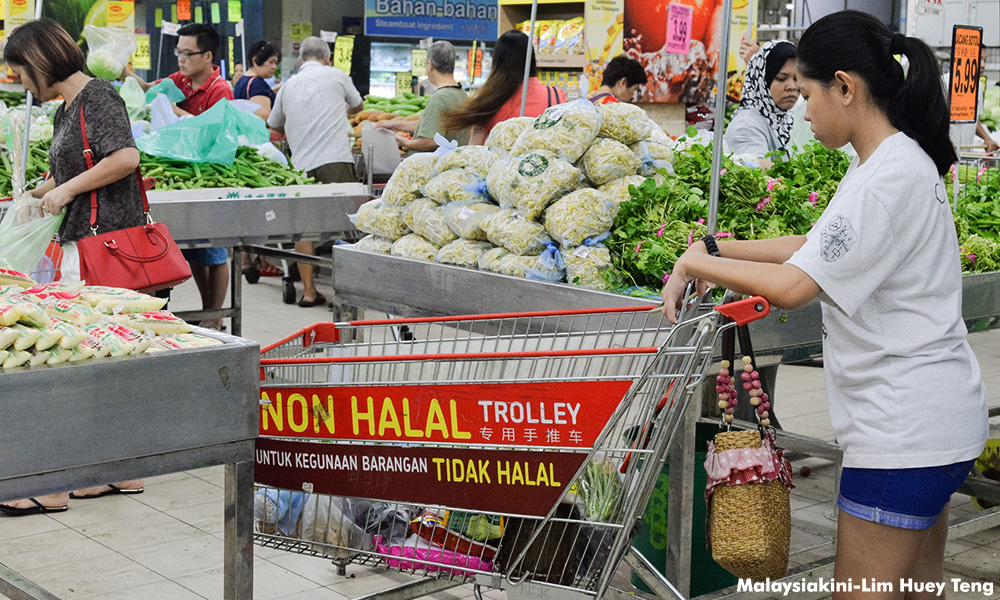

Going bonkers over ‘halal-ism’
That‘s what the appearance of halal and non-halal trolleys in a supermarket shows - a crazy, shallow-minded act since it has not taken into account the subtle, negative consequences of segregating shoppers into Muslims and non-Muslims when there is no sensible reason to do so.
While this act erects another wall between the Muslims and non-Muslims, there are leaders who are so excited about it that they want to cast it in stone by making it a legal requirement rather than tearing the walls down in keeping with their public pronouncements about enhancing national unity. This only makes hypocrisy of talk of national unity.
The supermarket probably thought it was a brilliant idea to do this to curry favour with the state and religious authorities for reasons best known to itself. Or maybe it thought it might be awarded a prize or something for being innovative and ‘sensitive’ to the feelings of a section of its customers, and the first to recognise the need to protect Muslim shoppers from contamination by things non-halal?
Do we not already have more than enough policies and acts that are driving citizens professing different religious beliefs apart? Must more wedges be driven between them while on the other hand public pronouncements are made by our leaders about strengthening national unity?
Such ‘syiok sendiri’ ideas driven by impulse rather than reason and common sense, yet implemented straightaway without second thoughts, have become a Malaysian culture of doing things.
Just look at all the ‘syiok sendiri’ ideas that have been mooted and implemented in our education system to get an idea of the long-term damage that results and which is near impossible to correct, e.g. the killing of proficiency in English. Well, what can we expect from the generation that went through school without being taught HOTS - Higher Order Thinking Skills.
What’s even more surprising is that the Domestic Trade, Cooperatives and Consumerism Ministry is all excited by this racist idea and is planning to make halal and non-halal trolleys in supermarkets a legal requirement; with the blessings of the Federation of Malaysian Consumers Associations (Fomca) and the Muslim Consumers Association of Malaysia (PPIM).
The law will be easy to make, but how will it be enforced? Not all non-Muslims look alike. They are not of the same colour and features. Similarly not all Muslims look alike. So if an Indian pushes a halal-trolley, how would the religious police know whether he is an Indian Muslim or non-Muslim? Similarly if a Chinese pushes a halal-trolley, will he have to show proof he is Muslim?
By the way, what is the harm that has been done to Muslims who have been using the trolleys that everyone else has been using all these donkey’s years?
The preachers of haramphobia should go to a wet market (that has a non-halal meat section, albeit hidden from public view,) and study about haram halal by following the people who come out of that section after purchasing non-halal meat, until they leave the market.
They would have paid in notes and coins and received change in notes and coins. The non-halal change handed by non-halal hands goes into their purse or pocket. One of the next stops may be a Muslim fish stall. The money to pay is taken from THAT purse or pocket and handed to the Muslim person.
And so it goes, i.e. the money. From the hands of a pork seller to the hands of a Muslim. However, I have never come across any Muslim business person objecting to be paid in Malaysian Ringgit and Sen. No champion of halal-ism has said a word about the really, really tainted, polluted, haramised ringgit notes and sen coins that openly go from non-Muslim to Muslim hands, purses, pockets, homes and vice-versa.
Daily, real-life situations
There are hundreds and hundreds of daily, real-life situations where no barriers can be drawn between halal and non-halal. Is a pork-eater’s blood halal or non-halal? Some of the blood in blood-banks is from them. In the event halal blood is unavailable, would non-halal blood be used to save the life of a Muslim or not?
People travel in public transport. Pork eaters would be breathing out ‘tainted’ non-halal air. Should Muslims stop breathing the air until it is made halal, or should the non-Muslims be barred from travelling in public transport? But then air is everywhere and inseparable with walls. Can halalists solve this major issue?
So what is the big deal about segregating the trolleys? What is the agenda behind this show of piousness? Is it piousness in the first place? Is this a way to enhance national unity of the peoples of various religious beliefs and cultures? Is this true Islam?
So if it is so important that Muslims must be prevented from using trolleys that have been used to merely transport properly packed, canned or bottled non-halal stuff, why is it not much more important to ensure that Muslims do not touch the notes and coins that are freely circulating from pork sellers, to vegetable sellers, to newspaper vendors, to kuih sellers, etc, etc?
Is it not a fact that all money is not halal? Even brand-new notes and coins may not be halal as those making them, packing them, transporting them may have touched non-halal stuff somewhere, somehow.
If the free circulation of non-halal money is perfectly okay, then please don’t create a halal non-halal fuss about anything else. So what is the agenda of making a mountain of anything that is touched by non-Muslims?
Beef is haram to me and I don’t eat it. That is the limit of my haram-ness to it. I don’t demand a trolley that has not been used to transport beef in any form, packed or even fresh. I don’t care if the ringgit and sen that come into my hands have been handled by beef sellers or pork sellers. Similarly, the Muslims have lived the same way for centuries. So why can’t life go on the same way, respecting each other’s beliefs, culture, etc.
Reason. What has happened to it? Doesn’t the Holy Book start with the command that people should “Read”? On reading, philosopher Francis Bacon said: “Read not to contradict and confute; nor to believe and take for granted; nor to find talk and discourse; but to weigh and consider.”


Are you sure you want to delete this comment?
This action cannot be undone.