


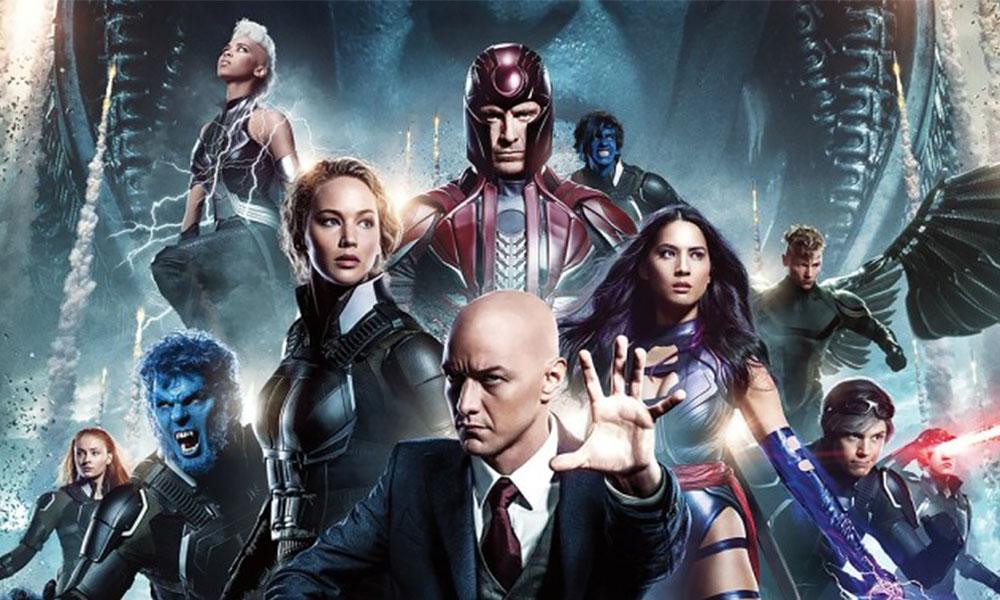

X-Men series exposes delusion that evolution needs moral values
‘X-Men: First Class’ lays bare the central ideological conflict underpinning the entire artifice of the X men universe - that between the Darwinian battle for tribal primacy and the countervailing force attempting to stop the force of natural selection, and thus evolution itself.
A pop-culture movie might not appear to warrant a literary analysis but a serious idea with much implications is being introduced to the masses through the vehicle of a comic-book-movie, aided with lubricating doses of low-brow humour and low-cut dresses.
The idea at times is almost overwhelmed by the amount of cleavage, but proves to be unmistakable: That Evolution cannot be the basis of Morality. The most direct way to cut through the distracting fog and into the thick of the matter is to examine the character given the name Darwin, which is almost the equivalent of hanging a sign around his neck that says: ‘I am a heavily symbolic character, analyse me’.
The character which claims to embody Darwin in both his powers and words - “I adapt to circumstances” - proves to be a fool that removes himself from the gene pool.
Natural selection does not favour showing altruistic behaviour, but that was what Darwin did - His last action was to shield a friend who had just betrayed him, which is possibly the most un-Darwinian action possible. Or is it? Altruism, epitomised by the act of self-sacrifice, has always been strange but real behaviour that appears to violate the theory of Evolution.
Recent branches of evolution has however attempted to accommodate this observed phenomenon within its framework by coming up with what is called the ‘Selfish Gene Theory’.
This theory explains altruism by pointing out that some altruistic actions that kills the individual can however lead to the increased chance of survival for the other members of the group to which the individual belongs. The selfish gene is considered ‘selfish’ because it promotes the sacrifice of its host (the individual) in order that group members can survive.
Natural selection will then propagate the ‘selfish’ gene to the extent that the group members are genetically similar to the individual. In the movie, we see Darwin (the individual sacrificed) attempting a feint and pretending to join the bad guys while his group moves into position to launch an attack.
It is not unlike groups of squirrels in the wild in which a squirrel (the individual sacrificed) calls out loudly when it spots a hawk, drawing the hawk’s attention while the other squirrels escape. The human strategy is much more complex, involving deception and stratagems, but the core principle of sacrificing an individual to promote the group's survival is the same.
Now that we understood the lengthy explanation, we will revert to the previous question: was Darwin really un-Darwinian or in fact, displaying the nuances of evolution? It could be so or not. The verdict on the science is not out and the truth to that question remains a tautology.
The good news is that even if altruism can be explained through the not-so-altruistic selfish-gene-theory, humans are not automatons to the (falsely) simple processes of evolution - We had established earlier that evolution is nuanced enough not to limit the scope of our moral actions as great as we might think, and that this scope still allows for truly noble behaviour.
'But you killed my mother'
The next step is to validate man’s complexity as a moral agent not beholden to evolution, and that his moral imagination is shaped by forces other than evolution. The most direct evidence to this can be found, strangely in a single melodramatic line by Magneto that will doubtlessly be enshrined as a timeless punchline: “... I want you to know I agree completely with everything you just said. But you killed my mother.”
The first segment is a rambling monologue by Magneto which reveals his belief in evolution, and the bastard child of that belief, that the next logical step of evolution is the elimination of the now defunct, non-mutated human race. The last five words then shows that despite Magneto’s unshakable beliefs in evolution, it is triumphed by his sense of justice and sentimentality.
It is this sense which then makes him kill Shaun, whose continued survival will have allowed for the fulfilment of Magneto’s goal - the destruction of the old race, fulfilling the prophecy of evolution. In short, Magneto, the harbinger of evolution, stops evolution because justice and sentimentality was more important to him.
It is also not hard to believe that less-magnetic humans might find themselves having other considerations besides propagating their genes. We have come to a point whereby we can deem ourselves to be sufficiently evolved such that we become moral agents that can choose and balance amongst competing influences and value systems beyond the compulsion of our genes.
The capacity for us to render evolution, natural selection, individual and group survival irrelevant has grown. It has even reached the extent that some of us can entertain sentimental flourishes like fighting for the inalienable right of fruit-bearing trees not to be plucked and harmed by the act of plucking.
That is the extent to which the fringe group of humanity, like the tree-hugging hippies, have transcended evolution. At core, their campaign for rights of plants effectively places them in line with Charles Xavier, who fights for the rights of a lesser species. Evolution is not, should not, and will not become the basis for our morality. Evolution and natural selection are real forces, but that should be the limits of its implications.
The decline of religion and the implicit guarantee of god-given rights has gave birth to fears that evolution will be the bible of secularism and bring about ills such as Social Darwinism. This fear is in fact what that changed the modern theme of X-Men from racism, bigotry and exclusion to evolution and its potentially troubling implications. Yet, evolution is a fact, an influence, nothing more. It is not deterministic from this point on. That is, if we become X-Men, and battle the illogical delusion that evolution necessitates a system of moral values. That is where the real battle lies.
KUMARENDRAN BALACHANDRAN is a postgraduate student of Monash University.


Are you sure you want to delete this comment?
This action cannot be undone.