


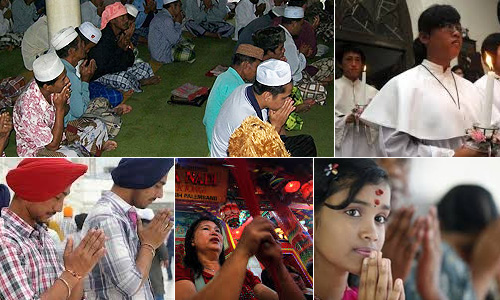

We need to embrace diversity of religion
In 2015 Saudi Arabia executed 157 people, up from 90 the year before. By July 2016, Saudi Arabia had executed 100 people. On Jan 2, a total of 47 people were beheaded and that included prominent cleric and supporter of anti-government protests, Sheikh Nimr al-Nimr. The trial of Sheikh Nimr was called out by Amnesty International as being “political and grossly unfair trial at the Specialised Criminal Court.”
The Saudis have been actively exporting their interpretation of Islam around the world, supported by a huge oil-funded budget that some estimates put at US$100 billion over the last 30 years.
Regrettably, this Saudi practice of execution has its origins in tribal practices. When in 1744, Muhammad ibn Abd al-Wahhab, a cleric, sought the protection of the powerful tribal leader Muhammad bin Saud, an alliance that continues today, it seems to me that the lines between tribal and religious practices got blurred.
World Bank 2016 study on recruits of Islamic State (IS)
This study called ‘Economic and Social Inclusion to Prevent Violent Extremism’ makes for interesting reading. Based on the statistics of foreign recruits of the IS, it says, “We find that the factors most strongly associated with foreign individuals joining IS have to do with a lack of economic and social inclusion in their country of residence.”
According to the report, IS recruits have above average educational background, with 69 percent having at least a secondary education. Of the 30 percent who pick their role, 17.2 percent want to become fighters and 11.7 percent suicide bombers.
The willingness to die and take the lives of innocent people is something that is completely alien to me since I firmly hold the belief that for any Muslim the taking of the life of an innocent person is forbidden. Al-Quran says [5:32] “On that account: We ordained for the Children of Israel that if any one slew a person, unless it be for murder or for spreading mischief in the land,it would be as if he slew the whole people: and if anyone saved a life, it would be as if he saved the life of the whole people.”
Why were these people willing to leave their country to participate in a ‘false jihad’? Some crave for that defining moment, believing that their deaths will make a difference, others are led to believe they will get a “go straight to heaven” pass.
The now-reformed British radical jihadist preacher, Manwar Ali, speaks of the relative ease with which he radicalised fighters over a 15-year period in Afghanistan, Bosnia, Chechnya and elsewhere. He thought and taught “violent jihad was noble, chivalrous and the best way to help” local people against invaders.
Ali now says that “there are no circumstances on Earth where violent jihad is permissible” because it will lead to greater harm. Malaysia seems to have successfully turned around a few radicals, which is great news, but my question remains - why were these people willing to put aside common decency, adopt a narrow and bigoted interpretation of the religion? I will come back to this point.
The recent action by Bukit Aman and arrest of 16 supporters of Malaysian IS militant leader Mohamad Wanndy Mohamad Jedi is to be commended. But it also serves as a reminder of the threat we face, since except for one foreigner, the others represented a cross-section of educated, gainfully employed Malaysians. This discontented bunch found it easy to find inspiration in an increasingly connected world. Let me explain further.
The disenfranchised are free to join an organisation of their choice
In a globalised world with ready communication access, it is all too easy for as few as one or two people who feel disenfranchised, displaced or discriminated against to find solace with other similar groups. What’s interesting, and frightening, is these people can find an ideology or group that they can feel empathy with and even join the organisation without being admitted.
It’s a case of you can write up your personal invitation letter, something that is only possible in today’s connected world. Consider this. In the 1920s if you wanted to join the Ku Klux Klan (KKK) ‘White Supremacy’ movement, you were first screened, then had to be invited by a member through a formal application process.
Recently, a 1921 KKK application form emerged for sale - it requires the recipient to complete 20 questions and return the completed application in the enclosed ‘stamped envelope’. Successful applicants would be notified by their introducer. Imagine that. Joining was not just a matter of association, but gaining admission through a formal process.
The point is, you could not be a member just by claiming to be one. Contrast that to the supporters of an English premier club team, Manchester United, Arsenal, Chelsea, or any other. The club management might have no idea that you are a supporter. The clubs collects no dues from you, may not know of your existence, and yet (donning even a fake T-shirt) you are part of the club.
So it is with lone terrorists who claim to be part of IS or other terror organisations - they claim membership without having been admitted to the organisation.
Funding promotes discontent
As long as economic opportunities are not provided, the possibility of discontent increases. Mix in a dose of religious fervor, tribal practices and you get a potent brew. Sadly, US efforts at effecting regime changes in Egypt, Syria, Iraq, coupled with Saudi and Qatari funding of the Wahhabi school of Islam has ripped apart one Muslim country after another.
Can we stop their meddling? Probably not, but the low oil prices will hopefully mean a scale-back of their funding. In Pakistan, Saudi funding for madrasahs during the leadership of General Zia UlHaq (1977-1988), led to an explosion of their numbers, from under 300 to over 24,000. Today, Saudi and Qatari money is being poured into several countries for the construction of new mosques, with new leadership aligned with to their practices.
Why is this necessary? Is the intention to split the Muslim community and plant the seeds of radical, doctrine-based teachings? If the reasons were altruistic, then the money should be used to improve existing mosques, the building of hospitals, schools, and factories so that communities can be built around sound economic fundamentals. Mosques need to embrace the community in a wider sense.
We have examples in other religions, whose centres offer vocational classes, modern gym facilities, and other activities - not just religious classes. It does seem that the teaching has become dogmatised and there is a lack of debate amongst the congregationor a discussion of ideas and initiatives relevant to society today.
The issues for Malaysia
Fortunately, we are safe from economic catastrophes and large-scale unemployment or protests, but despite the positive economic environment, we have seen the emergence of IS sympathisers. Many have been arrested and so far caused no damage or destruction, but we need to work harder to make sure this does not happen.
It seems to me that teachings are too focused on the reward system, therefore it should come as a surprise that later in life when a disenfranchised Muslim is offered the prize of a ‘ticket to heaven’ that he takes it. The radical conveniently puts aside his obligation to protect life, or to be accountable for all his actions. Al-Quran [50:17] “Behold, two (guardian angels) appointed to learn (his doings) learn (and noted them), one sitting on the right and one on the left.”
We need to learn how to embrace diversity
We need to embrace the diversity of practices and thought. Just as in a civil society, we learn how to ‘agree to disagree’, so it must be in religion. Why not embrace differing views in the community? This not only improves the level of knowledge but will allow youth an avenue within the community for discussion. We also need to be weaned off the reward system and start teaching about the responsibility of living in a community.
If we don’t act now to embrace more dialogue and diversity, I fear it will only be a matter of time before we are faced with a disaster.


Are you sure you want to delete this comment?
This action cannot be undone.