


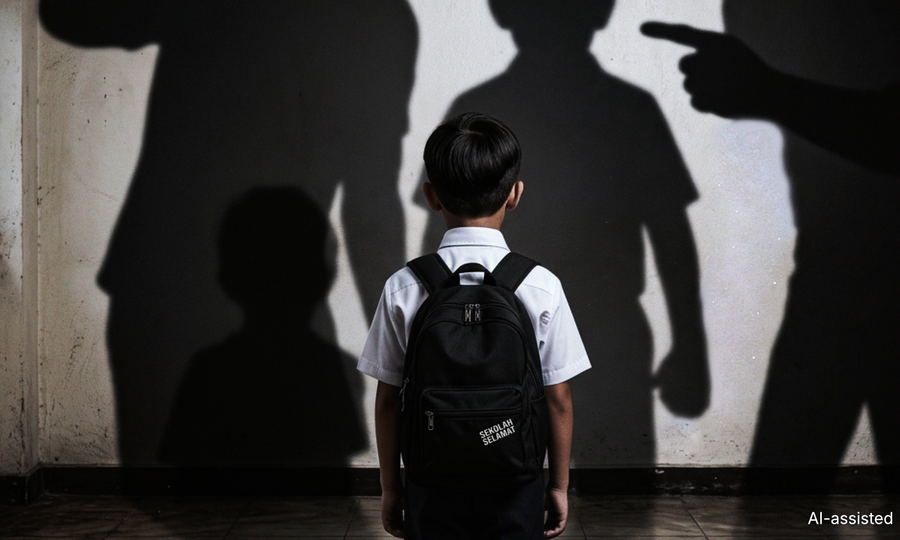

LETTER | Cameras, cops, circular: Why school bullying won't go away
LETTER | The Education Ministry recently released figures: 5,681 bullying cases reported in schools between January and August this year.
The prime minister himself admitted the real number is "definitely higher."
It's disheartening. CCTV cameras have been installed. Police have been sent into schools. Counsellors have been added. So why does the bullying keep happening?
Let me say something uncomfortable but necessary: we've been treating a human problem with a surveillance mindset.
Cameras cover corridors and corners. They don't cover the punch thrown in the toilet, or the note passed under the desk with something cruel written on it.
Police can arrest a perpetrator, but they can't arrest the fear a child carries walking into class every morning.
The PM himself noted that the school in Yong Peng, Johor, had cameras - but "not where it happened”.
That line is a metaphor: the real bullying hotspots have never been within camera range.
This isn't uniquely Malaysian. Unesco data across 144 countries shows 32 percent of students were bullied in the month before being surveyed.
South Korea bars students with bullying records from university entrance exams. Japan reported nearly 770,000 bullying incidents in fiscal 2024. Germany: nearly half of teenagers say they've been bullied.
However, here's what stands out: 27 percent of Malaysian students report being bullied, against an Organisation for Economic Co-operation and Development (OECD) average of 20 percent.

On being mocked by classmates, we're at 44 percent versus 35 percent.
We're not the worst but we're noticeably worse than average.
What’s the cause?
So, where's the problem? I think there's a key issue being overlooked: schools have lost the ability - and the space - to solve their own problems.
Right now, the ministry issues a circular; schools execute it. The ministry adds a system; teachers fill in data.

Teachers are drowning in non-teaching work. The National Union of the Teaching Profession (NUTP) said the main cause of teacher burnout is "not teaching itself" - it's administrative work, reports, data entry, meetings, committees, co-curricular activities, and endless parent WhatsApp messages.
iGuru has even proposed "One In One Out" - for every new task added, scrap an old one.
Think about it. A teacher juggling three or four systems, replying to dozens of parent messages, rushing reports - how much energy does he or she have left to notice the kid in class who's suddenly gone quiet?
How much patience to deal with friction between two students that "doesn't count as serious"?
Bullying never happens in a vacuum. It happens where adult attention is absent.
I'm not saying the ministry shouldn't be involved. Curriculum standards, teacher standards, safety floors - those must be set centrally.
But "how to run things" and "what to teach" are two different questions.
Learning from others
England's school autonomy reforms offer a useful lesson: the state sets curriculum standards, but schools hire their own staff, set their own budgets, and buy their own training.
Local authorities provide "support on demand”. Schools get room to judge based on their own students' needs.
Malaysia's problem isn't "too much direction”. It's too much direction and too little trust. Every circular carries an implicit message: "You can't do this, so I'll tell you how”.

Schools become execution terminals rather than educational communities with judgment.
G25's statement hit the mark: the current approach is "reactive" - add measures after a crisis, wait for the next tragedy once the heat dies down. Cameras, security guards, disciplinary procedures are "necessary but don't touch the root”.
Addressing root causes
What's the root? Kids growing up in an increasingly challenging environment. Academic competition.
Violence on social media. Dual-income parents with no time. Schools that offer little beyond grades in terms of belonging and meaning.
None of that shows up on camera. No police officer can manage it. No circular can solve it.
The only people who can see it are the teachers who spend every day with these kids. If teachers are buried in administrative work, that last line of defence is gone.

So, my view is simple: strip away what teachers don't need to do. Give the space back to them.
Let schools have the power to allocate resources and design interventions based on their own situation - instead of waiting for the next circular from the ministry.
And tie "accountability" to "autonomy": you give schools freedom, schools answer for student safety and growth. Data transparent. Results made public.
Giving schools autonomy isn't dumping responsibility. It's acknowledging a basic truth: the people closest to the children know best how to help them.
The author is affiliated with the Tan Sri Omar Centre for STI Policy Studies at UCSI University and is an Adjunct Professor at the Ungku Aziz Centre for Development Studies, Universiti Malaya. He can be reached at ahmadibrahim@ucsiuniversity.edu.my.
The views expressed here are those of the author/contributor and do not necessarily represent the views of Malaysiakini.





Report this comment
Are you sure you want to delete this comment?
This action cannot be undone.