




PBS 'rattled' by rise of PKR in Dusun votebank
Parti Bersatu Sabah (PBS) appears to have embarked on a pre-emptive strategy designed to prevent a one-on-one opposition electoral pact in Sabah and dislodge Parti Keadilan Rakyat (PKR) national vice-president Jeffrey Kitingan from his comfortable perch in the opposition politics of the state.
Parti Bersatu Sabah (PBS) appears to have embarked on a pre-emptive strategy designed to prevent a one-on-one opposition electoral pact in Sabah and dislodge Parti Keadilan Rakyat (PKR) national vice-president Jeffrey Kitingan from his comfortable perch in the opposition politics of the state.
This is the assessment of opposition leaders in the face of incessant attacks mounted in the press by PBS leaders linked to deputy president Maximus Jonity Ongkili ( below ) who is also the Federal Minister for Science, Technology and Innovation.
 "PBS is all but conceding that PKR in Sabah is finally cutting deeply into its Dusun and multiracial votebank. The party has its back to the wall for the next general election," said sources in Kitingan's inner circle in dismissing the press attacks.
"They have to ask themselves what they have really done for the people of Sabah since they re-joined BN (Barisan Nasional)."
"They have merely helped Umno to marginalise the people of Sabah and made it the most poverty-stricken part of Malaysia. What happened to BN's Sabah Baru (New Sabah) slogan in 1994 of Sabah Maju dalam 100 Hari? (Developed Sabah in 100 days)."
Already, it is said that PBS appears resigned to the loss of its Chinese seats to Sapp (Sabah People's Progressive Party) which went into opposition in Sept 17 last year.
The party will not have its Dusun and multiracial seats taken away too, and appears to be prepared to fight tooth and nail to keep them.
PBS has suffered declining support ever since its entry into the BN and only the lack of an opposition electoral pact saved the party during its last outing. Many of its seats were won by razor-thin margins.
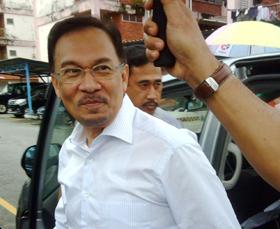 The theme of the PBS attacks against PKR in the local media is that "opposition leader Anwar Ibrahim (
right
) doesn't trust Kitingan to be the PKR leader for Sabah", that "he has been marginalised" and that "party members in both Sabah and Sarawak have to suffer the humiliation of having people from Peninsula Malaysia as their leaders".
The theme of the PBS attacks against PKR in the local media is that "opposition leader Anwar Ibrahim (
right
) doesn't trust Kitingan to be the PKR leader for Sabah", that "he has been marginalised" and that "party members in both Sabah and Sarawak have to suffer the humiliation of having people from Peninsula Malaysia as their leaders".
"The leadership (PKR) does not trust Jeffrey," charged PBS vice-president Herbert Timbon Lagadan who is leading the media onslaught.
"He has been reduced to a mere ‘yes' man. This is what happened during the last General Election when many of Jeffrey's chosen candidates were replaced by Ansari Abdullah's (Tuaran PKR chief) candidates."
Lagadan was responding in his latest salvo to PKR vice youth chief Jaffery Jomion's spirited defence of Kitingan's role in the party.
Jomion also pointed out that it was former Umno president Dr Mahathir Mohamad who masterminded Umno's entry into Sabah and that PKR party advisor Anwar Ibrahim should not be faulted for this.
Marginalisation does not arise
"PBS is also responsible for Umno's entry into Sabah because it did not honour an electoral pact with Usno in 1985," said Jomion.
"So, Umno came in. PBS should have given two ministerial posts to Usno as suggested by Ghaffar Baba (then Umno deputy president and DPM) and kept Umno out."
When Umno announced its entry into Sabah well before the 1994 state elections, then PBS chief Minister Joseph Pairin Kitingan hastily announced the formation of a PBS-Usno coalition government.
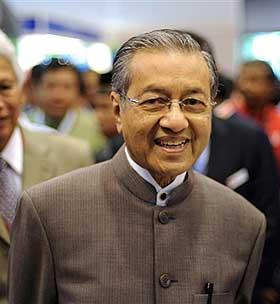
Mahathir ( below ) fought back by masterminding the deregistration of Usno by the Registrar of Societies.
 Jomion was one of the PKR leaders to respond to Lagadan who apparently initiated a media campaign against the party ‘seemingly out of the blue".
Lagadan used the recent announcement of a new state line-up for Sabah PKR as his launching pad for the attacks in the media.
Daniel John Jambun, another senior PKR youth leader, pointed out that the current state leadership line-up in PKR, in both Sabah and Sarawak, were temporary appointments and the question of anyone being marginalised does not arise.
"The leaders that party members want will emerge after our elections in May next year," said Jambun in castigating Lagadan for being "a busy body". "
Jeffrey is already a national vice-president and a member of the political bureau both at the central and state levels. This is a powerful position as the political bureau is the party's supreme council. Jeffrey is a national leader.
"In Sarawak, Gabriel Adit is also a member of both the central and state political bureaus. It's only recently that the party began organising itself there," added Jambun.
Adit is a nephew of Tenaga Nasional chairman Leo Moggie, a former federal minister and president of Parti Bansa Dayak Sarawak (PBDS) before it was de-registered following political in-fighting.
The demise of PBDS left Adit without a political vehicle for the rural poor majority.
People will decide who leads the party
Squashing the marginalisation theory, both Jamion and Jambun stressed that Anwar himself has declared that the "people will decide who will lead the party, not me", that PKR is a democratic party with the presidency limited to three terms, and that members will vote for their leaders through direct elections.
"If Shafie Apdal from Sabah can be Kedah Umno chief, why can't Azmin Ali from Selangor be Sabah PKR chief?" the duo from PKR asked.
"We don't see BN members in Kedah making a big fuss over a Sabahan being the Umno chief in Kedah. Lagadan should not embarrass Sabahans and portray us as petty-minded and parochial."
"We challenge Lagadan to propose at PBS's forthcoming congress to emulate PKR and make constitutional changes for genuine democracy in the party. The same people have been squatting there for years. He needs to check things in his own house before poking his nose into other people's affairs."
Lagadan was not put off by the comparison. He thanked Umno for having shown high respect for Sabah with Shafie's appointment, "unlike PKR which shows total disrespect for Sabahans". He invited Sabah PKR leaders to "join me in BN for Sabah's sake".
Lagadan initially began his press attacks by questioning the appointment of Gombak MP and Bukit Antarabangsa state assemblyperson Mohamad Azmin Ali as Sabah PKR chief.
 Azmin's (
right
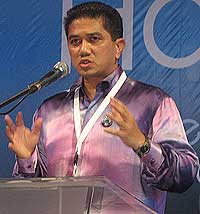
) subsequent clarification that his mandate would only last until the emergence of a one-on-one opposition electoral pact in Sabah rang alarm bells in PBS and forced Lagadan to step up his attacks against PKR and questioning "the sincerity of Anwar Ibrahim towards Sabah and Sarawak".
Azmin's (
right
) subsequent clarification that his mandate would only last until the emergence of a one-on-one opposition electoral pact in Sabah rang alarm bells in PBS and forced Lagadan to step up his attacks against PKR and questioning "the sincerity of Anwar Ibrahim towards Sabah and Sarawak".
Ongkili did not directly respond to a short text message from malaysiakini on whether he, as speculated, was masterminding Lagadan's attacks against PKR in the local media.
"I have been away in Uganda and London with the DPM (Muhiyiddin Yasin). I'm out of touch with what's happening locally," said Ongkili.
Kitingan himself refused to be drawn into comments on the press attacks. One theory is that he has mellowed over time and doesn't want to "jeopardise family ties unnecessarily like in the past".
Ongkili is Kitingan's nephew while elder brother Joseph Pairin Kitingan is PBS president, the Huguan Siou (paramount chief) of the KadazanDusuns and deputy chief minister.
Citing instead from his doctoral thesis at Harvard University, Kitingan expressed confidence that if his "Theory of Social Expectations (SET)" is read together with the "Kitingan Vulnerability Point (KVP)", political change is inevitable in Sabah.
The KVP is a set of diagnostic tools that can predict political instability.
Both SET and KVP, according to Kitingan, will be the thrust of "leadership training courses" that the party plans to run throughout the state in the run-up to the General Election.
Other components of the courses, according to details available, include presentations by Ansari and other key speakers.


Are you sure you want to delete this comment?
This action cannot be undone.