




Doc expects H1N1 to last till next April
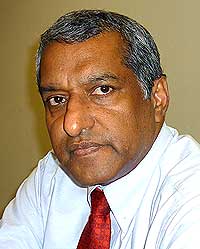
President of the Association of Private Hospitals Dr Jacob Thomas warned that the current H1N1 situation may drag on until April next year.
President of the Association of Private Hospitals Dr Jacob Thomas warned that the current H1N1 situation may drag on until April next year.
According to him, this is based on projections taking into account of the current extent of the infection. He explained that the infection is so widespread that it will take some time for it to die out.
"There is also the risk and chances of [the H1N1 virus] developing drug resistance" he added, warning that the virus may mutate rendering current drugs and treatments ineffective against the virus.
 To contain the situation, Thomas urged the health ministry to develop better lines of communications with those in the public and private health services, in order to
synchronise
efforts in dispensing the right kind of treatment for those infected.
To contain the situation, Thomas urged the health ministry to develop better lines of communications with those in the public and private health services, in order to
synchronise
efforts in dispensing the right kind of treatment for those infected.
He also said that confusion arises when the message that is going out to the public is not the same as to what is being told to hospitals.
"Communication needs to be better and the health ministry must be specific" said the doctor, expressing his hope that information would be disseminated to medical practitioners in a timely manner.
As an example, he mentioned the time when throat swabs or Tamiflu were asked to be given to everyone in 21 hospitals, resulting in big crowds gathering outside hospitals.
"We did not have enough supplies at that time so it is not right for anyone to put the blame on us" he said, stating that people need to understand that information takes time to trickle down.
He also conveyed the frustrations of doctors as they could not cope with the rapid changes of health directives issued by the health ministry.
"For instance, it is stated in one of the guidelines issued for hospitals to take the temperature of all patients. Because we cannot use the oral thermometer on everyone, it took us at least two days to get the infrared thermometer," he added.
"Another example is the order to conduct throat swabs. We did not have the kit and had to wait for its availability so there were delays in doing the throat swab. It is unfair to blame the hospitals," he said.
Face masks are not helpful
Commenting on the issue of face masks, the doctor said that "face mask do not [totally] prevent one from being infected with the virus. It is a droplet infection that could spread through coughs or sneezes."
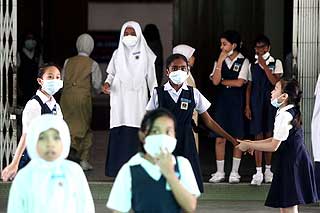 Though he admits that "chances of catching the virus is not as much as if you do not wear a face mask".
Thomas, who is also Sime Darby Medical Centre group medical advisor, added that he does not rely on the "unreliable" rapid test kit recommended by the Health Ministry.
He told his staff that "if symptoms are very strong do not even bother to conduct the test. Treat patient as having H1N1 positive. If we do not treat it, it might be a fatal case. So we go ahead and treat the patient because we have only 48 hours."
"As we are not sure, we go by the symptoms. We treat those displaying symptoms or showing signs of complication with Tamiflu," he explained.


