




Ministry anticipating second wave of H1N1
Anticipating that the waves might arrive in six to eight months time or two to three years time, the government remains optimistic it can better manage the situation.
Medical experts are making preparations in anticipation of a potential second H1N1 pandemic wave soon.
Stressing that this is not surprising and predictable, infectious disease head and senior consultant Dr Christopher Lee said that it has happened three times over the last century and pointed out that every single pandemic came in waves.
"We may not hear the last of H1N1 and with the coming winter months in the northern hemisphere, the second wave will come.
"It is troubling but it has happened before," he said, during a media workshop on Influenza A (H1N1) organised by the Ministry of Health today.
Anticipating that the waves might arrive in six to eight months time or two to three years time, Dr Lee said that the government remains optimistic it can better manage the situation.
"We will come out of it better the next time," he said.
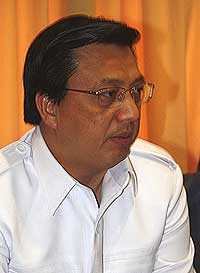 To improve mitigation efforts, Health Minister Liow Tiong Lai said that 15 "H1N1 champions", who are mostly experienced government doctors in senior positions, will be appointed in every state to advise doctors on how best they can treat patients as well as to interact with the "grassroots".
"The H1N1 champions were given tasks last week and are now moving around in Intensive Care Unit (ICU) wards to save patients," he said.
H1N1 cases to rise over Raya
Adding that a mortality review team was set up to review every death case before classifying it under H1N1, Tiong also said that the ministry would "adjust measures" to handle H1N1 effectively from time to time.
The committee, chaired by Dr Lee, will look into primary H1N1 death factors and other contributing causes.
Liow said that the ministry is focusing on secondary infections such as septicemia and kidney failure as H1N1 patients are vulnerable to these and other diseases due to low immunity.
He concured with the World Health Organisation's (WHO) forecast that the number of deaths in the non high risk group might increase to 40 percent, a rise of 20 percent from the current death rate.
But Liow added: "Those who get the virus will recover easily and quickly."
Liow said he expects a sharp rise in H1N1 cases during the Raya period as there will be movement of people in big numbers.
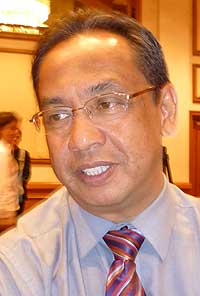 Also present at the workshop was Disease Control director Dr Hassan Abdul Rahman
(right)
and Institute of Medical Research director Dr Shahnaz Murad.
Also present at the workshop was Disease Control director Dr Hassan Abdul Rahman
(right)
and Institute of Medical Research director Dr Shahnaz Murad.
Since it is the virus' nature to constantly change, Dr Hassan warned that a completely new virus strain might be detected in time to come.
Echoing his concerns, Dr Shahnaz urged health care practitioners to be vigilant for signs of drug resistance since more Tamiflu are being dispensed.
She also urged members of the public not to rely on "Rapid Test" kits as none of its 60 types can distinguish Influenza A (H1N1) and other seasonal influenza A viruses.
As of today, 126 new patients displaying influenza-like illness (ILI) were hospitalised.
With 233 patients discharged yesterday, the total number of ILI-infected patients hospitalised were brought down to 1,176 today, said Health Ministry director general Dr Ismail Merican in a press statement.


