




Narathiwat awaits Najib visit
Malaysian Prime Minister Najib Abdul Razak will pen a new chapter in the country’s relationship with Thailand, during his first official visit from today to the neighbour to the north.
Malaysian Prime Minister Najib Abdul Razak will pen a new chapter in the country’s relationship with Thailand, during his first official visit from today to its northern neighbour.
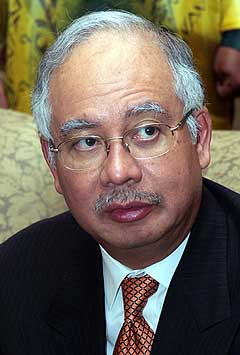 He will become the first Malaysian leader to venture into Thailand’s southern provinces, where an insurgency has been raging for nearly six years.
Najib’s planned six-hour foray into the province of Narathiwat on Wednesday illustrates the significance of the troubled region in the ties that bind the two countries.
Narathiwat and its neighbouring provinces of Pattani and Yala are home to Malay-Muslims, the largest minority in predominantly Buddhist Thailand.
Beyond that is an acknowledgment among some within Thailand’s political establishment that a solution to the unrest in the provinces close to the Thai-Malaysian border requires help from Kuala Lumpur.
The latest cycle of violence, pitting a shadowy network of Malay-Muslim rebels against the heavily armed Thai military, has seen close to 4,000 deaths since early January 2004.
And the insurgency shows no sign of easing. Last Friday, two soldiers and two civilians were injured when a motorcycle bomb exploded near an open market in Pattani. Such attacks - including roadside bombs and gunmen on motorcycles - have been the favoured choice of the rebels in targeting their enemies.
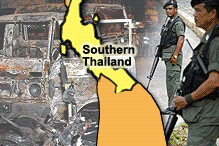 Thai authorities are not unduly worried, adding that Najib’s willingness to visit Narathiwat is a measure of his faith in the Thai military to ensure adequate security.
"It is proof of (his) confidence in the security arrangements," said a Thai foreign ministry official.
Najib’s three-day visit - at the head of a high-powered delegation that will include nine ministers - comes at a particularly sensitive time for the Thai government of Prime Minister Abhisit Vejjajiva.
Thus far, Abhisit has kept the Malay-Muslim minority guessing about what exactly his policies are to solve unrest and to act on his preferred solutions.
When he was leader of the opposition and soon after he began his term as premier a year ago, he placed his faith in a political response - instead of a military one - to ensure a lasting peace.
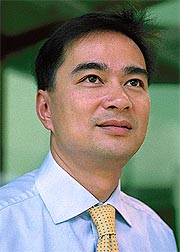 Abhisit
(left)
also offered an olive branch to the Muslim minority by declaring last month that counter-insurgency operations would be balanced with greater respect for justice to address continuing human rights violations.
Abhisit
(left)
also offered an olive branch to the Muslim minority by declaring last month that counter-insurgency operations would be balanced with greater respect for justice to address continuing human rights violations.
But the moment a former prime minister and the leader of the opposition party suggested a form of self-rule in the three southern provinces as an apt political solution to the violence, his coalition government did another of its policy flip-flops.
Chavalit Yongchaiyud’s proposal was rejected by the Abhisit administration, which labelled the idea of limited autonomy as "traitorous".
"People have begun to question Abhisit’s sincerity and his statements on the south," said Sunai Phasuk, Thai researcher for the global rights lobby Human Rights Watch.
"He was a supporter of some form of autonomy in the south till Chavalit made his proposal. Then he changed his mind and shot it down."
The government’s policy flip-flops mirror a wider problem in Thailand.
"The Thai public don’t have a sympathy and understanding of the desire by the Malay-Muslims for greater participation in politics," Sunai told IPS.
"The same is also the case for human rights violations in the south, so the government gets away saying the right things but not following through with actions."
'Malaysia has a role’
Najib himself has weighed into this discussion. He told two of Thailand’s English-language dailies in October that the Thai government should consider a form of autonomy for the three southern provinces. The reaction in Thailand was mixed.
It was a different scenario in 2005, when the relationship between the two countries hit a low point.
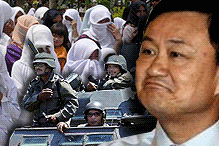 Thailand’s prime minister at the time, the abrasive and increasingly authoritarian Thaksin Shinawatra
(right)
, did not take too kindly to Malaysia opening its borders for 131 Malay-Muslims to flee the violence in the southern provinces.
Thailand’s prime minister at the time, the abrasive and increasingly authoritarian Thaksin Shinawatra
(right)
, did not take too kindly to Malaysia opening its borders for 131 Malay-Muslims to flee the violence in the southern provinces.
That act of mercy by Malaysia came after former prime minister, Dr Mahathir Mohamad, went public in 2004 urging Thailand to consider some form of autonomy for the three border provinces.
Former premier Abdullah Ahmad Badawi took a different approach. He pursued a track of quiet diplomacy through his ‘Three Es’ policy, offering Kuala Lumpur’s help through education, employment and entrepreneurship for the Malay-Muslims.
Malaysian interest in Thailand’s south stems from the many Malay-Muslims having family and economic ties on both sides of the border. The many access points and the porous stretches have enabled easy movement of people.
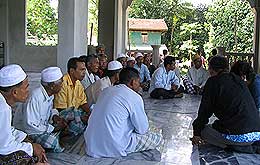 The Malay-Muslims in Thailand - who have a different language and culture from the majority Thais - have complained of cultural, economic and political marginalisation.
In the 1960s, a previous generation of Malay-Muslim militants had launched a separatist campaign that lasted through the 1980s. Some of those leaders took refuge in Malaysia.
No wonder civilians from the region welcome Najib’s visit to the south.
"He should have talks with the Thai government in order to solve the political and human rights problems. Malaysia has a role to play," said Abdul Aziz Tade-in, adviser to the Yala branch of the Young Muslim Association of Thailand. - IPS


Are you sure you want to delete this comment?
This action cannot be undone.