




Church bombings can undermine economy
From Singapore and Hong Kong in Asia, to Ghana in Africa to the cities of Western Europe and the US like Rome, London, New York and Washington, Malaysia popped up on news websites around the world over yesterday's firebombing of three churches.
From Singapore and Hong Kong in Asia, to Ghana in Africa to the cities of Western Europe and the US like Rome, London, New York and Washington, Malaysia popped up on news websites around the world over yesterday's firebombing of three churches.
Amidst controversy over the use by the Catholic publication Herald of the word ‘Allah' in its publication, the churchs, two Protestant and one Catholic were firebombed in the early hours of Jan 8.
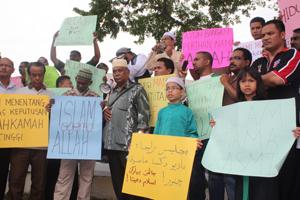 Later that day,
gatherings
were held at three different mosques in Kuala Lumpur and Shah Alam that saw Muslim crowds - angry over a court decision that overruled a three-year ban on the Herald's use of ‘Allah' for God in its Malay edition - calling for the decision to be quashed.
Later that day,
gatherings
were held at three different mosques in Kuala Lumpur and Shah Alam that saw Muslim crowds - angry over a court decision that overruled a three-year ban on the Herald's use of ‘Allah' for God in its Malay edition - calling for the decision to be quashed.
Elsewhere around the world, unflattering reports emerged following the incidents.
Cable News Network (CNN), for example, quoted Leonard Leo, chairman of the US Commission on International Religious Freedom , as noting that the High Court's decision "is not inconsistent with what the practice would be elsewhere around the world. The Malaysian ban is what's unusual, not the court's ruling."
"It's incumbent upon the Malaysian government to investigate the church bombings and to prosecute the perpetrators of this religiously motivated violence," said Leo, whose agency makes recommendations to the US congress and the president regarding how to handle violations of religious freedom around the world.
‘Model' Muslim country under question
Used to the image of Malaysia being a ‘model' Muslim-majority country where different religious and ethnic communities co-exist peacefully, the Ghana Broadcasting Corporation (GBC) in West Africa and the Australian Broadcasting Corporation (ABC) picked up BBC reports on the church attacks on their websites.
Citing a BBC report, GBC noted the Malaysian government's apparent authorisation of demonstrations against the court decision due to its reliance ‘ on the Malay-Moslem vote '.
 The US Washington Times, similarly, noted Malaysia's shattered
reputation
as a developing, progressive and pluralistic society and the escalation of religious tensions over the issue.
The US Washington Times, similarly, noted Malaysia's shattered
reputation
as a developing, progressive and pluralistic society and the escalation of religious tensions over the issue.
The ‘Allah' controversy ‘has the potential to shatter that carefully nurtured harmony, drive a deep racial wedge and scare away sorely needed foreign investment as the country struggles to emerge from the global financial crisis,' said the Washington Times report.
The New York-based Wall Street Journal as well as the New York Times contained similar articles .
Picking up on the same theme, the London-based Financial Times warned of the dire economic consequences for Malaysia should foreign investors' concerns about the government's management of social issues ‘deepen'.
‘Silly, ignorant people'
Malaysia, the Financial Times noted, had already suffered ‘the biggest foreign exchange outflows of any Asian country in 2009' due to the ‘massive withdrawal of capital by foreign investors' that year.
It also cited Home Minister Hishammuddin Hussein's vow to crackdown on dissenters, including the use of the Internal Security Act (ISA), to shore up national security.
The Christian Science Monitor based in Boston, meanwhile, wrote of the fine-line on which Prime Minister Najib Abdul Razak has to tread between the large Chinese-Indian minorities and the ethnic-Malay majority that serves as his party's pillar of support.
Citing an interview on Al Jazeera with academician Azmi Sharom, the Christian Science Monitor said the government had for long been ‘pandering' to quarters seeking greater Islamisation, thereby deciding differently on whether to allow public demonstrations, for example.
Some groups are allowed to protest when others were banned, Azmi was reported as saying, ‘because the main ruling Umno party - which depends on the Malay/Muslim demographic to remain in power - is ‘unwilling to do anything which would seem to go against what they think is the Malay/Muslim desire.'
Citing the Malaysian Insider, Christian Science Monitor went on to predict the start of a blame game ‘with opposition leaders pointing fingers at their political rivals" for stoking religious tensions.
The Italian Catholic AsiaNews.it website, quoted Herald editor Lawrence Andrew as saying there is no immediate danger, though " the situation is still worrying ."
Andrew was also reported as saying that there is a "national propaganda campaign to force the courts to decide in favour of proscribing the use of ‘Allah' by non-Muslims.
"We are worried - says the priest - but the situation is not dangerous as of yet. We have established close cooperation with the government to help restore peace in the country".
The Hong Kong-based Union of Catholic Asia News (UCANEWS) and the Singaporean Christian Post a also reported on the incident, quoting Father Phillips Muthu in Petaling Jaya had asked for his parishioners to ‘pray for the security and welfare of the nation'.
‘He is calling on members of all the parish's 30 basic ecclesiastical communities (BECs) to continue building friendships with their Muslim neighbours and to assure them that the Catholic Church has no agenda to convert them,' said the UCANEWS report.
Commenting on a Times Online report on yesterday's church attacks, Chris Frankland quotes Singpore's ex-premier Lee Kuan Yew as saying it takes very little time, given the right conditions, for a developing country to become developed.
"These silly, ignorant people are proving that the opposite can also be the case. They are stupidly shooting themselves, and their country, in the foot," wrote Frankland.
Maintaining the delicate balance between the majority Malay-Muslims and the minority ethnic Chinese and Indian populations who practise a range of religions including Christianity, Hinduism and Buddhism, ‘has always been a challenge in Malaysia,' said the Irish Times .


Are you sure you want to delete this comment?
This action cannot be undone.