




Sabah factories resist minimum wage moves
Sabah factory owners are resisting federal government plans to set minimum wage levels sector by sector, arguing that they are too small, production costs are higher than in the peninsula and that supply and demand should determine wage levels.
Sabah factory owners are resisting federal government plans to set minimum wage levels sector by sector, arguing that they are too small, production costs are higher than in the peninsula and that supply and demand should determine wage levels.
The Federation of Sabah Manufacturers (FSM) is taking up the cudgel on behalf of factory owners. However, its declared stand in a statement released early this week, has run into stiff opposition from the pro-minimum wage lobby.
The FSM's response follo
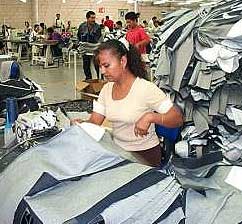 ws news that the federal government will make minimum wage a national policy soon and is expected to affect the hospitality, textile, electronic and security sectors.
Plantation workers already get minimum wages, the government claims, but this is hotly disputed since they are only paid between RM 500 and RM 600 per month.
"It is not that we are against workers getting a reasonable pay," said FSM president Wong Khen Thau clarifying the statement. "We have to keep in mind that industries must be able to compete."
The FSM fears that cheaper imports will drown local industries, ninety per cent of them being small-scale, if the minimum wage plan goes ahead in Sabah and Sarawak.
That will be the case, the FSM adds, if higher salaries in turn spike up the cost of local products, resulting in even greater job losses in the two states when industries are forced to close shop.
Minimum wages not competitive
Being competitive, according to Wong, means keeping production costs down as much as possible.
He attributed the lower salaries in Sabah vis-à-vis Peninsular Malaysia as also due to the locally prevailing supply-demand factors. Hence, there's no basis for comparison between the two, he added
Still, Wong holds out the possibility of factory owners accepting the minimum wage idea if the federal government helps brings down the cost of living in both states and standardises prices of goods throughout the country.
Pending standardisation of consumer prices in the country, the FSM wants East Malaysia and the peninsula be studied separately before the minimum wage ruling is imposed.
 "The various stakeholders in Sabah should be consulted on the minimum wage plan," argues Wong.
FSM Treasurer Danny Wong also sees part of the problem as stemming from "the age-old tradition of running factories inefficiently as family concerns".
"Most of these factories are working with ancient machinery," said Danny. "The government should be more proactive in helping small and medium industries in Sabah to upgrade and become energy efficient and productive."
Decent wages a boon, not bane
Kota Kinabalu Chinese Chamber of Commerce and Industry president Sari Nuar sees difficult choices ahead in the polemics over minimum wage.
"Better local salaries will prevent our people from fleeing to Singapore, Hong Kong, Taiwan and China," said Nuar in reeling off a list of favourite haunts for job-seekers driven out by an influx of illegal immigrants.
He argues for competitive
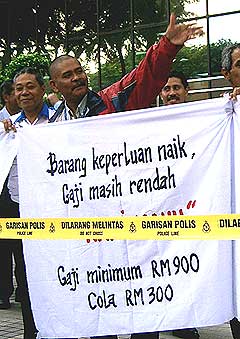 ness to be linked to productivity and its co-relation with decent wage levels.
This will assure a minimum standard of living at the existing cost of living levels, he added.
"Competitiveness and productivity cannot be based on a policy of hiring the cheap labour provided by illegal immigrants."
MTUC (Malaysian Trade Union Congress) Sabah Branch chairman Simon Yayun Lamadas laments that the cost of living in Kota Kinabalu, among other places in Sabah, is already "too high". He welcomes the government's moves towards minimum wage levels.
"The minimum wage in Sabah for security guards, for example, should be RM900. Even then, it is below the poverty line," said Lamadas in citing MTUC's research on the issue.
"The security guards, however, are already demanding between RM1,500 and RM1,700."
NGOs are happy that the government is slowly realising that "it doesn't pay in the long-run to beggar our workers with cheap labour policies".
"It should not be a source of pride to report indecent profits every year when it means nothing to others," they add.
"The key to our economic recovery and sustained development is clear. Businessmen should be encouraged to share the cake with their workers, shareholders, investors, consumers, the community and the government."
On a sour note, Consumers' Movement of Sabah and Labuan (Cash) president, Patrick Sindu, charged that workers in Sabah were already not getting their annual bonuses and annual salary increments following the global financial meltdown and economic crisis.
"It s good that the government plans to review the Wages Council Act 1947," said Sindu. "This will ensure that workers in the private sector also enjoy higher pay."
In calling for a national minimum wage policy, Sindu opined that uncertainties in the economy do not really affect workers in the government sector.
"Yet, it's the government workers who are enjoying annual bonuses and special payments while many in the private sector are left out," said Sindu.


Are you sure you want to delete this comment?
This action cannot be undone.