




Ex-Sabah A-G in 'hot water' over M'sia partnership
Former Sabah attorney-general Herman Luping is on the carpet for remarks in the local media earlier this week on "flogging the dead horse of the Malaysia partnership".
Former Sabah attorney-general Herman Luping is on the carpet for remarks in the local media earlier this week on "flogging the dead horse of the Malaysia partnership".
This comes exactly a month before he's due to speak at a Malaysia '63 Re-visited forum in Kota Kinabalu.
The former state A-G hopes that Sabahans would focus on the 10th Malaysia Plan (2011-2015) and Petronas - the latter point as suggested by former Sabah chief minister Harris Salleh - rather than continue to harp on the "what may have beens" on the Malaysian federation.
 "Herman (
right
) should not make such remarks in public especially after we very kindly invited him to say his piece at our forthcoming
seminar
," fumed Common Interest Group Malaysia (Cigma) deputy chairperson Daniel John Jambun in an exclusive interview with
Malaysiakini
. "He is not being very courteous to us."
"Herman (
right
) should not make such remarks in public especially after we very kindly invited him to say his piece at our forthcoming
seminar
," fumed Common Interest Group Malaysia (Cigma) deputy chairperson Daniel John Jambun in an exclusive interview with
Malaysiakini
. "He is not being very courteous to us."
Daniel, also the deputy chairperson of the Borneo Heritage Foundation (BHF) and a known hawk, said he "personally had a good mind to kick the former state A-G out of the seminar" but apparently not everybody agrees with him.
Herman's wife and a PhD undergraduate, Rosalind Bion, is one of the organisers of the seminar which has BHF sharing the honours with Cigma.
Herman, ironically, will be speaking on state rights, autonomy, the Inter Governmental Committee and the 20 Points (18 for Sarawak) at the seminar.
Daniel, for starters, fails to see the connection between the Malaysia Plan/Petronas and the Malaysia partnership issue. "We should, of course, do what we can to make the 10th Plan a reality for Sabah," said Daniel. "But does that mean that we should forget our history, where we came from and where we are headed?"
A dust and potholes situation
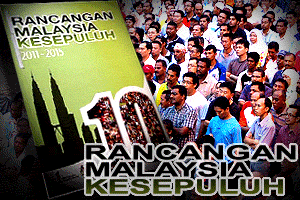 He also queried the rationale behind Herman's belief that the 10th Plan will see Sabah emerging as a fully-developed state by 2020 "where dust and potholes are no longer a problem on our roads".
Daniel added that this was just so much hype since even Malaysia, "independent projections show", will not achieve developed nation status by 2020.
"The records show that all the previous Malaysia plans have meant nothing for Sabah and Sarawak," he pointed out. " The figures show that both states are the poorest in Malaysia along with Kelantan and Terengganu."
Based on the previous nine Malaysia Plans, Daniel doesn't expect the 10th Plan to be any different for the two states. "As usual, there will be the usual leakages and delays and things will be carried forward to the 11th Plan," said Daniel.
"Even the current 9th Malaysian Plan targets have not been met and we understand that funds from Putrajaya slowed down recently."
Petronas - favorite whipping boy
He agrees with Herman, however, that Petronas, the national oil corporation, should be taken to task for excluding Sabahans and Sarawakians from its board and all its companies. He blames the exclusion on the imposition of proxy governments on Sabah and Sarawak.
However, Daniel stressed that it was unbecoming of Herman to throw cold water on a proposal that the Sabah and Sarawak state assemblies pass a resolution that Malaysia was an equal partnership of Malaya, Sabah and Sarawak.
 "Sabah Umno veteran Karim Ghani knows what he's talking about in putting forward the proposal in public," said Daniel. "He was one of the translators for the Cobbold Commission on Malaysia and the Malaysia Agreement documents."
He also dismissed Herman's observation that "there's no provision in the Sabah constitution (or Sarawak's) for the state assembly to take a stand on this".
If there's no provision, according to Daniel, that means the state constitution and the assembly rules are silent. This silence doesn't mean prohibition, he added."The state assembly is the supreme lawmaking body in Sabah. It can take a stand on the issue and resolve that Malaysia is indeed an equal partnership of three territories in a federation."
Sabah and Sarawak being just two of the states in Malaysia, stressed Daniel, is "totally unacceptable and unthinkable".
Giving credit, Daniel observed that Herman himself had stated that Malaysia indeed began well as an equal partnership of Malaya, Singapore, Sabah and Sarawak.
Distinct court systems
The difference arises, he said, because Herman reads too much into Article 1(1) of the Federal Constitution naming Sabah and Sarawak among the states in Malaysia along with those in the Peninsula.
The reality, said Daniel, is that both Sabah and Sarawak still have their own High Court system i.e. the High Court of Borneo (now Sabah, Sarawak) as distinct from the High Court of Malaya.
Also, they have cabinet systems of government unlike the states in the peninsula, control their own immigration, and laws made in Parliament have to be passed again by the respective state assemblies in East Malaysia before they can be extended, among others.
Had Herman clarified that "the Malaysia partnership never existed from the beginning or ceased to exist after Singapore's so-called expulsion", it would have been more acceptable.
"It must be remembered that the results of the UN Referendum announced on Sept 16, 1963 showed that only a third of the people, mostly the Muslims, supported the idea of Malaysia," said Daniel.
"So, this is like Indonesia marching into Timor Leste, when colonial power Portugal left, only to get kicked out by the UN 27 years later."


Are you sure you want to delete this comment?
This action cannot be undone.