




PKA must fight for justice to take its course
The very idea that the minister for transport can or may overrule the decision of the Port Klang Authority is anathema to the notion of fairness and justice to the PKA on the one hand, and on the other hand to the notion of integrity - structurally and otherwise - of a statutory body and to all Malaysians.
COMMENT The very idea that the minister for transport can or may overrule the decision of the Port Klang Authority is anathema to the notion of fairness and justice to the PKA on the one hand, and on the other hand to the notion of integrity - structurally and otherwise - of a statutory body and to all Malaysians.
Such a move will inevitably raise questions of political interference by the minister if he should override the PKA's decision to seek legal recourse from its former directors.
 That PKA's chairperson Lee Hwa Beng (
right
) should cast innocence of non-interference of the minister for transport in this case is not the same as casting doubt that political interference by a minister of any ministry in Malaysia, has not occurred in the Malaysian political economy.
That PKA's chairperson Lee Hwa Beng (
right
) should cast innocence of non-interference of the minister for transport in this case is not the same as casting doubt that political interference by a minister of any ministry in Malaysia, has not occurred in the Malaysian political economy.
The truth is otherwise. The facts are abundantly littered throughout contemporary Malaysian history. Nobody can be in any doubt that Malaysia is riddled by state-sanctioned corruption that reaches the depths of Malaysian society.
But the scourge of corruption is uncontainable at the top of Malaysian society. It is even worse at the pinnacle of the ruling regime and its component racialist parties.
A potential of a decision by the ministry to overrule the PKA from suing its former directors will inevitably smack of a deliberate attempt by the regime of Najib Abdul Razak and his Umno-BN coalition to protect its cronies and nepotists.
This will come at a time when Malaysia needs to urgently deal with rampant corruption in government and within the public and private sectors.
Already Malaysia's police force is a laughing stock. Malaysia's police are the regime's lapdog, trenchantly corrupt, and hugely incompetent. They act as black-hooded thugs for the regime and react incredibly rapidly against their political masters' dissenters.
Battered image
The increasingly battered image of the regime is widespread. Worse, it is deepening globally. And it controls a judicial system that is as corrupt and incompetent as its political masters.
To that end Malaysia has been losing credibility amongst foreign investors since the late nineties economic crisis. The economy has also fast been losing its competitiveness vis-à-vis its regional competitors, viz. Indonesia. Not that Indonesia is any better than Malaysia or any of its Asean neighbours, with the possible exception of Singapore.
Lee must hold strong. He must not waver in the face of pressure, implicit or otherwise, from his political masters. He cannot resile from the PKA fiasco and label it as nothing more than a "managerial lapse".
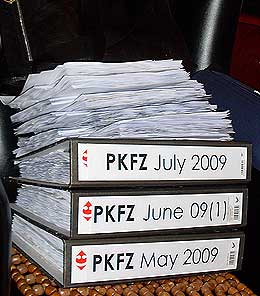 It looked like blatant corruption by the former directors. It would have been farcical if not for the amount of people's money that was swindled.
For Lee to assign it anything less than a crime, as it was clearly, saddles on an excuse skinned by the potential of fear and loathing by his political bosses.
IF PKA's lawyers have already advised that the statutory body should sue its former directors with criminal negligence at the least, and corruption at the most, Lee should not weaken at the knees now. Neither should the rest of the new board of directors.
Not only is the whole of Malaysia watching how this case plays out; so is the rest of the world's investment community.
The stench of incompetence, corruption, nastiness and even stupidity of the Najib regime has been highlighted repeatedly as a continuum of the stench that was born by the introduction of the New Economic Policy in 1970-71.
What is more, the level of corruption was actively heightened, promoted and protected by the scandalous dictatorship of the equally odious and vile former premier Dr Mahathir Mohamad.
Backing off?
If PKA's Lee is, as I see it, already laying the groundwork for the authority to back off from suing its former directors, the loser will be the Malaysian economy and those Malaysians whose hard-earned tax dollars have been used to enrich the indelibly corrupt of Malaysia's dominant political and economic classes.
All Malaysians must now put sustained pressure on the corrupt and incompetent Najib regime to ensure that it calls off its dogs against the PKA and provides an unambiguous avenue for the PKA to pursue the former directors in Malaysian courts to right wrongs, even allowing for the presumption of innocence of the accused.
And there must be sustained pressure by all Malaysians and especially the Malaysian Bar Council to ensure that the regime, especially the ignominiously incompetent pseudo law minister Nazri Abdul Aziz, allows justice to be seen to happen and that justice as fairness prevails as the first principles of law.
The biggest challenge, however, is whether Malaysians in general have the self-belief any more in seeking real change at this time, let alone at any time.
Or whether, as previously, they will only talk loudly behind closed doors and whine about the level of corruption that besieges their country's international image whilst national wealth is siphoned off by the regime's loyalists.
When the crunch comes, they'll turn a blind eye to injustices. Or, worse, they will turn their backs to all fair-minded Malaysians who need far greater popular support as much as popular revolt against the regime's growing bastardisation of the notion of good governance amidst, amazingly, its bogus boast of valuing democracy.
PKA's Lee and his fellow board of directors need to show more backbone. They must not pander to and then hopelessly and pathetically crumble at the feet of their political masters. To do so would sink all hope to carve a better, fairer, just and democratic future for all Malaysians.
MANJIT BHATIA, an academician and writer, is also research director of AsiaRisk, a political, economic and risk analysis consultancy in Australia. He specialises in international economics and politics, with a focus on the Asia-Pacific.


Are you sure you want to delete this comment?
This action cannot be undone.